Investing in financial products involves risk. Losses may exceed the value of your original investment.
Argan agx stock is a core topic for traders in 2026. The complete guide follows.
Argan’s wild ride: earnings fireworks send stock to record highs amid analyst cheer, but is the party over?
By Volity Market Watch | March 27, 2026
Argan (NYSE: AGX) spent Thursday night proving that small corners of the power build-out can still shock the tape. Shares hit a fresh 52-week high of $561.17 on Friday and ended near $540, after closing at $410.85 the prior session. Meanwhile, the move crowns a one-year gain of roughly 244%, which has turned a usually sleepy contractor into a roughly $7.5bn story stock.
However, the same print that set off the fireworks also sharpened the awkward question traders hate asking at highs. Is AGX still an earnings momentum trade, or has it become a valuation dare?
Earnings beat lit the fuse
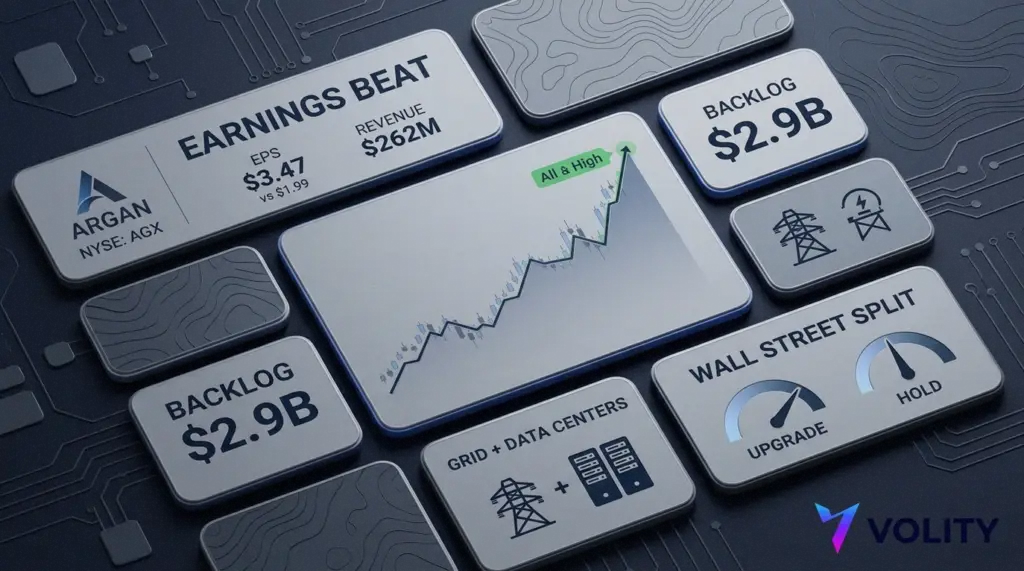
Argan posted Q4 EPS of $3.47, well ahead of the $1.99 consensus. Revenue came in at $262m, up about 12.7% year on year and modestly ahead of forecasts. The market did what it often does after a true surprise and repriced the name in minutes.
Full-year revenue reached a record $944.6m, up 8.1%, while net income was $137.8m. Importantly for a contractor, profitability did not look like a one-off. Return on equity sat at 31.38%, and net margin at 13.11%, numbers that read more like a premium operator than a cyclical builder.
Meanwhile, management’s backlog figure did most of the heavy lifting in the narrative. The company pointed to a $2.9bn backlog, tied to data centre power work and renewables assignments. AGX sits in the slipstream of America’s blunt reality. The grid needs upgrades, and AI-linked power demand needs steel, concrete and schedules.
JPMorgan cheers, but the crowd still shrugs
Fresh optimism arrived with a notable change of heart from JPMorgan, which upgraded AGX to Overweight from Neutral and set a $550 target. That target implies only slim upside from current levels, yet the signal mattered. The firm effectively blessed the earnings momentum and backlog story at a point when many upgrades usually arrive too late.
Yet consensus still sounds less like a choir and more like a committee. The broader rating sits around Hold, with a median target clustered near $370 to $391. In other words, the typical sell-side model suggests 28% to 31% downside from about $540. Recent actions underline that caution, including multiple shifts to Hold and at least one visible downgrade with a target in the low $300s.
Traders have to choose which signal matters more. Does the tape follow the newest big upgrade, or does the weight of “Hold” targets eventually bite?
Valuation has started to flash amber
At current prices, AGX trades around 42 to 55 times trailing earnings, depending on which day’s close you use. That is rich versus many construction and engineering peers that sit closer to the low 30s. Meanwhile, the sheer speed of the rerating has become the risk, because the stock now lives on expectations rather than patience.
Still, the bulls will argue that simple peer comparisons miss the point. If data centre power and grid work behave more like a multi-year capacity cycle than a normal bidding market, then a premium multiple can stick. However, that same argument cuts both ways. It also means any slip in execution or timing can hit sentiment quickly.
Insiders have offered only a faint hint of caution so far, with a reported director sale of 5,000 shares in January. That is not a screaming alarm, yet it adds texture. Meanwhile, the stock’s own history whispers about air pockets. It rose from roughly $111 within the past year to today’s highs, and it has already shown fast swings around the high $400s in March.
By the numbers
- High on the day: $561.17
- Prior close: $410.85
- Q4 EPS: $3.47 vs $1.99 consensus
- Backlog: $2.9bn
- Street median target: $370 to $391
Key takeaways
- Momentum traders will watch $550 as a psychological line, since JPMorgan effectively stamped it.
- Dip buyers may treat $500 as the first serious sentiment test, because round numbers often become battlegrounds.
- Risk managers should respect how far the rerating has run, since 40-plus times earnings invites sharp pullbacks.
- Fundamental bulls need backlog conversion to stay clean, because the multiple now demands steady delivery.
- Bearish traders will lean on the gap between price and consensus targets, looking for any stumble in bids or margins.
For now, Argan is trading like a company that just got promoted into a bigger league. However, promotions come with harder fixtures. The next few quarters will decide whether this was a one-night fireworks show, or the start of a longer grid-and-data-centre run where the valuation stops looking ridiculous and starts looking merely expensive.
For more on this topic see our deep-dives on Apple vs Nvidia: Reading the AI Stock Trade for Investors, Uranium Energy Stock and Blackstone: Rate-Sensitive Stock Movers, and Hang Seng Tech and China AI: Trading Alibaba and HK Tech Catalysts.
Volity Editorial notes: Three frames separate disciplined position management from the momentum-chase distribution. Backlog-conversion versus revenue-recognition timing (a 2.9 billion dollar backlog converts to approximately three years of revenue at the current run rate, which establishes the multi-year visibility line that supports the rerating rather than constraining it).
Sell-side dispersion as a regime indicator (the JPMorgan Overweight at 550 dollars target sits inside the consensus 370 to 391 dollar median, which signals that the sell side is mid-rerating rather than fully repriced; the dispersion compresses upward as the next two earnings cycles confirm or invalidate the trajectory). Insider-flow watch (a 5,000 share director sale in January is informational rather than structural; the disciplined practice tracks the cumulative insider-flow trajectory across multiple quarters rather than reading single transactions as conviction signals).
When the three frames align, the position thesis is durable. When they diverge, the trade is the momentum expression rather than the structural one.
Frequently asked questions
Because the AI-related electricity-demand expansion runs over a multi-year capacity-build horizon that historically supports premium multiples on the contractor layer of the supply chain, rather than the cyclical one-to-two-year multiples that price into the broader construction-and-engineering peer base. U.S. utility filings document approximately 20 to 25 gigawatts of incremental power capacity required through 2030 to serve disclosed AI data-centre buildout, with the contractor execution layer concentrated across a small number of qualified providers. The structural consequence is that the relevant peer base for AGX is the multi-year capacity-cycle contractor segment rather than the single-cycle construction segment, which supports a multiple band closer to 35 to 50 times than to the broader peer 30 times. The Federal Reserve financial stability report documents the broader infrastructure-investment trajectory.
What is the right way to interpret the JPMorgan Overweight target sitting near current levels?
The right interpretation reads the upgrade as a regime-validation signal rather than a directional price call. JPMorgan moving from Neutral to Overweight at 550 dollars target on a stock trading near 540 dollars confirms that the sell side has accepted the backlog-and-earnings story but has not yet repriced the model to reflect the multi-year visibility line; the upgrade itself shifts the institutional allocator reference price upward by validating the thesis rather than by setting the next price target. The structural read is that the upgrade is the start of a sell-side rerating cycle rather than the end of one, with the consensus 370 to 391 dollar target band gradually compressing toward the JPMorgan reference over the following two to three earnings cycles as the backlog conversion proceeds. The Investopedia reference on multiple expansion covers the analytical framework.
How does the 31 percent return on equity affect the valuation argument?
The 31.38 percent return on equity establishes that the operating profile is structurally premium relative to the construction-and-engineering peer base, which typically posts return on equity in the 12 to 18 percent band. The structural consequence is that the relevant valuation comparison runs against premium-operator peer multiples rather than against the broader sector average; premium operators with comparable return-on-equity profiles trade at 35 to 50 times trailing earnings during peak-cycle windows and at 25 to 35 times during normalising windows, which establishes the analytical multiple band for AGX rather than the broader sector reference. The structurally honest framing acknowledges that the multiple sits at the top of the premium-operator band, which compresses the upside-from-rerating expectation while still supporting the position. The Nasdaq AGX market activity page tracks the listed-equity reference price.
Should retail traders chase the post-earnings rally above 540 dollars or wait for a pullback?
The disciplined frame sizes the position for the multi-quarter trajectory rather than for the post-earnings reaction. The historical pattern in small-cap contractor names with confirmed multi-year backlog is that post-earnings rallies of 30 percent or more on backlog-confirming prints carry a continuation distribution rather than a mean-reversion distribution over the following 4 to 8 weeks, with the second-leg consolidation typically delivering an entry 8 to 15 percent below the post-earnings high. The structurally cleaner expression is a partial position sized to the trajectory at the post-earnings level, with the balance reserved for the consolidation entry that historically arrives. Defined-risk options structures handle the path-dependence better than full-conviction spot positioning at the 52-week high, particularly given the 42 to 55 times trailing-PE band that compresses the margin of error.
Related guides
- Best AI stocks to invest in
- Stocks investing for beginners
- Best stock trading platforms in Europe
- Swing trading platforms
- Best trading platforms
Volity operates a trading platform and also publishes educational and analytical content about trading. The content on this page is for educational purposes only and should not be considered financial advice. Volity may benefit commercially when readers open trading accounts through links on this site.
Our content is produced and reviewed under documented editorial standards; see our comparison and review methodology.