Investing in financial products involves risk. Losses may exceed the value of your original investment.
Crypto prices fall is a core topic for traders in 2026. The complete guide follows.
Crypto market dips amid FOMC buzz and Kelp DAO fallout
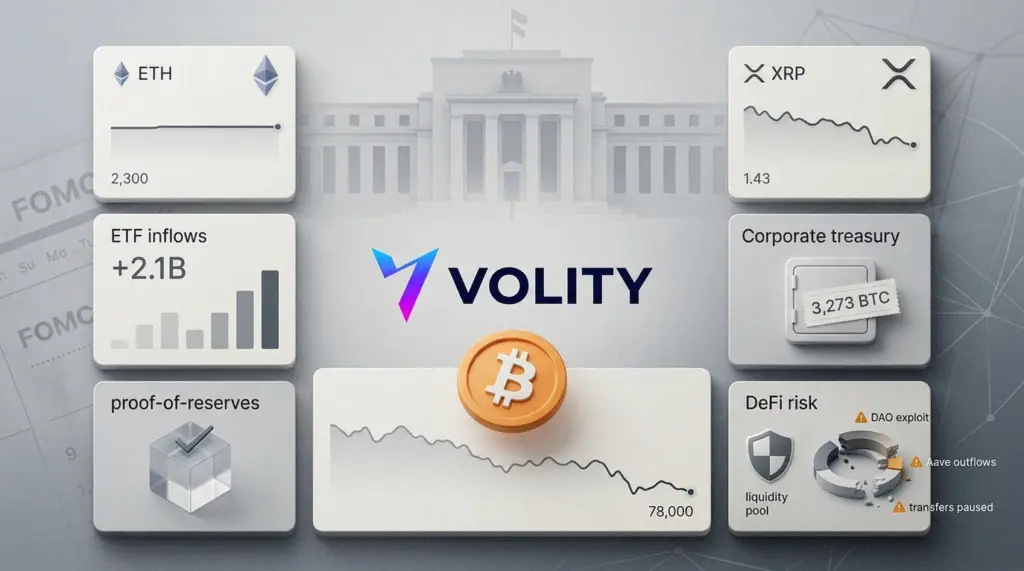
Crypto caught a risk-off draught on Monday, with traders choosing caution over conviction ahead of the next Federal Open Market Committee meeting. Bitcoin hovered around $78,000 after failing near $78,700, while Ethereum clung to $2,300 and XRP weakened around $1.43. The tape felt less like a breakout and more like a market waiting for permission.
Even so, the bid has not vanished. Spot Bitcoin ETF inflows have topped $2.1 billion over the latest streak, offering a steady, institutional counterweight to shorter-term macro nerves. However, with no rate cuts expected, many desks prepared for a familiar mix of whipsaw and forced de-risking.
Bitcoin steadies, but macro sets the tempo
Bitcoin pushed up to the top of its ascending channel, then slipped back into the middle of it. Meanwhile, ETF demand continued to do the quiet work that leveraged traders tend to neglect.
MicroStrategy added 3,273 BTC for about $255 million on April 27, its fourth purchase this month. As a result, the company kept reinforcing the “corporate treasury as a bid” narrative, even as broader markets looked jumpy. Elsewhere, Strive Asset Management has climbed into the top public holders with 14,557 BTC, which matters mainly because it broadens the set of institutions with a reason to defend dips.
Transparency also got a small lift. Block opened its Bitcoin reserves to public proof-of-reserves verification, a nod to a market that still remembers how quickly confidence can evaporate.
Yet the bigger catalyst sat in Washington. The White House teased a “major update” on a strategic Bitcoin reserve, which stirred speculation but did not offer details. The headline risk cut both ways, with traders hesitant to chase rumours into a policy-shaped void.
Altcoins feel the squeeze as DeFi confidence wobbles
While Bitcoin steadied, altcoins absorbed the nervous energy. Solana broke out of a multi-year bearish channel, hinting at a rebound. However, DeFi confidence took a hit after the $292 million Kelp DAO exploit narrative spread across risk dashboards.
Aave outflows reportedly reached $8.6 billion, slicing total value locked from $26.3 billion to $17.7 billion, with USDT and USDC pools accused of being drained. Governance went defensive. Aave DAO moved to pause buybacks, while DeFi United promised an rsETH recovery plan. Circle, for its part, was said to have quietly backstopped losses with USDC, which calmed some nerves but raised fresh questions about who ultimately absorbs tail risk.
Meanwhile, ZetaChain halted transfers after a reported $300,000 hit. The figure was small, yet the timing was awful. It fed the sense of a sector where operational risk still clusters at the worst moments.
XRP continued to trade like a chart, not a story. A bearish pennant pattern kept the $1 level in view for technicians, especially with cloud resistance overhead. However, Ripple has tried to shift the conversation with a quantum-resistant XRPL roadmap that targets a full rollout by 2028, with tests beginning this year.
Ethereum held $2,300, though a clean break would put $2,250 in play. Spot ETH ETFs drew about $23 million of inflows, helpful at the margin, but not yet a decisive trend.
Tokenisation keeps moving, quietly, under the noise
While prices dipped, the infrastructure story kept advancing. OKX integrated BlackRock’s BUIDL tokenised fund, pushing real-world asset rails further into crypto trading venues. Meanwhile, Ondo partnered with Broadridge to bring voting rights to tokenised stocks, a detail that will matter if tokenisation is to feel like ownership rather than a synthetic wrapper.
- OKX added access to BlackRock’s BUIDL tokenised fund.
- Ondo and Broadridge partnered on voting rights for tokenised equities.
- Israel greenlit the BILS shekel stablecoin after a Solana pilot.
- dLocal rolled out stablecoin payments across 44 emerging markets.
Stablecoins again did what they usually do in macro wobbles. They became the market’s cash register. Advocates noted that stablecoin settlement volume now exceeds Visa’s, though the comparison can be messy. Still, the direction is clear.
Policy and enforcement stay messy, which is the point
On regulation, momentum looked uneven. A Senate crypto bill snagged after Senator Thom Tillis pressed for limits tied to the White House. Meanwhile, the CLARITY Act missed an April deadline, despite a lobbying push from roughly 120 firms including Coinbase and Ripple.
The Blockchain Association urged the Fed to drop “reputation risk” from bank supervision, a phrase that often becomes a soft veto on crypto activity. Canada advanced a ban on political crypto donations. Meanwhile, the CFTC sued New York over prediction market labels, highlighting the growing turf war over what counts as gambling versus hedging.
By the numbers
- BTC around $78,000, after testing $78,700.
- ETH near $2,300; $2,250 marks the next downside level.
- Spot Bitcoin ETF inflows: $2.1bn+ over the latest streak.
- MicroStrategy bought 3,273 BTC for about $255m on April 27.
- Aave TVL cited falling from $26.3bn to $17.7bn.
Key takeaways
- Macro can trump crypto flows this week, so expect stops to matter more than narratives.
- ETF inflows support dips in BTC, but they do not prevent intraday shake-outs.
- DeFi headlines can spill into high-beta alts fast, especially when stablecoin pools look stressed.
- ETH’s $2,300 line remains the cleanest “risk-on versus risk-off” tell in majors.
- Tokenisation news keeps landing even on red days, which may shape the next rotation.
For now, crypto sits between two forces. Institutional inflows insist the floor is firmer than it used to be. However, the FOMC and the aftershocks of DeFi risk remind traders that floors can still feel like trapdoors.
For more on this topic see our deep-dives on Bitcoin and Altcoin Crash: Reading Crypto Market Drawdowns and Recovery Signals, Bitcoin Price Drops Sharply: Reading the Trapdoor Setup in BTC, and Bitcoin: ETF Inflows vs Shorts in a Fed-Driven Macro.
What our analysts watch: Three lenses dominate our reading of the equity tape. Sector rotation tells us where capital is moving (defensives versus cyclicals, value versus growth).
Earnings revisions show whether analyst expectations are catching up to or trailing reality. Real yields and the dollar set the discount rate that valuation multiples respond to.
When earnings estimates rise faster than the index price and real yields stabilise, the setup tends to favour patient longs.
Frequently asked questions
How much money do I need to start trading stocks?
Many regulated brokers now allow account opening with no minimum deposit and offer fractional shares for as little as $1. A practical starting balance for a long-only beginner is $500 to $2,000, enough to diversify across a handful of positions without paying meaningful percentage spreads. The FCA publishes investor education resources worth reading before opening an account.
What is the difference between stocks, ETFs, and CFDs?
A stock is direct ownership in a company. An ETF is a basket of stocks (or other assets) traded as a single security. A CFD (contract for difference) is a leveraged derivative that tracks the underlying price without conferring ownership. Each has different cost, tax, and risk profiles. ESMA imposes leverage caps on retail CFDs in the EU and UK.
How do I choose a trustworthy broker?
Verify regulation with a tier-one authority (FCA in the UK, CySEC in Cyprus, BaFin in Germany, ASIC in Australia, or your local regulator). Check segregated client funds, negative-balance protection, transparent fees, and a clean disciplinary record. Avoid any platform offering guaranteed returns or pressuring deposits. The FCA Financial Services Register is free to search.
Should I day-trade or invest long-term?
Most retail accounts that day-trade lose money over time. Long-term passive investing in diversified index ETFs has historically delivered competitive returns with far less effort and lower stress. Active day-trading can work, but it requires capital, an edge proven over hundreds of trades, and the time to monitor positions intraday. Start passive; layer active only after the basics are durable.
Related guides
Volity Editorial, Volity research: The Volity desk separates FOMC-week crypto risk into three layers. Layer one is the rates reaction: any hawkish surprise tightens dollar liquidity and pressures long-duration risk including Bitcoin.
Layer two is the perpetual leverage layer: crowded long or short positioning into the print produces forced flows that exaggerate the rates reaction. Layer three is the DeFi amplification layer: stablecoin pools, lending markets, and liquid-staking derivatives transmit the shock across protocols faster than centralised exchanges can absorb it.
A clean read of any FOMC drawdown requires watching all three layers, because the recovery quality depends on which layer breaks first.
Volity analyst FAQ
Why do crypto prices fall around FOMC meetings?
FOMC meetings reset short-rate expectations within minutes, which reprices every long-duration risk asset including Bitcoin and altcoins. The mechanical chain runs from rates expectations to dollar liquidity to perpetual funding to spot prices, with leveraged positions amplifying the move on both directions. The historical pattern shows elevated realised volatility in the seventy-two hours surrounding each statement. The Bank of England monetary policy page tracks the canonical statement record.
How does DeFi liquidity stress affect Bitcoin?
DeFi stress events transmit into Bitcoin through three channels: stablecoin redemption pressure that forces selling of liquid collateral, liquid-staking derivative depegs that force unwinds across DEX pools, and reputational contagion that reduces fresh on-ramps into majors. Bitcoin tends to lead the recovery once the DeFi stress clears, because spot ETF flows reset before high-beta alts find a floor. The BIS research on DeFi vulnerabilities covers the structural framing.
What is the safest way to hold crypto through FOMC week?
The honest framing is that no holding posture is universally safe; each carries different risk vectors. Spot holdings on regulated exchanges or in self-custody avoid liquidation risk but accept full mark-to-market exposure.
Reduced position size with stop-loss discipline accepts realised losses against larger drawdowns. Hedging through options accepts premium cost against position protection.
The Volity desk reduces gross exposure into the print rather than relying on any single hedging structure. The Investopedia FOMC primer covers the broader framing.
Are stablecoin yields safe during macro stress?
Stablecoin yields generated through DeFi lending pools carry two distinct risk vectors: smart-contract risk from the protocol code, and counterparty risk from the underlying borrower cohort. Both vectors elevate during macro stress windows because liquidations cascade and pool utilisation spikes. The yield premium during stress reflects the elevated risk, not a pricing inefficiency. Sophisticated allocators size pool exposure conservatively into known stress windows.
External references
- Bank of England monetary policy
- BIS research on DeFi vulnerabilities
- Investopedia FOMC primer
Volity operates a trading platform and also publishes educational and analytical content about trading. The content on this page is for educational purposes only and should not be considered financial advice. Volity may benefit commercially when readers open trading accounts through links on this site.
Our content is produced and reviewed under documented editorial standards; see our comparison and review methodology.