Investing in financial products involves risk. Losses may exceed the value of your original investment.
Bitcoin xrp etf is a core topic for traders in 2026. The complete guide follows.
Crypto markets hold steady amid Fed nerves and an XRP ETF rush
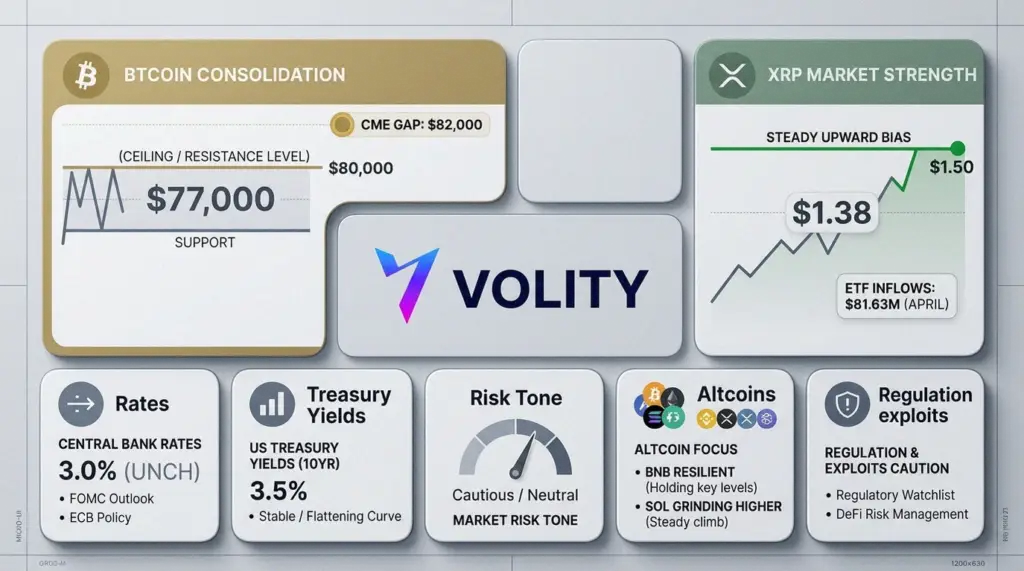
Crypto opened the week with a familiar look: prices barely moved, nerves did. Bitcoin hovered near $77,000 as traders held their breath for the Federal Reserve’s next rates message. Meanwhile, XRP stole a march on the rest of the tape, helped by a sharp jump in ETF inflows during April. The risk mood felt balanced on a pin, as it often does in late-cycle markets, when liquidity matters more than narratives.
Even so, the split screen is striking. On one side sits Bitcoin, trading like a macro asset. On the other sits XRP, trading like a product launch.
Bitcoin circles $80,000, but conviction is not yet a breakout
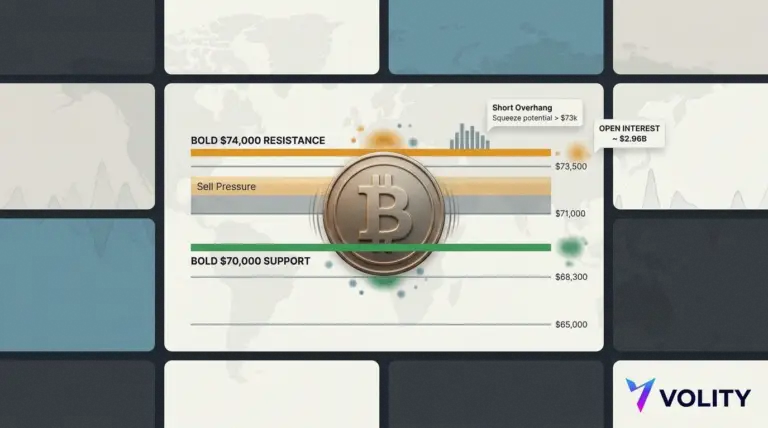
Bitcoin traded around $77,100, stabilising after recent swings and keeping April’s rally broadly intact. However, the level that matters sits higher. The market keeps leaning on $80,000, and it keeps failing to clear it with force. That has left spot buyers patient and leveraged traders restless.
Positioning looks punchy into the Fed, yet the price action remains stubbornly range-bound. The next catalyst likely comes from outside crypto. Rate guidance, Treasury yields and the tone around risk assets could decide whether $80,000 becomes a floor or another rejected ceiling.
Technicians continue to watch a gap area near $82,000 in CME bitcoin futures, which some traders treat as a magnet. If that zone fills cleanly, momentum accounts will talk up $90,000 again. However, two-way ETF flows have reduced the sense of one-directional demand, while weakness in parts of the AI complex has kept broader risk appetite in check.
XRP takes the limelight as ETFs log April’s biggest inflows
XRP-linked ETFs pulled in $81.63 million in April, the strongest month of 2026 after a softer March. That is not bitcoin-scale money, yet it is meaningful for XRP’s ecosystem because it signals sustained allocation rather than a one-day spike.
XRP traded near $1.38, and the chart is compressing. A symmetrical triangle pattern has drawn attention to $1.50 as the next obvious line. If price pushes through with volume, systematic traders may chase. However, failure at that level can flip the same structure into a bearish continuation, with $1.00 back on the conversation list.
Meanwhile, the token’s “real-world assets” storyline keeps resurfacing through pilots and partnerships. The market loves anything that looks like a bridge between TradFi plumbing and token rails. The ETF bid has arrived with good timing.
Altcoin tape: pockets of strength, but risk remains selective
- BNB held above $625 even as several majors stalled.
- Ethereum printed a weekly low, while whales pressed size into resistance with heavy leverage.
- Solana continued to grind higher after breaking a long-running bear channel.
- Pi Network rose about 15% on the week, with traders citing moving-average momentum.
- Perle spiked 63% in 24 hours, a reminder that thin liquidity still cuts both ways.
Wall Street edges further in, even as the rulebook stays cloudy
Traditional finance kept nudging deeper into the sector. T. Rowe Price explored an actively managed crypto ETF, while tokenisation products continued to multiply. Elsewhere, stablecoin-to-card wiring and self-custody spending tools remain a quiet battleground, because whoever owns the on-ramp owns the fees.
At the same time, tech’s infrastructure war is spilling into crypto-adjacent territory, with cloud shifts and large-scale AI compute partnerships shaping where new financial applications will run. That matters because custody, settlement and compliance tooling increasingly depends on the same pipes as AI.
Regulators and exploits bring the market back to earth
Regulatory headlines stayed mixed. Prediction markets pushed for clearer permissioning, while lawmakers argued over developer protections and banking oversight. Meanwhile, Canada floated tougher action on crypto ATMs amid fraud concerns. None of this kills demand, yet it feeds the same theme: regulation moves slower than capital, and it rarely arrives evenly.
Exploits did their usual job of puncturing optimism. A missed bug bounty and a $334,000 hit is small in dollar terms, but it is large in signalling terms. Security incidents keep acting as volatility triggers, especially for mid-caps and newer protocols.
By the numbers
- Bitcoin: about $77,100, with $80,000 the nearby pivot and $82,000 a closely watched futures level.
- XRP: about $1.38, with $1.50 the breakout line traders keep naming.
- XRP ETF flows: $81.63 million of April inflows.
- BNB: above $625.
- Exploit: $334,000 reported in one incident tied to a missed bounty window.
Key takeaways
- Bitcoin still trades like macro, so watch rates, the dollar and equity volatility before chasing $80,000.
- XRP has a cleaner catalyst path, because ETF flows can drive price even when bitcoin chops.
- Breakouts may be brief if leverage builds too fast into the Fed, so respect stops.
- Alt strength remains selective, so avoid treating “crypto up” as a single trade.
- Exploits and enforcement risk remain headline-driven vol, especially outside the top ten.
For more on this topic see our deep-dives on Bitcoin, the Yen Carry Trade and Tariffs: How Macro Shocks Move BTC, Bitcoin Options Expiry and Crypto Volatility: Trader Playbook, and Crypto Market Today: Bitcoin Options Expiry Risks Explained.
What our analysts watch: Three lenses dominate our reading of the equity tape. Sector rotation tells us where capital is moving (defensives versus cyclicals, value versus growth).
Earnings revisions show whether analyst expectations are catching up to or trailing reality. Real yields and the dollar set the discount rate that valuation multiples respond to.
When earnings estimates rise faster than the index price and real yields stabilise, the setup tends to favour patient longs.
Frequently asked questions
How much money do I need to start trading stocks?
Many regulated brokers now allow account opening with no minimum deposit and offer fractional shares for as little as $1. A practical starting balance for a long-only beginner is $500 to $2,000, enough to diversify across a handful of positions without paying meaningful percentage spreads. The FCA publishes investor education resources worth reading before opening an account.
What is the difference between stocks, ETFs, and CFDs?
A stock is direct ownership in a company. An ETF is a basket of stocks (or other assets) traded as a single security. A CFD (contract for difference) is a leveraged derivative that tracks the underlying price without conferring ownership. Each has different cost, tax, and risk profiles. ESMA imposes leverage caps on retail CFDs in the EU and UK.
How do I choose a trustworthy broker?
Verify regulation with a tier-one authority (FCA in the UK, CySEC in Cyprus, BaFin in Germany, ASIC in Australia, or your local regulator). Check segregated client funds, negative-balance protection, transparent fees, and a clean disciplinary record. Avoid any platform offering guaranteed returns or pressuring deposits. The FCA Financial Services Register is free to search.
Should I day-trade or invest long-term?
Most retail accounts that day-trade lose money over time. Long-term passive investing in diversified index ETFs has historically delivered competitive returns with far less effort and lower stress. Active day-trading can work, but it requires capital, an edge proven over hundreds of trades, and the time to monitor positions intraday. Start passive; layer active only after the basics are durable.
Related guides
- Bitcoin explained
- Cryptocurrency trading
- Crypto trading platforms
- Best crypto investments
- Risk management
Volity Editorial, Volity research: The Volity desk evaluates each product through three filters. First, flow stickiness: rolling thirty-day net flow trends carry materially more signal than single-month prints, because allocator decisions pace slower than market headlines.
Second, fee competition: BTC ETFs already operate on tight fee margins, while XRP products face an earlier-stage fee race that compresses issuer economics. Third, regulatory clarity: the SEC framework now tolerates spot products across multiple chains, which extends the BTC playbook to XRP and adjacent assets.
Capital flows tend to reward whichever product offers the cleanest combination of all three filters at the lowest tracking-error premium.
Volity analyst FAQ
How does Fed policy affect Bitcoin ETF flows?
Fed policy moves dollar liquidity, rates expectations, and risk appetite, with each variable feeding directly into ETF flow decisions across the institutional allocator base. Tighter policy compresses flows; easier policy expands them. The transmission runs through quarters rather than days, because allocator rebalancing follows scheduled investment-committee cycles rather than tactical trading windows. The Bank of England monetary policy page tracks the canonical policy record.
Why are XRP ETF inflows interesting for traders?
XRP ETF inflows describe sustained allocator interest beyond a single-day spike. April inflows above 80 million dollars signal that allocators view XRP as a portfolio addition rather than a tactical trade, which raises the probability of structural rather than transient demand. The signal worth tracking is whether the inflow trend continues across three or more rolling windows. The CoinDesk XRP price reference tracks the underlying tape.
Can XRP catch up to Bitcoin in ETF assets?
The honest framing is that XRP ETF assets will not match Bitcoin scale because the institutional allocation universe for BTC is materially deeper and the product launch sequence began earlier. However, XRP can grow faster on a percentage basis from a smaller base, which is the metric that matters for marginal price impact. Both can be true at the same time. The Investopedia ETF primer covers the structural framing.
How should I allocate between Bitcoin and XRP exposure?
The Volity desk frames the allocation through three filters: macro sensitivity (BTC trades macro, XRP trades product cycle), liquidity profile (BTC offers deeper spot and futures liquidity), and conviction time horizon (BTC suits longer holding periods, XRP suits tactical sizing tied to specific catalysts). Most diversified crypto allocations carry a meaningful BTC core and a measured XRP overlay, with the ratio adjusted by regime rather than treating the choice as binary.
External references
- Bank of England monetary policy
- CoinDesk XRP price
- Investopedia ETF primer
Volity operates a trading platform and also publishes educational and analytical content about trading. The content on this page is for educational purposes only and should not be considered financial advice. Volity may benefit commercially when readers open trading accounts through links on this site.
Our content is produced and reviewed under documented editorial standards; see our comparison and review methodology.