Investing in financial products involves risk. Losses may exceed the value of your original investment.
Stocks watch aapl is a core topic for traders in 2026. The complete guide follows.
Traders’ radar: 10 hot stocks to watch this week, plus one red flag in banks
Equities keep drifting higher, and the tape feels oddly forgiving. However, the leadership is narrow and the mood is jumpy. Tech is doing the heavy lifting, streaming adverts are stirring again, and biotech remains a headline machine. Meanwhile, the financial complex looks like it is walking on eggshells.
Below are ten tickers with near term catalysts and clean, observable levels. Treat them as scenarios, not sermons. Wait for confirmation in volume and price, especially after gaps.
Bullish thunder: four with momentum and a clear line in the sand
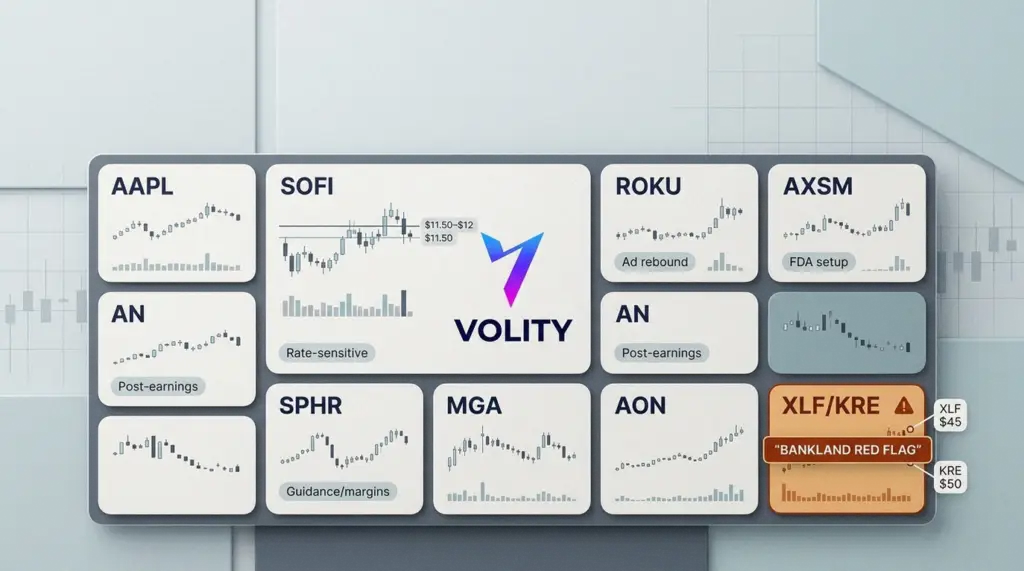
- Apple (AAPL): The post earnings bid is still intact, and the buyback helped. However, the stock needs to prove it can attract fresh money, not just squeeze shorts. Watch $225 as the breakout line, and look for 50m plus shares to validate it. Meanwhile, a hold above $218 keeps the higher low structure alive.
- Roku (ROKU): Guidance optimism has brought buyers back into a chart that had looked exhausted. Still, streaming names can whipsaw on ad checks and peer commentary. Hold $58 and the bulls have room to press; reclaim $62 and $70 enters the conversation. Conversely, a close below $56 turns it into a fade.
- SoFi (SOFI): The product story is working, and traders like it when a growth name trades on execution. Yet the rate narrative can flip overnight. A push through $12 on expanding volume matters, while $11.50 is the key near term line. A clean hold there sets up a run towards $15.
- Axsome Therapeutics (AXSM): The FDA angle gives it a real, tradeable catalyst rather than vague hope. Even so, biotech rallies can die without follow through funds. Watch $95 as the trigger, then $110 becomes the next obvious magnet. Meanwhile, any hint of funding risk would change the tone fast.
Earnings roulette: five where the reaction matters more than the headline
These names can move on one line in a transcript. Focus on guidance, margins, and what management will not answer.
- AutoNation (AN): Pre earnings downgrades have set the bar low, which can cut both ways. Watch $165 support. However, a miss with soft forward language opens a quick slide towards $150. A volatility trade fits better than a point forecast.
- Sphere Entertainment (SPHR): The story lives in margins and forward bookings, not spectacle. A break above $45 can force momentum buying. Conversely, weakness below $42 makes it a clean short setup.
- Moderna (MRNA): Traders will trade the pipeline narrative, not the old pandemic cashflow. Hold $105 and the market may pay for optionality. Meanwhile, credible oncology vaccine updates could pull it towards $120. If the call feels thin, fades tend to be brutal.
- Magna International (MGA): It often trades as a proxy for auto confidence and pricing. $45 is the level to watch. However, commentary on EV demand and OEM inventory will likely decide direction more than the quarter itself.
- Aon (AON): This is the steadier corner of the list, and it can benefit if investors rotate into defensives. The uptrend holds above $330, while $340 remains the near term pressure point. Dip buyers will want to see it reclaim that level quickly.
One big red flag: stress signals in financials
The market has ignored plenty of bad banking headlines lately, but that indifference can vanish if credit metrics creep the wrong way. Watch the Financial Select Sector SPDR (XLF) around $45. Meanwhile, the SPDR S&P Regional Banking ETF (KRE) near $50 is the cleaner tripwire.
If those levels break and hold, selling can cascade through the thinner names first. Traders who are long the index may prefer hedges in the sector rather than dumping core positions in a hurry.
By the numbers
- AAPL: breakout watch $225, volume tell 50m plus
- ROKU: support $58, trigger $62, upside magnet $70
- SOFI: line in sand $11.50, momentum trigger $12
- AXSM: trigger $95, next level $110
- KRE: risk level $50, XLF: risk level $45
Key takeaways
- Prefer trades with defined invalidation points, especially after earnings gaps.
- Demand volume confirmation on AAPL and ROKU breakouts, or treat them as fades.
- In SOFI, respect $11.50, because the tape will punish sloppy entries.
- In AXSM and MRNA, news drives price, so size like a headline risk trade.
- If XLF and KRE crack together, reduce beta or hedge rather than arguing with the tape.
For more on this topic see our deep-dives on AI Trading: Top Tools, Stock Predictions, and Success Strategies, SolarEdge Stock Jumps as Jefferies Lifts Price Target on SEDG, and Biogen Buys Apellis: Biotech M&A Sympathy Trades Explained.
What our analysts watch: Three reads convert the watchlist into a sized position framework rather than a list of tickers. The KRE-XLF coordination read (KRE breaking 50 dollars while XLF holds 45 dollars is a regional-banking-specific stress that may stay contained at the sector level; KRE and XLF breaking together is the broader financial-sector signal that historically cascades into the S&P 500 within one to two sessions and demands a hedging response rather than position liquidation).
The volume-and-invalidation discipline on momentum names (AAPL, ROKU, SOFI, AXSM each have a defined invalidation level below the trigger; the discipline is to require volume confirmation on the breakout day and to size the position to the dollar-distance from the invalidation rather than to a fixed percentage of capital). The earnings-roulette options structure (the five earnings names carry binary-print risk that defined-risk options structures handle better than directional cash positions; the disciplined trader uses long strangles or vertical spreads to capture the move size without requiring directional accuracy on names where the print can resolve either direction).
The UK FCA prudential regulation pages cover the bank-supervision framework that anchors cross-jurisdictional stress reads, the Bank of England monetary policy documents the U.S. supervisory posture that frames the regional-bank disclosure read, and the ECB Economic Bulletin reference on stress testing covers the cross-sector framework. Volity offers U.S. and European equity, ETF, and bank-sector CFD execution under CySEC oversight via UBK Markets (licence 186/12), with entities in Saint Lucia and Cyprus.
Frequently asked questions
Why is KRE the cleaner tripwire than XLF for financial-sector stress?
Because KRE concentrates exposure in regional and community banks, which carry the higher commercial-real-estate exposure, deposit-flight sensitivity, and net-interest-margin compression that historically signal the leading edge of financial-sector stress. XLF holds the larger universal banks (JPM, BAC, WFC) which have diversified revenue streams (capital markets, wealth, payments) that absorb stress before it shows up in the price action. The structural read is that KRE breaks first on a credit-deterioration cycle, with XLF following one to two weeks later as the universal-bank earnings-revisions cycle catches up. The disciplined trader monitors KRE 50 dollars as the early-warning threshold and XLF 45 dollars as the confirmation threshold rather than treating the two ETFs as equivalent indicators.
How should traders read the AAPL 50 million-plus volume threshold for the 225 dollar breakout?
The threshold encodes the institutional sponsorship requirement that distinguishes a sustainable breakout from a momentum-trader squeeze. AAPL trades a 60 to 80 million-share daily baseline; a breakout day that prints 50 million-plus while closing above 225 dollars represents materially elevated participation that signals institutional accumulation rather than retail-driven price action. The structural pattern is that volume-confirmed breakouts on AAPL extend over two to four weeks, while volume-thin breakouts fail back into the prior range within one to two sessions. The disciplined sizing framework treats the volume threshold as the gating condition for the long entry and uses 218 dollars as the invalidation level if the breakout fails to hold the higher-low support.
What does the AXSM FDA catalyst structure look like for position sizing?
It looks like a binary-print structure with a real, tradeable catalyst rather than vague hope, which is the distinction that separates a clinical-trial-driven biotech long from a speculative biotech long. The 95 dollar trigger represents the level above which institutional momentum has historically extended biotech positions, while 110 dollars is the next obvious magnet on a positive read-through. The discipline is to size the position to the FDA-event invalidation rather than to a fixed percentage of capital, because the realised move on a binary-print outcome can range materially in either direction. A long-call or long-call-spread structure captures the upside without exposing the position to the full downside that a cash long would carry on a negative outcome.
Does the SOFI rate-narrative sensitivity change the 11.50 dollar invalidation framework?
It changes the position duration but not the technical invalidation. The 11.50 dollar level is the structural support that the price action has defended; a daily close below it invalidates the long thesis regardless of the rate-narrative state. The rate sensitivity affects the holding-period expectation rather than the entry trigger; in a rate-cut-friendly tape, SOFI tends to extend toward the 15 dollar reference within four to six weeks of the 12 dollar momentum trigger, while in a rate-cut-deferred tape the same 12 dollar trigger may produce a slower path with deeper intermediate retracements. The disciplined response is to require the 11.50 dollar hold for the long entry and to scale the position size to the rate-cycle expectation rather than treating the two factors as separate trades.
Related guides
- Stocks investing for beginners
- Best stock trading platforms in Europe
- Best AI stocks to invest in
- Swing trading platforms
- Best trading platforms
Volity operates a trading platform and also publishes educational and analytical content about trading. The content on this page is for educational purposes only and should not be considered financial advice. Volity may benefit commercially when readers open trading accounts through links on this site.
Our content is produced and reviewed under documented editorial standards; see our comparison and review methodology.