Wall Street’s Ai Obsession Meets Real-world Risk
Wall Street keeps treating artificial intelligence as both engine and alibi. This week, traders face the harder question.
Which companies can turn AI excitement into revenue, margins and cash? And which names merely enjoy the glow?
That split matters now. Options desks are braced for sharp earnings moves. Meanwhile, chip stocks remain the market’s weather vane. In the background, space, housing, biotech, cannabis and China risk are all throwing off tradeable signals.
By the Numbers
- Adobe (ADBE): options imply a near double-digit post-earnings move.
- Oracle (ORCL): backlog and remaining performance obligations dominate the AI capex debate.
- Intel (INTC): fresh analyst support has revived the turnaround trade.
- Lennar (LEN): orders, cancellations and margins will offer a live housing read.
- Aurora Cannabis (ACB): its scheduled results make cannabis a small but lively event trade.
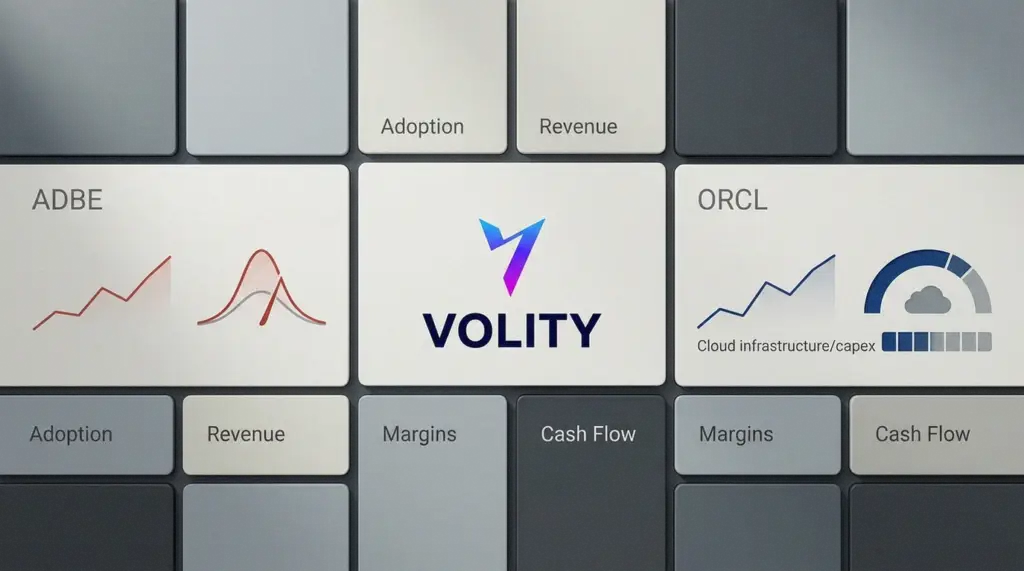
Adobe sits first in the queue. Its chart has been tightening before earnings, and options traders have noticed. The company often beats revenue expectations. However, the real test now is whether AI appears in the numbers.
Investors will listen for Firefly adoption, Acrobat AI usage and Creative Cloud pricing power. Traders, however, have a cleaner setup. They can buy volatility before the print, or chase momentum after it. A weak AI answer would make the same trade work in reverse.
Intel has also forced its way back into the conversation. A major bank upgrade gave the stock a cleaner narrative around CPUs, foundry ambitions and AI-related demand. The shares can still catch momentum while semiconductors trade as an AI proxy.
Still, Intel remains a turnaround, not a victory lap. Foundry credibility, process execution and competition from TSMC, AMD and Nvidia still frame the risk. Traders may buy the upgrade. Long-term investors need proof.
AMD has the opposite problem. The market already treats it as an AI infrastructure champion. Its data centre CPUs and accelerators fit neatly into the dominant story of the year. Meanwhile, that popularity makes the stock crowded.
Fresh bullish calls can still pull in buyers. However, each note also risks a sell-the-news reaction. For investors, AMD offers real AI exposure. But valuation leaves little room for any wobble in server demand.
The space trade has warmed up again, partly because SpaceX IPO chatter keeps resurfacing. Since public-market access remains limited, Rocket Lab (RKLB) often becomes the liquid substitute. That makes it a classic sympathy trade.
When the headlines grow louder, RKLB can move quickly. Yet the premium can fade just as fast when risk appetite cools. Traders should treat it as a tape-sensitive vehicle, not a slow compounder.
AST SpaceMobile (ASTS) brings a sharper catalyst. Its stock moves around launch schedules, technical milestones and telecom partnership hopes. As a result, a firm launch date creates an event calendar. The run-up can be powerful. The aftermath can be binary.
Investors need a different mindset. ASTS offers a bold satellite-to-phone story. It also carries financing risk, execution risk and possible dilution. That mix belongs in the speculative drawer.
Back on Earth, Lennar will help investors read the housing cycle. Its report matters less for headline earnings than for orders, cancellations, incentives and gross margins. Those details reveal rate sensitivity better than most monthly housing releases.
Here, traders should avoid stale consensus numbers. The right setup depends on live estimates and current guidance. Once framed correctly, LEN becomes an earnings volatility trade and a sector read-through for homebuilders.
Healthcare offers quieter catalysts. Novartis (NVS) has drawn attention with early data in facioscapulohumeral muscular dystrophy. The Phase 1/2 signal helps the rare-disease story. However, Phase 3 risk still sits squarely ahead.
Most short-term traders will ignore it unless the stock moves unusually hard. Long-term healthcare investors may see another brick in a broader rare-disease franchise.
The competitive story looks sharper in Sanofi (SNY) and Argenx (ARGX). Sanofi halted a Phase 3 CIDP study for riliprubart on efficacy grounds. As a result, Argenx’s Vyvgart faces a cleaner lane in that indication.
That creates a relative-strength setup. Traders can watch ARGX against a weaker Sanofi chart. Investors, meanwhile, can argue that Vyvgart’s moat in CIDP has widened.
Stitch Fix (SFIX) has finally delivered something the market wanted: an earnings beat and client growth. After years in the penalty box, that was enough to spark turnaround talk.
Still, the stock remains a trader’s arena. Gap-ups in broken consumer-tech names often invite momentum chasers. However, memories of failed turnarounds can turn a breakout into a gap-and-fade session.
Oracle sits closer to the centre of the AI spending argument. Management points to a large backlog and remaining performance obligations to justify aggressive AI data centre investment. Critics worry about margins, customer concentration and the return on capital.
ORCL has become a referendum on AI infrastructure spending. Dip buyers keep testing the stock after selloffs. Longer-term holders must accept the trade-off: faster cloud growth now, margin pressure today.
The broader tape helps. Equity futures have leaned higher, and risk appetite remains firm. Meanwhile, tech and financial leadership has kept intraday buyers engaged.
That backdrop matters for NIO (NIO). Small moves higher do not create a thesis by themselves. The useful framing is a China EV risk-reward bet. Tariffs, pricing pressure, domestic competition and balance-sheet demands all shape the trade.
For traders, NIO can serve as a tactical bounce or high-beta hedge. For investors, it remains a long-duration story with substantial political and financial risk.
WuXi AppTec brings policy risk into sharper view. A sizeable buyback can support the shares and attract opportunistic flows. However, U.S. pressure on Chinese biotech and contract research still dominates the investment case.
Procurement restrictions, export controls and national-security reviews can overwhelm decent fundamentals. Traders may buy buyback-supported dips. Investors must price in rule changes that can arrive without warning.
Energy is sending a more technical message. Some weaker names have broken key levels, with traders watching 200-day averages, lower highs and fading momentum. However, ticker confusion around names such as “WKC” shows why confirmation matters.
Once the correct charts are clear, the trade becomes tactical. Momentum funds can short the weakest energy stocks or underweight the group. Investors should avoid turning that into a grand verdict on the whole sector.
Finally, Aurora Cannabis gives cannabis traders a dated catalyst. Its Q4 and full-year 2026 results are scheduled, not already settled. That distinction matters in a market where loose feeds can move thinly traded names.
The important numbers will be cash burn, restructuring progress and the mix between medical and recreational revenue. Guidance will matter more than nostalgia. Cannabis bulls need evidence that profitability is approaching, not another promise wrapped in green paper.
Related coverage on Volity
- Today Stock Market Watchlist: CASY, AAOI, DKNG, SPY, QQQ
- Bitcoin Price Slips Below $61k as ETF Outflows Hit Crypto
- Oracle (ORCL) Earnings: Key Stocks to Watch Pre-Market
- Bitcoin Price Today: BTC at $64k as Fear Hits 10/100
- Marvell (MRVL) S&P 500 Boost as Biotech & Fintech Rally Widens
Key Takeaways
- AI trades need numbers now: Adobe and Oracle must show adoption, revenue and margin discipline.
- Semis remain crowded: Intel offers turnaround momentum, while AMD carries leadership expectations.
- Space is event-driven: Rocket Lab follows sentiment, while ASTS follows milestones.
- Biotech has cleaner relative trades: Argenx benefits as Sanofi steps back in CIDP.
- Policy risk is real: WuXi and NIO can move on headlines as much as fundamentals.
Taken together, these 15 situations capture the market’s current mood. AI still shouts loudest. Yet the more useful trades may come from knowing which stories have numbers behind them, and which are just noise on a bright screen.