Crypto Markets Today: Bitcoin Slips as Wall Street Builds and Defi Braces for Washington
Bitcoin is back under pressure, yet the plumbing around crypto keeps getting heavier and more institutional.
That split defines today’s market. Prices look nervous. However, exchanges, banks and regulators are still building the next version of the trade.
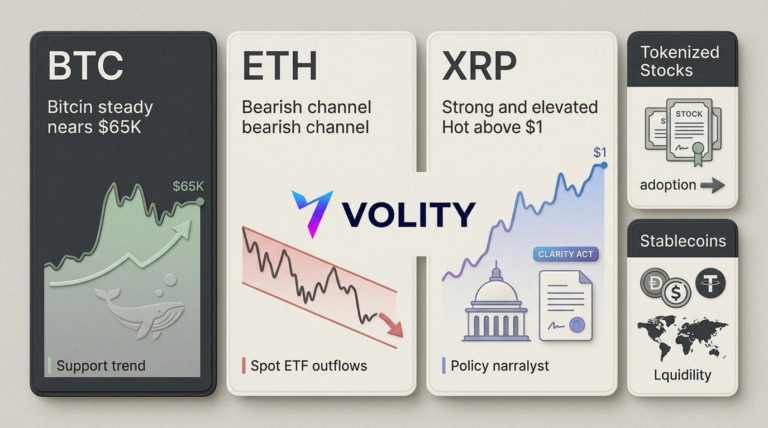
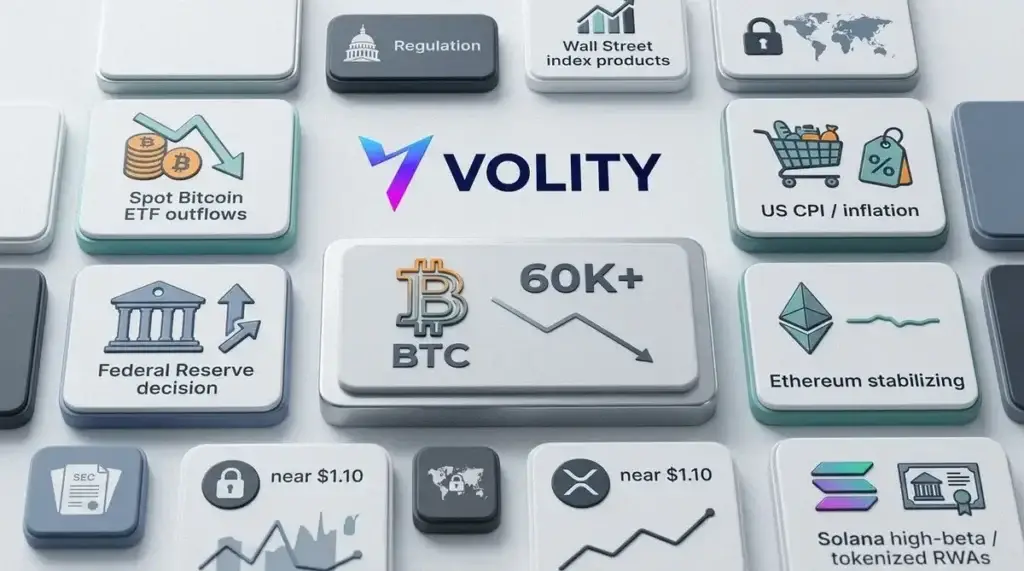
Bitcoin recently slipped below $61,000 as traders turned defensive before the next U.S. inflation report and Federal Reserve decision. Futures markets still expect the Fed to hold rates steady. However, the tone of the statement matters more than the decision itself.
For now, macro desks are trading three broad paths. A softer inflation print could pull buyers back toward risk assets. Meanwhile, sticky prices would keep bitcoin trapped near recent lows. A hot number would likely send leverage out of the market quickly.
The key levels are plain enough. Bulls want bitcoin back above $65,000 with volume. Bears want a break into the high $50,000s. Until then, the market remains jumpy, thin and headline-sensitive.
Bitcoin exchange-traded funds have also lost momentum. More than $1.8 billion has left spot products heading into June, while bitcoin trades roughly 40% below its cycle high. Dip buyers need fresh evidence that institutional demand has returned.
Altcoins: Ethereum Steadies, Xrp Watches Flows, Solana Chases Real Assets
Ethereum is holding a key support area after a rough stretch. Still, traders are watching whale wallets more closely than chart patterns.
BitMine reportedly added about 75,000 ETH, a size large enough to steady sentiment. However, one whale does not fix weak spot demand. Ethereum needs better follow-through from funds, apps and fees.
Meanwhile, CME is adding crypto index futures covering bitcoin, ether, XRP and Solana. That gives professional investors a cleaner way to trade baskets rather than single coins. Over time, it could deepen liquidity and tighten spreads.
XRP is trying to stabilise near $1.10. Binance reserves have declined, which some traders read as reduced selling pressure from that venue. Still, XRP remains a flow trade first and a legal-regulatory trade second.
Two structural developments matter. Kalshi has launched regulated XRP-linked event contracts for U.S. traders. Also, XRP exchange-traded products have drawn more than $1.4 billion in cumulative inflows. Those flows do not guarantee upside, but they change the ownership base.
Solana remains the market’s favourite high-beta story. Tokenised real-world assets on Solana have reached about $2.7 billion, according to market trackers. SOL traders are watching whether risk appetite can support another push toward $77.
Related coverage on Volity
- Oracle (ORCL) Earnings: Key Stocks to Watch Pre-Market
- Bitcoin Price Today: BTC at $64k as Fear Hits 10/100
- Marvell (MRVL) S&P 500 Boost as Biotech & Fintech Rally Widens
- Bitcoin Price Outlook After Crash: Key $60k-$64k Levels
- Bitcoin Dips as SpaceX Tokens Hype; Stablecoin Rules Loom
By the Numbers
- $61,000: recent bitcoin pressure point as traders wait for inflation data.
- $1.8 billion: estimated recent outflows from spot bitcoin ETFs heading into June.
- 75,000 ETH: reported BitMine purchase during ethereum’s pullback.
- $1.4 billion: cumulative inflows into XRP-linked exchange-traded products.
- $2.7 billion: value of tokenised real-world assets on Solana.
Wall Street: Tokenised Stocks Move from Experiment to Threat
Binance has launched bStocks, offering round-the-clock trading of tokenised U.S. equities. The pitch is simple: Apple at midnight, Nvidia on Sunday, with settlement moving on-chain.
That idea challenges the old rhythm of markets. However, it also raises familiar questions about custody, shareholder rights, liquidity and legal venue. Regulators will not ignore synthetic access to U.S. stocks for long.
For traders, the appeal is obvious. Tokenised equities create more ways to hedge crypto exposure against tech stocks. They also open basis trades between listed shares, tokenised wrappers and derivatives.
Meanwhile, Nasdaq and CME are preparing more crypto-linked index products. Large funds increasingly want diversified exposure instead of coin-by-coin execution. Crypto is becoming less of a side pocket and more of a macro sleeve.
There is also competition for speculative money. Traders are watching a potential SpaceX listing after reports of heavy oversubscription. A giant equity debut could pull capital from crypto briefly, especially from retail accounts already nursing losses.
Regulation: Stablecoins, Clarity and Prediction Markets
Washington is now the other main trading venue. The GENIUS Act could reset rules for stablecoins and DeFi, especially around reserves, redemptions and on-chain activity.
New York’s financial regulator has already tightened its stablecoin framework. That move gives licensed issuers clearer expectations, but it also narrows room for improvisation.
DeFi firms are pushing back. Hyperliquid and Paradigm argue that one proposed rule could damage liquidity by forcing decentralised protocols into bank-like structures. Their worry is blunt: bad rules may not stop risk, they may export it.
Separately, Paradigm is challenging restrictions on bank yield products tied to stablecoins. The case matters because stablecoin yield sits near the border between payments, securities and banking.
Meanwhile, more than 200 crypto firms are urging the Senate to move on the CLARITY Act. Supporters want federal definitions for digital assets. Critics worry those definitions may age badly and freeze today’s assumptions into law.
Prediction markets are becoming the sharpest test. Congress is weighing limits on lawmakers betting through crypto-based markets. At the same time, Kalshi has introduced mandatory employer disclosures to reduce insider-trading risk.
That fight cuts to the product’s core. Prediction markets work because people trade information. However, markets also fail when privileged information becomes a business model.
Security and Geopolitics: Risk is Not Abstract
Law enforcement is also getting better at following coins. South Korean police have partnered with Chainalysis to trace funds tied to North Korean hacking campaigns.
That matters for exchanges and market makers. Compliance screens are becoming operating infrastructure, not back-office decoration. As a result, dirty liquidity has fewer places to hide.
Protocol risk remains just as visible. A recent exploit in the Token of Power ecosystem drained about $1.58 million from a Balancer liquidity pool. Once again, yield came with code risk attached.
Geopolitics has added another layer. After reports of a U.S. military response order involving Iran, bitcoin sold off sharply as traders cut exposure. In stress windows, crypto still behaves more like high-beta technology than digital gold.
Trading View: What Matters Now
- Respect the calendar: CPI, PPI and the Fed can overpower chart setups within minutes.
- Watch ETF flows: bitcoin needs renewed spot demand before a durable bottom looks convincing.
- Separate structure from price: CME futures and tokenised stocks matter, even if coins fall today.
- Treat defi yield carefully: audits reduce risk, but they do not remove smart-contract failure.
- Track regulation as a catalyst: GENIUS and CLARITY could move liquidity, leverage and stablecoin demand.
For now, crypto is less a single trade than a crowded intersection. Inflation data, ETF flows, tokenised equities, DeFi rules and geopolitics are all sharing the same screen.