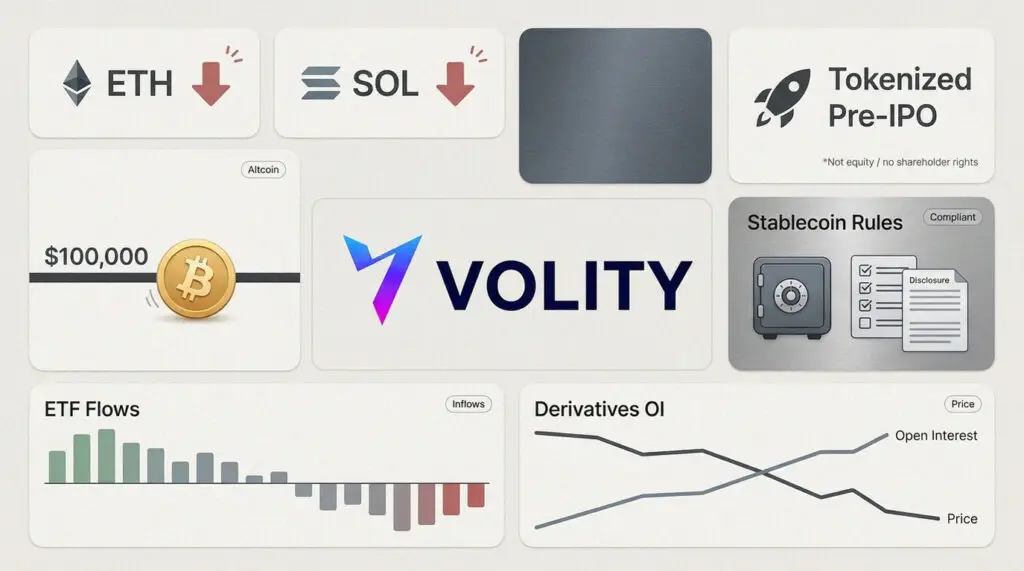
Crypto market digest: token fever meets a harder tape
Crypto starts the week with a sour taste. Bitcoin is below recent round-number supports, spot volume has thinned, and altcoins are taking the sort of beating that makes even committed bulls check their calendars.
Yet the news tape is not dead. In fact, it is noisy. Tokenised SpaceX exposure has stirred pre-IPO fever. Stablecoin issuers face a tougher rulebook. Meanwhile, institutions keep building the rails that could make digital assets look less exotic and more like plumbing.
That split matters for traders. Price is saying caution. Structure is saying transition. The next move may depend less on slogans and more on leverage, liquidity and regulatory survivability.
Leverage on the on-chain venues is posted in dollar tokens rather than in coins, which changes how quickly a position gets into trouble. That mechanism is unpacked in our explainer on USDC margin.
Space Fever in Token Form
The week’s liveliest story sits at the intersection of Elon Musk, private markets and crypto distribution.
Bybit and Kraken have moved to offer tokenised exposure tied to a possible SpaceX IPO. These products aim to mimic access to pre-IPO economics, or at least something close enough for traders hungry for the trade.
Bybit’s “IPO Express” product gives users a synthetic route into SpaceX-linked exposure. Kraken, meanwhile, has framed its SpaceX tokens as a challenge to investment banks, which usually control access to the biggest private-market listings.
The timing helps. SpaceX has been linked to a large GPU arrangement with Google, adding another growth angle to an already crowded story. As a result, any product with SpaceX on the label can find eager demand.
However, traders should read the fine print. These tokens are not the same as owning ordinary shares. The real question is whether holders receive enforceable economic rights, or merely a tradable instrument with clever packaging.
Still, demand itself is useful information. Tokenised equity risk is no longer a conference-panel idea. It is becoming a product fight.
Bitcoin Feels the Rotation
Bitcoin’s latest weakness has several causes. Macro nerves remain high. ETF flows have cooled. Retail traders have stepped back. Yet speculative rotation may also be playing a role.
Some desks see traders taking Bitcoin profits to chase higher-beta SpaceX-linked products. Others read it more simply. In a fragile market, a shiny new story can drain attention and capital from the old leader.
Meanwhile, US spot Bitcoin ETFs have just broken a 13-day outflow streak. One session of inflows helped sentiment briefly, but it did not repair the damage. The prior redemption run was the longest since the products launched.
BlackRock’s IBIT remains the key symbol here. When flows into the market’s flagship institutional wrapper wobble, traders notice. Bitcoin’s problem is not merely chart-based. It is also about sponsorship.
Leverage Builds Under Falling Prices
Derivatives now carry the sharper warning. Bitcoin has fallen while open interest has risen across major futures venues. That is rarely a quiet combination.
More leverage on a falling tape can create two very different outcomes. If shorts crowd the trade and funding stays negative, even modest good news can spark a fast squeeze higher.
However, if Bitcoin loses another support area, forced selling could deepen the decline. Leverage does not pick sides. It merely makes the move louder.
- ETF flows: Spot Bitcoin funds recently ended a 13-day outflow run.
- Ethereum: ETH has traded near the low $1,500s.
- XRP: The $1 area remains the market’s psychological fault line.
- Solana: Traders are watching possible downside toward $50.
- Greece: Officials have floated a 15 per cent crypto-gains tax.
Altcoins Look Worse Than Bitcoin
The altcoin tape looks less like a tidy correction and more like late-cycle stress.
Ethereum has slipped toward the low $1,500s. More importantly, ETH/BTC has weakened, which shows traders prefer relative safety over platform beta. If macro pressure persists, bears will talk again about $1,000.
Solana is also under pressure. Large holders have cut exposure, while technicians warn that a break of support could reopen the path toward $50. That level is not destiny, but it is now on screens.
Dogecoin has printed a large head-and-shoulders structure on higher-time-frame charts. Such patterns can fail, of course. Still, neckline levels now matter more than social-media noise.
AVAX has fallen back toward zones last seen in early 2021. As a result, investors face a familiar question. Is this forced capitulation, or just another resting point in a broader repricing?
Cardano offers a stranger mix. ADA mentions and social activity have jumped while the price keeps sliding. Sometimes that produces a sharp mean-reversion rally. Sometimes it only measures denial.
Zcash Faces a Confidence Test
Zcash has become the most dramatic pocket of stress. A recently disclosed Orchard pool bug hit sentiment first. Then high-profile selling added fuel.
The token has fallen by roughly half in a matter of days. Cameron Winklevoss and several technologists have tried to reassure the market, but concern around shielded pools and so-called lonely coins has dented trust.
Privacy coins trade partly on cryptography, but also on confidence. When both are questioned at once, liquidity can disappear quickly.
Xrp Pivots from Litigation to Assets
XRP is fighting around $1. Bulls see an oversold setup. Bears see a fragile level that could break if Bitcoin makes fresh local lows.
Yet the more interesting story sits on the XRP Ledger. Capital is moving toward real-world asset projects building on XRPL. The chain is beginning to test Ethereum’s grip on tokenised asset issuance at the margin.
David Schwartz and other XRPL architects have also been discussing institutional use cases. The pitch is straightforward: issue, settle and manage assets on-chain, inside a structure that large counterparties can understand.
That will not change XRP’s chart overnight. However, it gives the ecosystem a cleaner narrative than courtroom residue.
Stablecoins Meet Harder Rules
Stablecoin issuers face a more serious regulatory calendar. The GENIUS Act would impose tougher standards on reserves, disclosures and compliance. The deadline is now close enough to change behaviour.
Large, regulated issuers should survive the shift. In fact, they may gain share by advertising cleaner reserves and stronger oversight.
Smaller offshore players face a harder choice. They can reorganise, restrict access in key markets, or risk being pushed out.
Meanwhile, Washington’s tax posture is turning colder. Lawmakers have criticised stablecoin-based tax refund products as potential evasion tools. New crypto tax plans also focus on DeFi flows and stablecoin transactions.
The message is blunt. The era of building around the edges of the tax code is fading.
Regulators Tighten the Map
The pressure is not only American. Greece has floated a 15 per cent tax on crypto gains. Illinois lawmakers have advanced a crypto tax framework with felony penalties for some kinds of non-compliance.
In Britain, the FCA has warned about derivatives venue Hyperliquid. Interestingly, ICE has been studying parts of the same model. That contrast says plenty. Regulators dislike the risk, while incumbents like the market design.
Monetary policy also sits in the background. A more pragmatic Federal Reserve stance could help digital assets over time. However, inflation risk has not vanished. If rate expectations rise again, crypto will struggle to escape the pressure on risk assets.
Institutions Keep Building
Here is the cycle’s paradox. Tokens are falling, but the market’s institutional machinery keeps improving.
Securitize, backed by BlackRock, is nearing a New York Stock Exchange debut after regulatory progress. Its business is simple to describe and difficult to execute: tokenising securities in a compliant format.
Morgan Stanley is also working with Galaxy Digital on crypto-backed access around Bitcoin ETF products. That would let wealthy clients borrow against, or structure around, crypto positions inside regulated wrappers.
Grayscale continues to test new ETF concepts too, including ideas linked to Canton Coin and Hyperliquid-style exposure. Some will fail. Yet the product factory is clearly still running.
Miners Chase the Ai Trade
Bitcoin miners are no longer only miners. Increasingly, they are trying to become high-performance computing landlords.
The logic is clear. Block rewards shrink, power costs bite, and AI customers need energy-hungry data centres. Miners with cheap electricity, land and cooling can repurpose facilities for GPU workloads.
For investors, that creates a valuation wrinkle. A miner with credible AI contracts may deserve a different multiple from one relying only on Bitcoin price appreciation.
However, execution risk is real. Running AI infrastructure is not the same as plugging in mining rigs. Customers will demand uptime, networking quality and serious service agreements.
Related coverage on Volity
- Bitcoin Price Dips Below $60k as Crypto Leverage Breaks
- AI Stocks Today: AVGO Drops as AI Trade Spreads Beyond Chips
- Bitcoin Price Eyes $60k as Banks Build Tokenisation Rails
- Stocks to Watch: AVGO, CIEN, MARA as Clean Catalysts Win
- Bitcoin Price Dips as ETF Outflows Hit Crypto Markets
Key Takeaways
- Expect sharper Bitcoin moves: Rising open interest and thin spot liquidity raise squeeze risk both ways.
- Do not treat all altcoin dips equally: Look for balance-sheet strength, catalysts and real user demand.
- Watch $1 on XRP and $1,500 on ETH: Breaks there could hit broader sentiment.
- Follow tokenisation infrastructure: Securitize, tokenised equities and RWA platforms may outlast this drawdown.
- Separate miners carefully: AI-capable operators could detach from pure Bitcoin beta.
This is an uncomfortable market, which is precisely why it matters. Prices are warning traders to stay nimble. Meanwhile, regulation and infrastructure are deciding who gets to survive the next cycle.