Crypto Markets Lose Altitude as Institutions Dig in
Crypto has lost the easy part of the trade.
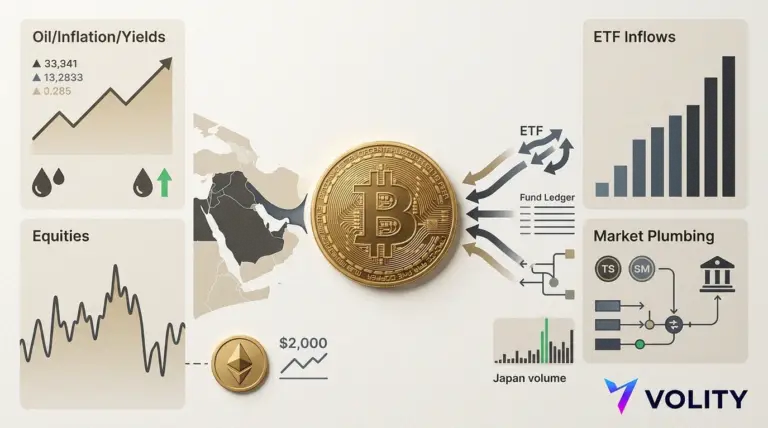
Bitcoin still draws the biggest cheques, the loudest arguments and the cleanest institutional story. Yet it now trades less like a rebel asset and more like a macro instrument with poorer manners. When ETF money leaves, price wobbles. When the dollar firms, buyers pause. When risk appetite thins, leverage usually pays the bill.
That shift matters for traders. The market no longer runs mainly on retail heat and weekend enthusiasm. Instead, flows now pass through spot ETFs, derivatives desks, corporate treasuries and compliance committees. The marginal buyer looks more patient, but also more price-sensitive.
Bitcoin Loses Its Momentum Bid
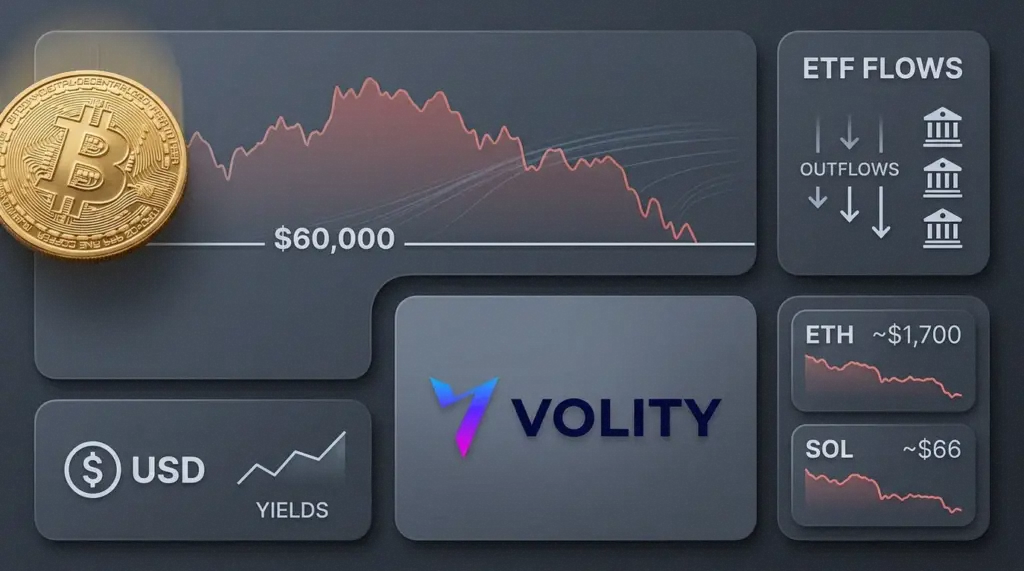
Bitcoin has slipped back towards the low $60,000s, after May’s correction pushed it through several watched cost-basis levels. Those levels track the average entry price for different holder groups.
For short-term holders, that breach usually stings quickly. However, longer-term cohorts also felt pressure during the sell-off. That does not guarantee capitulation. Still, it tells traders that pain has moved beyond late buyers.
Valuation desks have also pointed to a near 28 per cent ”quantum discount”, a measure comparing price with long-term bands. In plain terms, Bitcoin is no longer obviously expensive against its own history. However, cheap can always get cheaper when ETF redemptions drive the tape.
Recent spot Bitcoin ETF outflows have reached the billion-dollar range on some weekly estimates. Citigroup analysts have pinned the latest leg lower on those redemptions, rather than MicroStrategy’s much discussed Bitcoin sale. The distinction is important. One company selling makes a headline. ETF outflows change market plumbing.
Charles Schwab strategist Jim Ferraioli put it bluntly: Bitcoin has ”lost its momentum trade”. That comment landed because it matches the screen. BTC still has buyers below the market, but rallies now meet faster selling. Meanwhile, cash yields, Treasuries, AI stocks and gold all compete for the same institutional attention.
Ethereum and Solana Feel the Sharper Pain
The drawdown has not spread evenly. Ethereum has lagged Bitcoin, with ETH grinding near the high $1,700 area. Technical desks see oversold signals, but not a broken downtrend. The next clean move matters more than the latest intraday bounce.
Ethereum faces three pressures at once:
- ETF excitement has not turned into steady spot demand.
- Earlier altcoin rotation is reversing into BTC and stablecoins.
- Newer layer-one chains keep challenging Ethereum’s fee and speed story.
Solana has taken a harder hit. SOL touched a fresh 52-week low near $66, erasing much of the 2024 euphoria trade. That level now carries emotional weight. It forces leveraged longs to choose between buying a deep dip and admitting the second-cycle story has cracked.
However, broken momentum does not mean a dead network. Solana still has active users, cheap transactions and a loyal developer base. The issue is valuation. Traders once paid for perfection. Now they want proof.
Altcoins Split Between Stories and Stress
While majors sag, narrative tokens still find pockets of heat. Worldcoin, or WLD, has jumped sharply after trading firm Maelstrom framed it as an ”AI IPO trade”. The token has been linked to enthusiasm around artificial intelligence listings, and whale accumulation has climbed to yearly highs.
That story can work in bursts. However, WLD still needs real demand beyond the AI label. Traders are watching the $0.65 region as a possible target if momentum holds.
XRP, meanwhile, is trying to defend the $1.14 zone. Newly launched products cooled after early interest, and some funds rotated out. If XRP loses that area cleanly, technicians will look to lower supports. If it holds, the latest outflows may look like digestion rather than rejection.
Notably, one prominent XRP builder has pushed back against loud price targets. He argued that silence can speak louder than bold forecasts. That is not meme-friendly. Still, it may suit a market that now cares more about usage and regulation.
Memecoins remain the wildest corner. Little Pepe, or LILPEPE, has reportedly raised about $28 million in presale at $0.0022. Promoters point to staking and zero-tax tokenomics. However, presales always make the upside easy to describe. Liquidity, exchange listings and post-launch demand are the harder tests.
Cardano faces a different problem. Charles Hoskinson has warned that parts of the ecosystem could collapse as several firms shut down. The base chain continues to run. Yet developer services and surrounding infrastructure matter. Without them, a chain can become technically alive but commercially quiet.
Coinbase and Goldman Move Into the Middle
Coinbase is no longer content to be a spot exchange with a famous app. Fresh approvals let the company offer perpetual futures to more clients. At the same time, it has launched pre-IPO perpetual futures linked to SpaceX, with up to 5 times leverage.
That product pulls Silicon Valley speculation into crypto rails. It also makes Coinbase look more like a multi-asset derivatives venue than a simple brokerage. COIN investors may start judging it against exchanges, futures platforms and structured-product shops.
Activity is also moving away from Ethereum mainnet. Coinbase’s x402 entity has processed more than 100 million transactions on Base, its layer-two network. Lower fees are doing what ideology rarely does. They are changing user behaviour.
Meanwhile, Goldman Sachs has launched a tokenised property fund on its GS DAP platform. This is not about cartoon JPEGs or weekend coins. It is about settlement, administration and fund operations. Slowly, tokenisation is becoming back-office infrastructure rather than a marketing slogan.
South Korea’s Shinhan Bank is also testing Canton Network for tokenised financial assets. Traders should not expect these projects to move BTC by lunchtime. However, they shape the market’s long-term ceiling. Large pools of capital need rails they can explain to auditors.
Washington Keeps Tightening the Frame
Regulation is moving from mood music to market input. Senator Cynthia Lummis has said a vote on the CLARITY Act looks more likely before the August recess. If passed, the bill could give digital assets sharper legal boundaries.
At the same time, the CFTC has scrapped its criticised ”no deny” rule. That change signals a broader rethink of enforcement mechanics. It may also alter how crypto firms settle cases without admitting wrongdoing.
Prediction markets are drawing fresh heat. House Democrats want the FTC to examine advertising around platforms such as Polymarket. Separately, Polymarket upheld a disputed ”No” ruling in a high-profile Bitcoin-linked market. The signal from Washington is plain. Products mixing politics, retail money and speculation will face harder questions.
Enforcement also remains practical, not theoretical. U.S. authorities have forced Coinbase to freeze roughly $3 million allegedly tied to Southeast Asian scam networks. Centralised exchanges still act as chokepoints, even in a market built around decentralisation.
Related coverage on Volity
- CrowdStrike (CRWD) Leads AI Cyber Rally as Funding Risk Bites
- Bitcoin Price Eyes $73k as Regulation, Stablecoins Bite
- AI Stocks to Watch: NVDA, TSM, CRWV and MRVL in Focus
- Bitcoin ETF Outflows Hit $3.45bn as Wall Street Shifts Crypto
- NVDA Leads: How to Read the Daily Watchlist Like a Pro
By the Numbers
- $60,000s: Bitcoin’s recent danger zone during the May correction.
- 28 per cent: Approximate long-term valuation discount flagged by some desks.
- $1,700s: Ethereum’s current support band under technical scrutiny.
- $66: Solana’s fresh 52-week low area.
- $3 million: Assets frozen on Coinbase in a scam-linked case.
Trading Implications
- Watch ETF flows first. Bitcoin now trades around institutional pipes, not just crypto sentiment.
- Treat on-chain value signals as zones. Cost-basis levels help with sizing, but they do not stop sell-offs.
- Separate stories from supply. AI tokens and memecoins need liquidity and clean unlock schedules.
- Respect regulatory timing. The CLARITY Act, CFTC changes and market probes can move risk appetite.
- Track infrastructure quietly. Tokenised funds and layer-two usage may matter more than the loudest coin pitch.
The market has shifted from easy momentum to grinding selection. That is less fun, but more useful. In this phase, disciplined traders have an edge over traders merely chasing the brightest narrative on the screen.