AI, Biotech and Battlegrounds: What Active Traders Are Watching Next
The market is still paying for clean catalysts. However, it is charging rent to anything vague, crowded or late.
That split now runs through artificial intelligence, biotech and a handful of old-fashioned battleground stocks. Traders want names with news, volume and obvious reaction levels. They are less patient with distant earnings dreams or second-hand price targets.
For now, the AI trade is no longer one trade. It has split into three baskets: compute, networking and enterprise software. Meanwhile, biotech has returned to its familiar rhythm of trial data, financing risk and violent gaps. In slower corners, names such as HP Inc. and ZIM Integrated Shipping are trading more like mood rings than compounders.
CoreWeave: the Pure AI Infrastructure Test
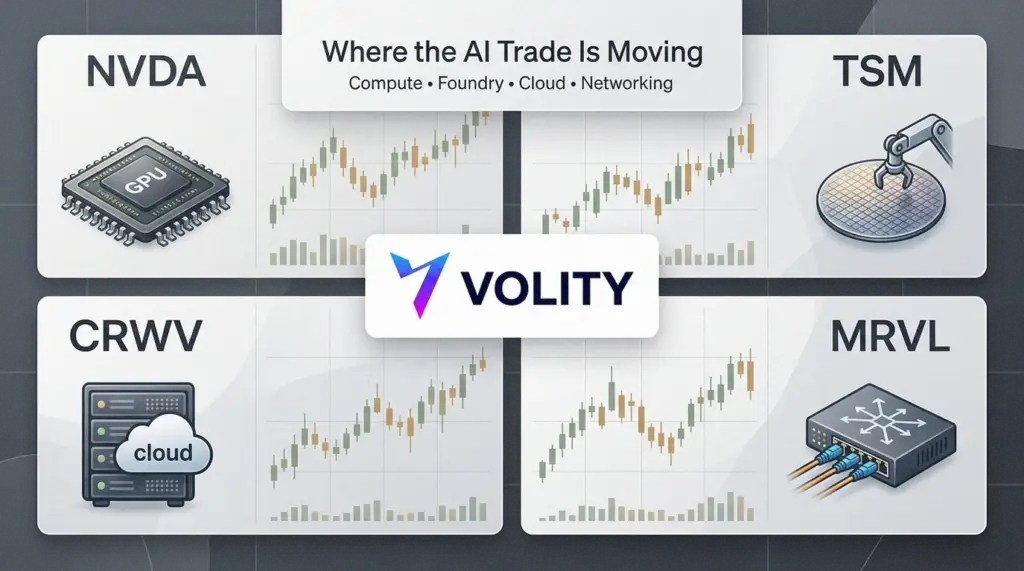
CoreWeave, ticker CRWV, has become one of the cleanest listed proxies for AI cloud capacity. That makes it useful, but also dangerous.
The company sits close to the market’s favourite obsession: scarce graphics processors, rented by the hour, inside power-hungry data centres. Traders are watching it as a live test of demand beyond Nvidia.
The near-term question is simple. Can CRWV hold higher lows after its latest burst of interest? If buyers support dips on heavy volume, the stock can keep drawing momentum money. However, weak closes after strong opens would suggest the easy AI infrastructure trade is tiring.
For active accounts, the setup is not about a five-year cloud forecast. Instead, it is about whether institutions still want direct exposure to GPU-heavy capacity.
Marvell: When the Plumbing Catches Fire
Marvell Technology, ticker MRVL, sits inside the less glamorous part of the AI boom. Yet that is exactly why traders care.
AI models need more than chips that do the calculations. They need networking, custom silicon and fast movement of data between racks. Marvell plays in that plumbing layer, which has helped the stock attract buyers hunting for the next AI derivative.
However, fast moves create fragile charts. Traders are watching whether MRVL can digest its recent strength without cracking through short-term moving averages. Tight pullbacks would keep the bull case alive. By contrast, a heavy-volume reversal would warn that the “picks and shovels” trade has gone too vertical.
In this part of the market, good stories still need good tape.
Guardant Health: the Upgrade Glow Gets Tested
Guardant Health, ticker GH, remains a high-beta way to trade enthusiasm around cancer diagnostics. The company’s liquid biopsy story still draws attention quickly when analysts turn more positive.
Even so, traders are not simply buying the long-term science. They are watching the stock’s behaviour after the upgrade pop.
If GH defends the post-news gap, buyers may treat that zone as a new base. However, a slide back into the old range would send a different message. It would show that risk appetite for unprofitable healthcare growth remains thin.
That matters beyond one ticker. Meanwhile, the broader biotech tape has become more selective. Strong data can still produce explosive moves. But weak balance sheets and vague timelines now face far less mercy.
OSTX and ABVX: Biotech’s Binary Corner
OSTX and ABVX sit in the part of biotech where calendars matter more than valuation screens. These are not sleepy research stories. They are event stocks.
OSTX is drawing attention as traders position around oncology-related survival data and possible regulatory steps. Any hint of progress towards a filing can reset expectations quickly, especially in a thinner stock.
ABVX, meanwhile, is being watched by traders looking for sharp downside if a clinical or regulatory update disappoints. That does not make the bear case correct. It does mean the market sees asymmetric risk around the next headline.
These setups reward speed more than conviction. Bulls look for call activity, accumulation and strength into news. Bears watch failed rallies, financing risk and slipping timelines.
For many desks, the cleaner trade comes after the release. React first, argue later.
Nvidia and TSMC: the AI Backbone Still Sets the Mood
Nvidia, ticker NVDA, and Taiwan Semiconductor Manufacturing, ticker TSM, remain the core pair in listed AI hardware.
Nvidia drives demand with its accelerator road map, from H100 systems to newer Blackwell-generation chips. TSMC manufactures much of the advanced silicon that makes the boom possible. Together, they give traders a compact read on AI demand, supply and geopolitics.
NVDA still acts as the sentiment gauge. When it rises and other AI-linked semiconductors follow, breadth looks healthy. However, if NVDA holds up while smaller peers fade, the tape is narrowing.
TSM adds a different read. It reflects foundry capacity, capital spending and export-control anxiety. Traders watch not only its own chart, but also its behaviour against the Philadelphia Semiconductor Index and the broader Taiwan complex.
The next important clue may come from rotation. If money leaves the obvious AI winners and buys second-tier beneficiaries, risk appetite remains alive. If the megacaps alone carry the trade, the rally becomes easier to knock over.
Salesforce and Alphabet: Enterprise AI Faces the Budget Test
Salesforce, ticker CRM, has tried to turn itself into an enterprise AI vehicle. The pitch now reaches beyond customer databases into automation, analytics and workflow tools.
Still, corporate buyers do not pay for slogans forever. Traders want proof that AI features can lift pricing or retention without damaging margins. CRM’s reaction around recent earnings levels and prior congestion zones matters more than abstract excitement.
A clean push through those bands on rising volume would suggest fresh buyers have arrived. However, another failed move would keep Salesforce in the “show me” bucket.
Alphabet, tickers GOOGL and GOOG, faces a different version of the same test. It owns search, cloud and deep AI engineering talent. Yet investors still debate how much extra spending is needed to defend its moat.
For Alphabet, the focus is capex, cloud growth and AI product traction. Because the company produces immense cash flow, the issue is not survival funding. Instead, traders are watching capital allocation and partnership choices.
If GOOGL keeps pace with the AI basket during spending-heavy periods, confidence improves. If it lags again, investors may question whether AI is boosting the franchise or taxing it.
HP and ZIM: Battlegrounds for Different Reasons
HP Inc., ticker HPQ, remains a split-decision stock. Bulls like capital returns, cost control and possible PC refresh demand. Bears point to printers, weak hardware cycles and limited excitement around AI-enabled devices.
As a result, HPQ often trades best as a battleground, not a love story. Options skew, short interest and earnings gaps can matter more than long-range spreadsheets. Traders frequently use prior reaction zones as risk lines.
ZIM Integrated Shipping, ticker ZIM, is even more sensitive to outside forces. It trades like a proxy for freight rates, regional tension and shipping-lane disruption.
When chokepoints flare or spot rates jump, ZIM can move before fundamentals catch up. However, those moves can fade quickly once the immediate risk premium eases.
That makes ZIM a volatility instrument for many short-term players. It is not a quiet transport holding. It is a headline trade with a balance sheet attached.
BNPL and Credit Data: the Quiet Data Fight
Consumer credit remains another active pocket, especially around buy now, pay later data. The obvious winners are not always the lenders making the most noise.
The stronger long-term position may belong to companies that price risk better. That includes credit bureaus, scoring providers and platforms that can fold BNPL behaviour into mainstream lending models.
Regulators have also sharpened the market’s attention. Partnership announcements and data-sharing moves can trigger real volume. Traders are trying to separate firms monetising better information from those merely riding the BNPL label.
By the Numbers
- 3 buckets dominate this watchlist: AI infrastructure, event-driven biotech and battleground cyclicals.
- 2 tickers, NVDA and TSM, still anchor the AI hardware read.
- 4 software and data names, CRM, GOOGL, GOOG and BNPL-linked firms, face the budget test.
- 2 biotech setups, OSTX and ABVX, hinge on binary clinical or regulatory headlines.
- 0 patience remains for vague catalysts when volume fails to confirm the story.
Related coverage on Volity
- NVDA Leads: How to Read the Daily Watchlist Like a Pro
- Bitcoin ETF Outflows Hit $1.67bn as XRP ETF Inflows Surge
- Crypto Market Today: Bitcoin Fork Fears, BNB $820, Vietnam Loans
- Bitcoin Price Holds $73k as ETF Outflows, US Clarity Act Bite
- AI Stocks Today: QQQ Market Radar on China Risk & Rates
Key Takeaways
- Momentum traders should watch volume first in CRWV and MRVL.
- Semiconductor breadth around NVDA remains the cleanest AI sentiment check.
- Biotech names with binary events require strict risk lines and fast execution.
- CRM and GOOGL need proof that AI spending converts into enterprise value.
- HPQ and ZIM are better treated as reaction trades than long-term commitments.
The watchlist has one common thread. Traders want a reason to act now. Earnings, clinical data, upgrades, capex commentary or geopolitical shocks can all provide it. Without that spark, even a clever story can sit cold on the screen.