Trader Watchlist Turns on Buybacks, AI Heat and Index Flows
The market has a fresh stack of single-stock stories, but traders should resist treating them alike.
Some names have hard catalysts. Others have analyst fuel, technical repairs or index-related demand. Meanwhile, several have already run far enough to make the easy money look less easy.
That matters on a day when momentum remains concentrated in AI, chips and infrastructure. However, the cleaner trade is not always the loudest headline. It is the setup where price, volume and timing line up.
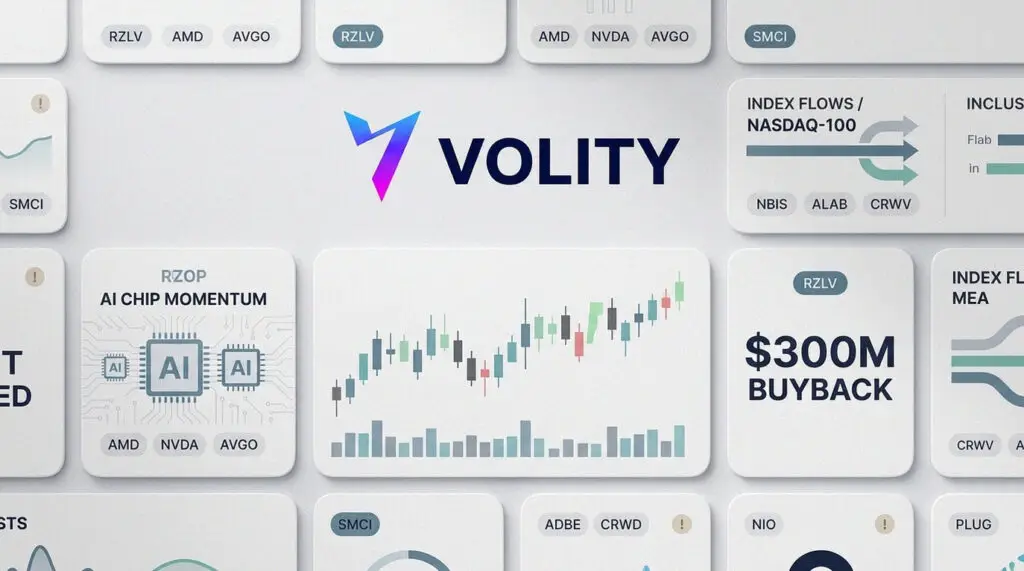
Today’s watchlist starts with RZLV, after a proposed $300 million buyback. Buybacks can support shares because they reduce the float and signal confidence. Still, traders will want proof that buyers defend the move after the first burst.
If volume holds, RZLV may stay in the momentum bucket. If the stock fades quickly, however, the buyback becomes less of a trade and more of a press release.
AMD sits in a more familiar lane. The stock continues to draw attention from bullish AI commentary, and investors still frame it as one of the cleaner challengers to NVDA. The key is not whether the AI story sounds exciting. It already does.
Instead, traders should watch whether AMD holds its opening gap, respects nearby resistance and avoids a fast reversal. A strong first hour followed by steady tape would matter more than another glowing paragraph about accelerators.
NVDA and AVGO remain the centre of the AI hardware trade. Both stocks still work as bellwethers for risk appetite across semiconductors. Meanwhile, related chip names can move in sympathy, especially when traders search for second-order winners.
That sympathy trade can be profitable, but it can also be sloppy. When NVDA and AVGO lead, lower-quality AI names often borrow the glow. As a result, traders should separate infrastructure demand from simple ticker association.
Index Flows Matter, but Timing Matters More
NBIS, ALAB and CRWV have a different catalyst: Nasdaq-100 inclusion. That kind of event can force buying from funds that track the index. It can also boost liquidity and bring fresh attention from systematic desks.
However, index inclusion often creates a two-step trade. First comes anticipation, as traders buy ahead of expected demand. Then comes the risk of a “buy the rumour, sell the news” reaction once the flow becomes obvious.
For NBIS, ALAB and CRWV, the ideal long setup would show controlled pullbacks and strong closing demand. Conversely, big early spikes without follow-through would warn that institutions have already done much of their buying.
The same logic applies across event-driven names. Forced buyers can bend the tape for a while. Yet once the forced buying ends, ordinary valuation and liquidity questions return quickly.
Post-event Names Need Confirmation
SMCI appears on the list as a support-bounce candidate. The stock has spent months as one of the market’s more dramatic AI infrastructure trades. Because of that history, even modest technical repairs can attract fast money.
The setup is simple. SMCI needs to reclaim short-term moving averages, hold above support and show volume that is not merely short covering. Until then, it remains a bounce candidate rather than a confirmed reversal.
ADBE is the cleaner weakness read. After post-earnings selling, the question is whether investors treat the drop as deserved or overdone. That split makes it useful for both momentum sellers and mean-reversion traders.
If ADBE keeps making lower highs after the report, sellers retain control. However, if buyers absorb supply near the lows, a sharp relief bounce becomes possible. Big software names rarely fall in a straight line for long.
CRWD belongs in the watchlist camp, not the chase camp. The cybersecurity story remains solid, and large customers still prize security spending. Still, the immediate setup needs a breakout with real participation before it earns more attention.
Without that confirmation, CRWD risks becoming a familiar story with an ordinary chart. Traders have seen plenty of those this year.
Headline Stocks Still Carry Sharp Edges
NIO remains one of the market’s more headline-sensitive EV trades. It can move sharply on delivery data, China policy hopes and sector sentiment. Confirmation matters more than the news text itself.
For NIO, a high-beta setup means traders should demand clean levels. A move that fails at resistance can unwind quickly. Meanwhile, a breakout with volume can squeeze late bears and attract momentum funds.
PLUG also needs care. The company remains tied to liquidity, balance-sheet confidence and sentiment around hydrogen. That makes it less suitable as a conviction long and more suitable as a sentiment-shift watch.
If PLUG rallies on thin volume, traders should stay sceptical. If it rises alongside improving credit and liquidity signals, however, the move deserves more respect.
Analyst-driven names round out the board. FORM, EDU, MKTX, SNX and ORCL all fall into that category today. In each case, price confirmation matters more than the rating change.
Analyst calls can start a move, especially in less crowded names. Still, they rarely sustain one without follow-through from larger managers. By the second hour, the tape usually reveals whether the call has real sponsorship.
Overbought is Not the Same as Short
UNM and PAYO sit in the overbought bucket. That does not make them automatic shorts. Strong stocks can stay stretched for longer than cautious traders expect.
Instead, the better approach is to watch for behaviour change. Failed breakouts, heavy volume on down days and weak closes matter more than an elevated oscillator. Until those signs appear, fading strength can become expensive.
That is especially true in a market where momentum still gets rewarded. However, stretched charts leave less room for mistakes. Late buyers need tighter risk controls, not louder conviction.
By the Numbers
- $300 million – proposed buyback keeping RZLV in focus.
- 3 stocks – NBIS, ALAB and CRWV tied to Nasdaq-100 inclusion flows.
- 2 bellwethers – NVDA and AVGO remain the cleanest AI hardware reads.
- 1 weakness name – ADBE offers the clearest post-earnings downside test.
- 2 fade-risk names – UNM and PAYO look stretched, but not broken.
More news on Volity
- AI Earnings Test: Adobe (ADBE) and Oracle (ORCL) in Focus
- Bitcoin Price Wobbles as Tokenisation Goes Mainstream
- Today Stock Market Watchlist: CASY, AAOI, DKNG, SPY, QQQ
- Bitcoin Price Slips Below $61k as ETF Outflows Hit Crypto
- Oracle (ORCL) Earnings: Key Stocks to Watch Pre-Market
Key Takeaways
- Momentum watch: RZLV, AMD, NBIS, ALAB, CRWV, SMCI, NVDA, FORM and AVGO.
- Event watch: NIO, PLUG, CRWD, SNX, ORCL, NBIS, ALAB and CRWV.
- Weakness watch: ADBE, where post-earnings selling needs either follow-through or a failed breakdown.
- Fade-risk watch: UNM and PAYO, but only if price action confirms exhaustion.
- Main themes: AI chips, AI infrastructure, index inclusion, analyst support and headline-driven EV volatility.
The practical message is simple. This is a watchlist, not a shopping list. In a tape led by catalysts, the best edge often comes from waiting ten extra minutes and letting price answer first.
Related coverage on Volity
- What Is a P/E Ratio and How to Use It
- Fundamental Analysis in Stock Trading: A Working Definition
- Growth Investing vs Value Investing: Which Style Fits You?
- Fractional Shares Explained: How to Start Investing With $50
- How to Start Stock Trading: A 2026 Beginner Guide
- Dividend Investing for Beginners: How to Start