Investing in financial products involves risk. Losses may exceed the value of your original investment.
Bitcoin defi exploits is a core topic for traders in 2026. The complete guide follows.
Crypto headlines: Bitcoin squeezes higher, DeFi bleeds $600m, XRP eyes breakout
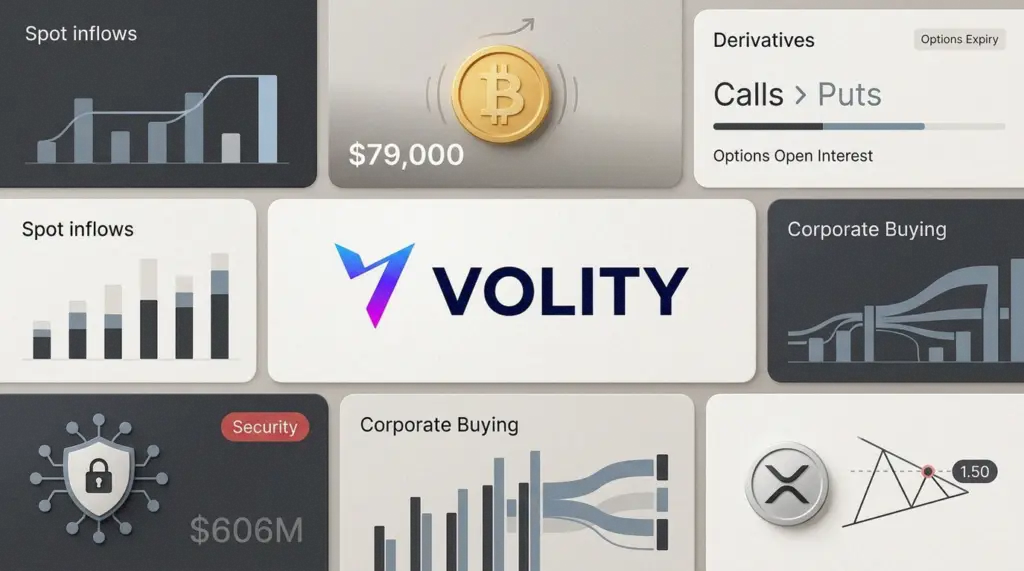
Bitcoin pushed back towards $79,000 on Thursday before easing, yet the mood stayed bullish. However, the more telling action sat in derivatives, where positioning ahead of a jumbo expiry looked like a slow, deliberate squeeze. Meanwhile, DeFi suffered another ugly fortnight, with April losses already at $606m and developers reaching for emergency brakes. Elsewhere, XRP tightened into a chart pattern traders love to argue about, with $1.50 now the obvious line in the sand.
Market movers: Bitcoin’s rally looks like positioning, not a conversion
Bitcoin notched an 11-week high above $78,000 and briefly reclaimed the $79,000 handle. However, the rally read less like fresh fundamental demand and more like a mechanical tug of war. With roughly $7.9bn of bitcoin options due to expire, call interest sat well above puts, therefore forcing dealers and short-vol traders to chase spot higher as price rose.
Price later hovered around $75,900, as traders weighed whether the squeeze had already paid out. Meanwhile, spot ETF flows stayed a prop, with BlackRock’s iShares vehicle again dominating the day’s net intake. Corporate buying added to the narrative too, after Strategy’s latest $2.54bn purchase lifted its bitcoin stash past 815,000 coins.
Risk appetite also bled into ether talk. Fundstrat’s Tom Lee kept the $250,000 long-term ETH target in circulation, while Bitmine’s reported $230m ether purchase gave bulls something concrete to point at. Meanwhile, a Trump-linked mining play drew attention after American Bitcoin surged 12% on news of 11,298 additional miners, taking reported hash power to 28.1 EH/s.
DeFi carnage: $606m gone, and the month is not half done
April 2026 has turned into another stress test for decentralised finance. Losses hit $606m in 18 days, making it the worst month since February 2025. However, the bigger worry is the rhythm, with large hits landing quickly enough to trip liquidations and spook lenders.
The headline incident was the $290m KelpDAO exploit, which investigators tied to North Korea’s Lazarus Group. The knock-on effect was brutal, as DeFi total value locked fell by about $13bn in two days. Meanwhile, Lazarus tactics reportedly shifted again, with crypto executives targeted using fake meeting invites designed to lure them into credential theft.
Developers responded in crisis mode. Flying Tulip shipped a withdrawal circuit breaker to slow exits and buy time. CertiK also warned that AI-enabled misuse and basic infrastructure gaps could drive 2026 losses higher, therefore turning security spend into a competitive advantage rather than a cost line.
Speculation did not stop, of course. RaveDAO surged 106% in a single session, though it still traded under the shadow of a claimed 95% crash scandal flagged by on-chain sleuth ZachXBT. In this tape, traders buy recoveries quickly, but they also sell stories faster.
XRP and regulation: a triangle tightens as lawmakers stir again
XRP coiled into a tightening triangle pattern, and chart watchers focused on $1.50 as the breakout trigger. However, catalysts still matter more than geometry. Firelight and Sentora announced a native DeFi protection partnership on XRP, which supporters hope can make the chain feel less like a trading token and more like a usable settlement rail.
Meanwhile, the regulatory drumbeat continued. Crypto advocates pushed the Senate to advance the Clarity Act, while Kraken pressed lawmakers to fix staking rules and stop treating routine transactions like taxable trivia. Elsewhere, Thailand’s SEC moved to streamline crypto derivatives rules, while New York and Illinois barred state staff from prediction markets.
Sam Bankman-Fried withdrew a new trial bid and asked for a new judge, keeping one of crypto’s longest-running legal dramas in the frame.
Drama and deals: funding, exits, and the AI everywhere trade
Personnel churn kept coming. MetaMask co-founder Dan Finlay departed Consensys, while WLFI co-founder Zach Witkoff faced renewed scrutiny tied to a 2022 arrest video. Meanwhile, a Believe founder arrest added pressure to an already noisy token case.
On the money side, Blockchain Capital weighed a $700m raise spanning early and growth funds. GSR launched what it billed as the first active multi-asset crypto staking ETF on Nasdaq, a structure that will test how much yield mainstream investors want when the underlying assets can gap 5% in an hour. Robinhood also backed OpenAI with a $75m retail strategy, while Google Cloud and CVC signed a multi-year agentic AI deal. KPMG, meanwhile, debuted AI tooling aimed at month-end finance chores, therefore pushing the “AI for back office” theme into the mainstream professional class.
By the numbers
- BTC spot: reclaimed $79,000 briefly, later near $75,900
- BTC options expiry: about $7.9bn notional
- Strategy BTC buy: $2.54bn, holdings above 815,000 coins
- DeFi losses (April 1-18): $606m
- KelpDAO exploit: $290m, with Lazarus blamed
Key takeaways
- BTC’s tone is still set by options mechanics, therefore watch expiry levels more than headlines.
- ETF flows and corporate buys support dips, yet they do not eliminate air pockets.
- DeFi risk is rising faster than yields, so size trades like you expect outages.
- XRP needs a clean break above $1.50 and follow-through volume, otherwise it remains range chop.
- Regulation chatter can move single names quickly, however it rarely moves the whole complex for long.
For traders, the near-term map is simple. Follow bitcoin into expiry, fade exuberance if the squeeze exhausts, and treat DeFi as a minefield until exploit cadence slows. Meanwhile, keep XRP on a tight leash, because triangles resolve quickly and reverse just as fast.
For more on this topic see our deep-dives on Bitcoin Reacts to Fed Politics as NFT Sales Slide: Reading Crypto Sentiment, Bitcoin Price Crashes Explained: BTC Volatility and What Traders Watch, and Bitcoin Price Forecast: How Fed Rate Cuts Drive Crypto Rallies.
For more on this topic see our deep-dives on Crypto Market Today: Bitcoin, Privacy Coin Bans and Altcoin Movers, Crypto Market Turmoil and the XRP ETF: Investment Insights, and Dogecoin ETF: How It Works and What It Means for Crypto.
What our analysts watch: Three filters keep crypto position sizing honest. The first is option-expiry concentration: when call open interest sits well above puts heading into a multi-billion-dollar settle, dealer hedging mechanically lifts spot, so the rally is a positioning artefact rather than a fundamental conversion.
The second is exploit cadence in DeFi; a $290 million KelpDAO-style hit followed by a fortnight of $600m+ aggregate losses tells the desk that protocol risk is repricing faster than yield. The third is the regulatory tape: Clarity Act milestones, Treasury sanctions actions, and FATF travel-rule guidance updates all change the available counterparty set without touching token fundamentals.
When all three line up positively, conviction follows. When any one breaks, exposure should compress before the candle does.
Editorial FAQ
How does an option expiry actually pull bitcoin spot higher?
When dealers are short gamma into a large bitcoin expiry, every move higher in spot forces them to buy more underlying to stay delta-neutral, which compresses upside volatility on the way in and creates the slow squeeze pattern. Once the expiry clears, the same flow can reverse violently. The ESMA investor protection publishes the spot bitcoin ETF prospectus filings that quantify the listed-options ecosystem and notional exposure now feeding back into spot.
What does a Lazarus-linked exploit signal for portfolio risk?
It signals that the attacker can reach across multiple chains, reuse infrastructure across hits, and exfiltrate via mixers and cross-chain bridges within hours, which means recovery rarely happens. Allocations to protocols with shallow audits, governance multi-sigs holding live keys, or unaudited bridge contracts deserve sharper haircuts during high-cadence weeks. The Financial Action Task Force publishes the DPRK virtual-asset typology reports that catalogue these intrusion patterns and the laundering routes that follow.
How should retail size a directional XRP trade around a triangle break?
The triangle does not predict direction; it predicts the location of the next acceleration. Two-percent risk per trade against the opposite triangle boundary, with a partial profit-take at the prior swing high and a full exit on a daily close back inside the pattern, gives the trade a defined risk envelope regardless of catalyst. StockCharts ChartSchool covers symmetrical-triangle volatility expansion and the classical breakout-failure framework.
Related coverage on Volity
- How to Avoid Crypto Scams: A Beginner Safety Checklist
- How to Choose a Trading Platform: A 10-Point Checklist
- Demo vs Live Trading Account: A 7-Step Checklist Before You Go Live
- How to Size a Trade: Position Sizing and Risk Per Trade for Beginners
- Risk-Reward Ratio Explained: How to Set It and Why It Matters
- ETF vs Index Fund: The Difference and Which to Pick
Frequently asked questions
How are Bitcoin spot ETFs reshaping market structure?
Spot Bitcoin ETFs aggregate retail and institutional flows into regulated wrappers, replacing direct exchange custody for many participants. Daily creation and redemption mechanics translate inflows into onchain demand pressure on authorised participants, which tightens the link between traditional finance liquidity and BTC spot prices. The SEC approval orders set the disclosure standard for all subsequent issuers.
Why do DeFi exploits keep recurring even as auditing improves?
Most exploits in 2025-2026 trace to upgrade keys, oracle manipulation, and bridge logic, not basic Solidity bugs. Audits cover code at a moment in time but cannot bind future governance actions or off-chain oracles. Risk concentrates in protocols holding pooled collateral with permissioned upgrade paths, where one signer compromise can drain hundreds of millions before a timelock would have helped.
What does the XRP-LINK rotation tell us about altcoin cycles?
Rotation from large-cap stores of value into mid-cap utility tokens typically signals risk appetite returning after a BTC-led rally consolidates. Volume migrating into XRP and LINK reflects narrative shifts toward payments and oracle infrastructure rather than speculation alone. The BIS Quarterly Review tracks these flows in its tokenisation analytics.
How should a retail trader read conflicting crypto signals?
Treat ETF inflows, exploit headlines, and altcoin rotation as three independent risk dimensions rather than one mood. Position size against the signal you trust least, set hard invalidation levels, and avoid stacking exposure across correlated names. The FATF virtual asset guidance explains why platform-level risk now matters as much as price risk.
Related guides
- Bitcoin explained
- Cryptocurrency trading
- Crypto trading platforms
- Best crypto investments
- Risk management
Volity operates a trading platform and also publishes educational and analytical content about trading. The content on this page is for educational purposes only and should not be considered financial advice. Volity may benefit commercially when readers open trading accounts through links on this site.
Our content is produced and reviewed under documented editorial standards; see our comparison and review methodology.