Crypto Markets Wobble as Bitcoin Bleeds ETFs and Wall Street Warms to XRP
The new trading week opens with an odd split screen. Bitcoin is losing fund money at speed, yet still trades near historic highs. Meanwhile, XRP has become the surprise winner in exchange-traded flows.
Behind that turn sits a larger shift. Crypto is no longer trading only on halving maths, memes and leverage. Instead, flows, regulation and market plumbing now matter almost as much as price.
Bitcoin Tests the ETF Bid
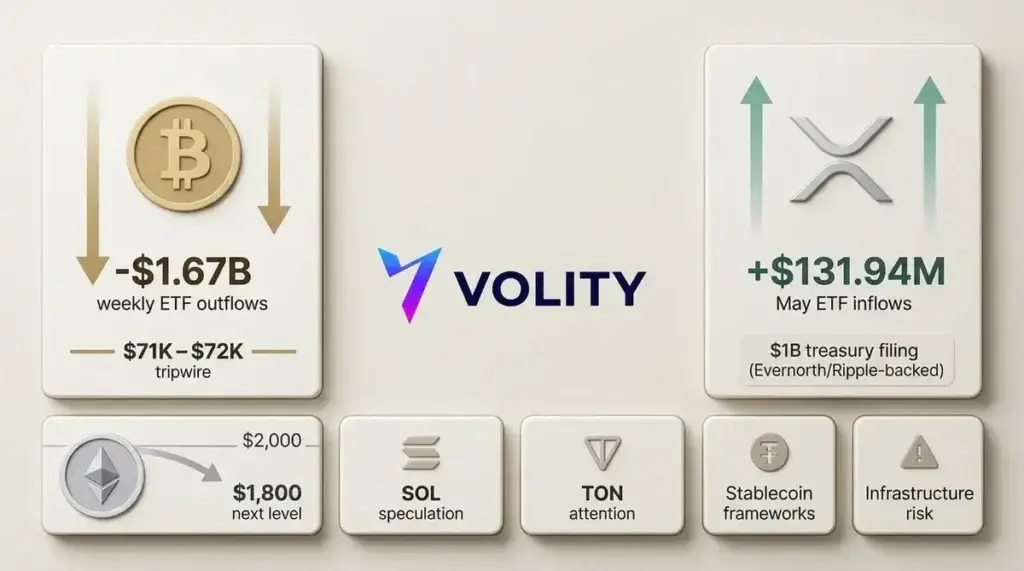
Bitcoin funds have just suffered their worst outflows of 2026. CoinShares data show about $1.67 billion left crypto investment products in one week, led by bitcoin vehicles.
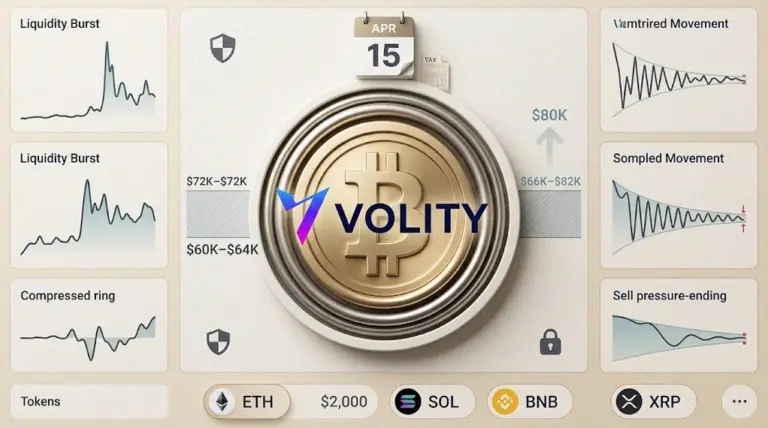
However, the price has not cracked properly. Traders still mark the main battlefield near $71,000 to $72,000. That zone now acts as the tape’s tripwire.
A clean break below $72,000 would likely flush crowded longs. Options desks would expect more hedging and wider implied volatility. Above that level, dip buyers still have room to defend the trend.
Technicians now describe bitcoin as trapped in a bearish channel. Still, the broader structure has not fully rolled over. Spot prices in the low-to-mid $70,000s keep the long-cycle bulls alive, if less loud.
Related coverage on Volity
- Bitcoin Price Holds $73k as ETF Outflows, US Clarity Act Bite
- AI Stocks Today: QQQ Market Radar on China Risk & Rates
- Bitcoin Price Today: Trump, MiCA and Hacks Shake Crypto
- Stock Morning Note: SNOW, CRM, NOK Setups
- Bitcoin Price: BTC Eyes $82,100 as Banks Back Crypto
By the Numbers
- $1.67 billion: weekly outflows from crypto investment products.
- $71,000-$72,000: bitcoin’s near-term support band.
- $131.94 million: May inflows into XRP ETFs.
- $300 billion: approximate size of the stablecoin market.
- $68.3 million: reported crypto hack losses in May.
XRP Gets the Flow, Bitcoin Gets the Doubt
While bitcoin funds leaked, XRP ETFs pulled in about $131.94 million in May. That beat both bitcoin and ethereum products for the period.
The move matters because XRP’s spot performance has not dazzled. Yet regulated wrappers seem to have changed the conversation. For allocators, XRP now looks less like courtroom debris and more like a traded policy bet.
Meanwhile, Ripple-backed Evernorth has amended filings for a planned $1 billion XRP treasury. If completed, that vehicle would become a large structural holder of the token.
Still, traders should ask boring questions first. Lockups, governance, custody and reporting will decide whether the treasury stabilises XRP or merely adds another headline.
- Trading signal: persistent ETF inflows can tighten spot liquidity faster than casual traders expect.
- Main risk: XRP remains heavily narrative-driven, despite its more settled legal status.
- Watch next: whether derivatives markets reprice XRP tail risk against bitcoin and ethereum.
Ethereum Fades, Solana Waits, Stellar Plays the Compliance Card
Ethereum has slipped back below $2,000, while traders eye $1,800 as the next magnet. That weakness keeps the BTC/ETH trade tilted towards bitcoin.
However, ethereum’s problem is not only technical. It sits in an awkward middle. It is too large for wild upside tales, yet not accepted like bitcoin as a macro hedge.
A reclaim of $2,000 to $2,100 would steady nerves. Conversely, a sustained break below $1,800 would revive talk of a longer consolidation.
Solana offers the opposite tension. Speculation over spot SOL products gives it institutional sparkle. Yet an ETF could also import the same crowding that now troubles bitcoin funds.
SOL remains a high-beta wager on risk appetite. Its apps, meme coins and DeFi venues still draw fast money when markets brighten. But without fresh fund access, organic fees must carry more weight.
Stellar is taking a quieter route. Its backers frame XLM as a compliance-first payments bet through 2030. That pitch sounded dull during the ICO years. Now, with stablecoins under political scrutiny, dull has value.
Telegram Revives the Super-app Trade
TON is again drawing attention after Telegram moved to tighten its role around the network. That changes the market’s mental model.
Most blockchains must buy distribution one campaign at a time. Telegram already has a vast messaging base. If it links chat, payments, mini-apps and games cleanly, TON becomes a direct bet on user conversion.
However, regulators will not ignore that ambition. A private messaging app with financial rails invites questions about payments, custody and sanctions controls. For traders, TON now carries execution risk and political risk in the same wallet.
Stablecoins Become Official Business
Stablecoins have moved from nuisance to infrastructure. In Washington, the GENIUS Act has pushed dollar tokens closer to the banking system. That shift favours cleaner, regulated coins such as USDC.
Across the Atlantic, ECB official Isabel Schnabel has argued that a digital euro is needed. Her concern is simple. If Europe waits, dollar-linked private coins could dominate everyday digital payments.
Meanwhile, Fed Governor Christopher Waller has offered a different angle. He has suggested dollar stablecoins could extend American monetary reach abroad.
That matters for markets. If policymakers bless regulated stablecoins, capital will migrate towards bank-friendly rails. As a result, DeFi yields around safer coins may compress. Lower risk rarely keeps paying the old coupons.
- Likely winners: regulated stablecoins, compliant payment chains and audited custodians.
- Likely pressure: offshore dollar tokens with weak transparency.
- Macro angle: dollarisation may increasingly travel through APIs, not suitcases.
Binance and Neobanks Chase the Same Customer
Binance has also widened the fight by entering U.S. stock trading. Its platform now offers access to roughly 7,000 equities, alongside crypto trading and yield products.
That move shows where fintech is heading. Banks are adding crypto. Crypto platforms are adding stocks. Meanwhile, neobanks want the payment account, the brokerage account and the trading habit.
Fees will probably fall further. However, the real prize is not zero-commission trading. It is recurring revenue from payments, lending, staking, custody and tokenised securities.
For investors, volume alone is a weaker valuation anchor. The better question is stickiness. Which platform becomes the daily financial screen?
Security Improves, but Bridges Still Creak
May brought one welcome number. CertiK reported crypto hack losses of $68.3 million, down about 90 percent from the prior month.
That looks reassuring. Still, the plumbing remains fragile. A $5.4 million drain on Gravity Bridge forced a halt of the Ethereum-Cosmos link.
Separately, Sui’s version 1.72 problems contributed to three outages before a fix. An exploit routed through the Zodiac delay module also pushed some users to exit Gnosis Pay.
Lower headline hack losses do not equal safety. Bridges, chain upgrades and payment layers remain the market’s weak joints. Position sizing should reflect that.
How to Trade This Tape
- Respect flows. Bitcoin still leads the asset class, but ETF outflows have changed the near-term balance.
- Do not dismiss XRP. Fund inflows and treasury plans can move liquidity, even when spot traders sneer.
- Use levels, not slogans. Bitcoin’s $71,000-$72,000 band and ethereum’s $1,800 level matter now.
- Prefer clean rails. Regulation is becoming a catalyst for stablecoins, custodians and compliant payment networks.
- Price the plumbing. Bridges and upgrades can turn a sound thesis into a forced exit.
The market is choppy because capital is choosing new favourites. Bitcoin still wears the crown. Yet the next trade may belong to the rails beneath it.