Crypto week: etfs thaw, tether squeezed, politics crash the party
Crypto enters the weekend with relief in one hand and a subpoena-shaped cloud in the other. Bitcoin ETF flows have finally turned positive. Tether is losing room in Europe. Meanwhile, politics has barged into token markets with its shoes on.
For traders, this was not a clean risk-on week. It was a market of pauses, tests and selective bids. Flows mattered as much as candles. Regulation mattered as much as resistance levels.
Bitcoin
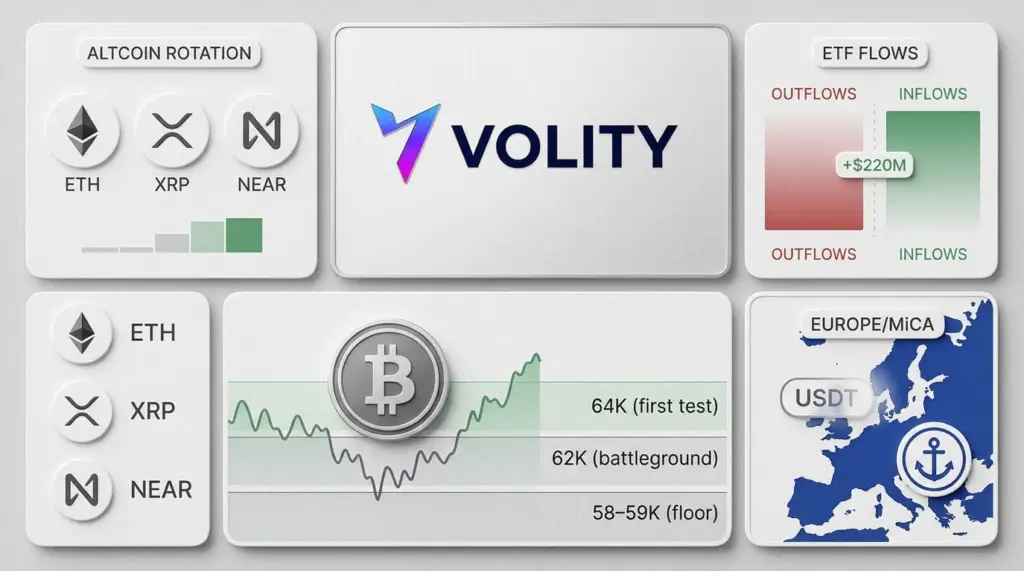
U.S. spot Bitcoin ETFs snapped a 10-day outflow streak with about $220 million in net inflows. Bitcoin found enough support to reclaim the low-$62,000 area after dipping below $58,000 earlier this month.
The bounce helped sentiment. However, it did not erase the damage from May and June. ETF redemptions had dragged on the market for weeks, with heavy withdrawals hitting funds after a strong spring run.
Earlier in May, Bitcoin briefly pushed back towards the $80,000 area after nine straight ETF inflow days. Those funds pulled in roughly $2.7 billion during that stretch. Then the tape turned cold, and the bid vanished quickly.
For now, traders are watching three zones:
- $58,000 to $59,000: the near-term floor tested in late June.
- $62,000: the current battleground for spot buyers and short-term funds.
- $64,000: the first serious upside test before bulls can talk about the mid-$70,000s.
Still, one inflow day does not make a fresh bull leg. ETF data needs to build a pattern. Otherwise, this remains a relief bounce dressed as confidence.
Altcoins
While Bitcoin dominated the screen, several large tokens quietly outperformed. Ethereum traded near $1,750, helped by stronger DeFi activity and a cluster of technical buy signals.
Meanwhile, XRP flashed a Supertrend buy signal, giving momentum traders a cleaner setup than Bitcoin offered. Some desks are watching for a roughly 14% move if buyers hold the signal.
NEAR also caught attention after Bitwise refiled for an ETF structure that includes staking. That matters because yield is becoming part of the institutional pitch. The next generation of crypto funds may sell income, not just exposure.
Worldcoin added a more speculative note. It broke out of a bearish channel and pushed towards its 50-day moving average. For short-term traders, that gives a clear line for invalidation.
However, the rotation still looks selective. Capital is moving first into liquid majors and credible layer-one names. It has not yet sprayed across the speculative tail.
Regulation
Europe’s MiCA regime has moved from paperwork to market structure. Revolut has dropped Tether’s USDT for EU users, cutting a major retail route into dollar liquidity on-chain.
That decision shows how stablecoin rules can reshape trading behaviour without a dramatic ban. If a large app removes a token, liquidity fragments. Then spreads change, funding shifts and users migrate.
At the same time, Standard Chartered secured a MiCA passport. That gives the bank a clearer path across the bloc. It also gives well-capitalised firms a regulatory moat against smaller rivals.
Stripe’s Bridge unit has also gained MiCA and e-money permissions in Europe. The compliant on-ramp race is becoming a bank-and-fintech contest, not a crypto-native free-for-all.
Meanwhile, ESMA has warned Polymarket that its prediction-market structure may breach EU rules. A retail clampdown would not surprise many lawyers. Still, it would sting a sector that has thrived on political volatility.
United states
In Washington, the CLARITY Act failed to deliver its hoped-for pre-July 4 breakthrough. The bill aims to define when crypto assets count as commodities or securities.
The House has pushed versions of the legislation forward with bipartisan support. However, the Senate remains caught between agency turf fights and deeper philosophical arguments.
Markets had quietly priced in some chance of a cleaner path. The delay therefore keeps a headline-risk discount on many altcoins, especially those exposed to U.S. trading and custody rules.
Institutional allocators will not disappear. Yet many will wait for sharper definitions before adding size outside Bitcoin and Ethereum. Custody, staking and token classification still sit in a legal fog.
One small opening remains. Some law-enforcement groups that opposed parts of the bill have softened their objections. That removes one obstacle, though not the larger Senate bottleneck.
India and brazil
Outside the U.S. and Europe, regulators are taking a harder line. India’s central bank has called for ring-fencing and prohibition of crypto assets across regulated finance.
If adopted, that approach would keep banks and financial firms away from crypto and private stablecoins. Fiat on-ramps would face fresh pressure in one of the world’s largest markets.
Brazil is also tightening. New rules raise capital requirements for exchanges and service providers. That may strengthen the market over time, but it will probably force consolidation first.
For investors, the map is no longer simple. Europe is building a licensed corridor. India wants distance. Brazil wants thicker balance sheets. Meanwhile, the U.S. still wants a dictionary.
Tether
Tether sits at the centre of several stories at once. In Europe, USDT faces practical exclusion from major retail channels under MiCA. In Britain, political scrutiny has added another layer.
Nigel Farage faces watchdog attention over alleged lobbying connected to the stablecoin issuer. The political details may take time to settle. However, the market question is simpler: does USDT lose meaningful liquidity?
So far, there is no sign of a hard peg break. Traders continue to use USDT heavily across offshore venues. Still, the direction of travel is clear.
Over time, regulated stablecoins may take share in Europe and other licensed markets. Tether can remain huge and still lose prized distribution in bank-linked retail channels.
Crime and security
This week also reminded investors that crypto risk does not live only in price charts. Operational failures and outright fraud continue to drain users.
- French police dismantled a $1.8 million crypto villa scam involving a fake luxury property deal.
- Indian authorities are probing Myanmar camps linked to forced-labour crypto fraud operations.
- Gnosis Pay disclosed a hidden flaw behind a $1.5 million hack.
- U.S. prosecutors charged an alleged teen member of Scattered Spider over a crypto ransom scheme.
None of these events looks systemic. However, they strengthen the regulatory case for tougher custody, disclosure and consumer-protection rules.
For funds, that means compliance-heavy venues gain appeal. For individuals, it means basic security still beats chasing extra yield on obscure platforms.
Politics
The strangest corner of the week came from political tokens. Donald Trump’s official memecoin has reportedly generated about $636 million for him on paper. Buyers, meanwhile, have collectively sat on losses near $3.8 billion.
Trump has said he did not know about a separate $1.4 billion crypto windfall tied to his brand. Still, the optics have pulled lawmakers towards a new fight.
Senator Kirsten Gillibrand is pushing a crypto ethics framework for elected officials. The plan would restrict how politicians launch, promote or trade tokens linked to their public persona.
For traders, the message is practical. Politically linked memecoins behave like leveraged bets on headlines. One investigation, one rally speech or one filing can swamp the chart.
Infrastructure
Behind the noise, larger finance firms keep laying tracks. Germany’s DZ Bank is rolling out crypto trading access across local banks, putting digital assets closer to mainstream savers.
BTSE has launched a regulated crypto platform in Indonesia. That gives the exchange a licensed foothold in a young, mobile-heavy market with deep retail interest.
On-chain, XRPL continues to develop institutional DeFi tools. That may sound less dramatic than memecoin fireworks. However, predictable rails are what large pools of capital usually demand.
Key takeaways
- Track ETF flows daily. Bitcoin needs sustained inflows, not a single green print.
- Respect the $58,000 floor. A break below it would weaken the bounce.
- Diversify stablecoin exposure. MiCA shows distribution risk can arrive quickly.
- Price political tokens as event trades. Headlines can overwhelm liquidity.
- Watch licensed infrastructure. Banks and fintechs are shaping the next adoption cycle.
The weekend setup is therefore uneasy but tradable. Bitcoin has stopped bleeding through ETFs. Altcoins have pockets of strength. Yet regulation, politics and stablecoin pressure now sit directly in the order book.
Related coverage on Volity
- How to Avoid Crypto Scams: A Beginner Safety Checklist
- How to Choose a Trading Platform: A 10-Point Checklist
- Demo vs Live Trading Account: A 7-Step Checklist Before You Go Live
- How to Size a Trade: Position Sizing and Risk Per Trade for Beginners
- Risk-Reward Ratio Explained: How to Set It and Why It Matters
- ETF vs Index Fund: The Difference and Which to Pick