Crypto Market Today: Bitcoin Forks, BNB Charts and Vietnam’s Tokenised Loans
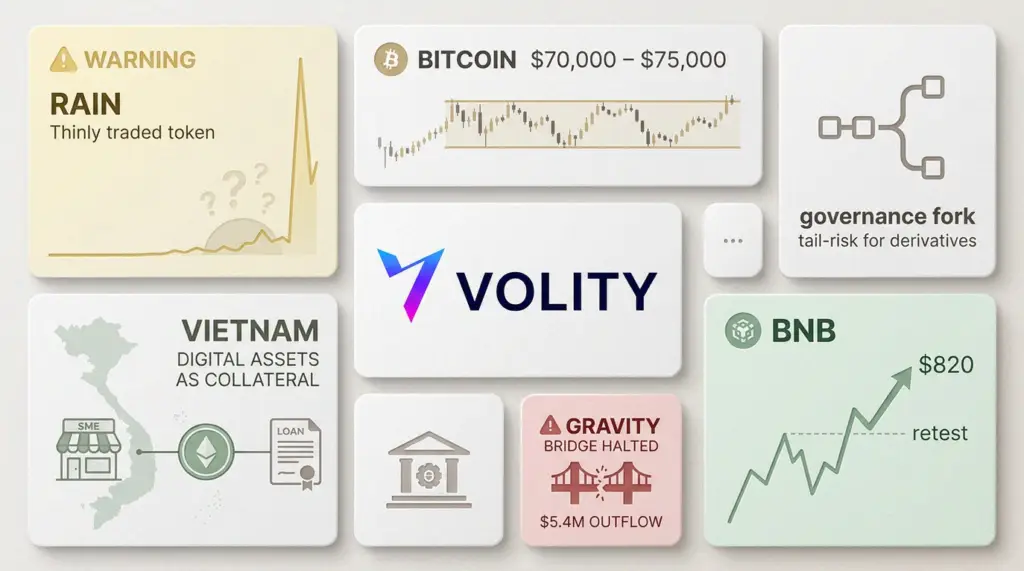
Crypto ends the week jumpy, but far from dull. Bitcoin remains boxed between roughly $70,000 and $75,000. Meanwhile, pockets of the altcoin market keep producing sharp rallies, sudden scandals and familiar warnings.
For traders, the tape now has two competing stories. On one side, regulation, exchange products and tokenisation look more serious. However, speculative tokens, bridge exploits and “AI arbitrage” schemes still smell like late-cycle excess.
Bitcoin Fork Debate Returns
The bitcoin community has reopened an old wound: forks, censorship and who controls the protocol. Adam Back, the Blockstream co-founder, dismissed claims that BIP-110 could enable transaction censorship.
Critics argue that consensus changes may give miners or developers more influence over block inclusion. However, supporters see the concern as overstated and technically confused.
Markets usually dislike this kind of argument. Protocol politics can feel abstract, until it hits derivatives pricing. Any return of “soft fork”, “hard fork” and “chain split” headlines deserves attention.
Spot holders may shrug. Still, options desks and leveraged traders rarely ignore tail risk around bitcoin governance.
RAIN Surges, Then Meets the Chain Detectives
The token RAIN became the day’s warning label. Its market value reportedly ran towards about $9 billion in hours. Almost immediately, on-chain investigator ZachXBT flagged concerns about insider activity and unfair distribution.
The pattern feels painfully familiar. A thinly watched token suddenly gets attention. Then its market value outruns order-book depth. Finally, wallet clusters begin telling a less flattering story.
That does not make every fast rally fraudulent. However, it does make risk management non-negotiable. If liquidity cannot support the valuation, treat the move as a trade, not an investment case.
BNB Points to $820, but Needs Confirmation
BNB has broken from a classic cup-and-handle formation, according to technical traders. The bullish target now sits near $820, if momentum holds.
That matters because BNB is not a microcap sideshow. It remains one of crypto’s bigger market bellwethers. A clean breakout can lift appetite for other large layer-1 tokens.
However, technicians will watch the retest more than the headline target. A failure back below the handle zone would weaken the setup quickly.
Bitcoin Balances Fear and FOMO
Bitcoin itself remains caught between buyers defending $71,000 and bulls eyeing another push towards $75,000. Robert Kiyosaki has warned that the dip could become a trap for buyers chasing fear of missing out.
Forecasts for 2026 remain wildly scattered. Some models keep bitcoin near current levels. Others stretch the possible range from about $60,000 to nearly $500,000 a coin.
That spread says more about uncertainty than precision. Traders should plan ranges, not worship single price targets. Leverage also needs restraint, since liquidations do not respect long-term conviction.
XRP Gets Flows, ETFs and a Harder Political Edge
XRP has a rare cluster of positive drivers. Coins have been leaving centralised exchanges, which traders often read as reduced sell pressure. Meanwhile, XRP-linked ETF products are gaining traction, with large institutions disclosing positions.
Institutional interest changes the character of the trade. However, another comment added a sharper edge. One XRP Ledger architect said the network could “go underground” if governments turned hostile.
That language helps the decentralisation argument. Still, it also reminds investors that the regulatory fight never fully disappeared. For XRP, volatility looks more like a timetable issue than a possibility.
Cardano Shows the Cost of Missed Events
ADA took a different kind of hit. The cancellation of the Cardano Summit 2026 hurt sentiment and pushed analysts to discuss downside risk near $0.113.
Code was not the issue. Expectations were. Conferences often matter because markets price possible announcements before the stage lights come on.
So, when a major event disappears, traders do not just remove one catalyst. They also start asking whether something inside the ecosystem has gone wrong.
Vietnam Tests Crypto as Working Capital
Vietnam may deliver the most interesting real-world story of the day. Regulators are considering whether small and medium-sized businesses can use digital assets as collateral for bank loans.
If adopted, the model would push crypto beyond trading screens. Tokenised holdings could become working capital for companies that struggle with traditional credit access.
For investors, the implication is clear. Custody, tokenisation and regtech companies could gain from this sort of policy experiment. Meanwhile, local tokens tied to compliant infrastructure may attract a valuation premium.
Gravity Bridge Reminds Traders What Can Break
Gravity Bridge, which links Ethereum with the Cosmos ecosystem, halted after about $5.4 million left the system. Cross-chain bridges remain among crypto’s most useful and fragile structures.
The market impact can travel quickly. First, liquidity routes narrow. Then related tokens trade with a friction discount. Finally, regulators get another example for their DeFi risk files.
Portfolio managers should map bridge exposure, not just token exposure. A position can look diversified while depending on one weak transfer route.
Washington Keeps the Market Waiting
In the United States, Senator Cynthia Lummis warned that failure to pass the CLARITY Act could delay meaningful crypto legislation until around 2030.
At the same time, the CFTC approved the first bitcoin perpetual futures on a regulated American exchange. That gives institutions another way to trade crypto exposure inside familiar market plumbing.
However, not everyone wants traditional markets to copy crypto’s 24-hour rhythm. Some CFTC voices argue that not every derivatives market suits round-the-clock trading.
JPMorgan, led by Jamie Dimon, has also criticised the CLARITY Act. The bank points to deposit risks if crypto products pull money away from the regulated banking system.
Politics Adds a Premium, and Some Danger
Texas is advancing plans for a state bitcoin reserve, while federal efforts remain stuck. That deepens the “states versus Washington” split in American crypto policy.
Meanwhile, Iran has tightened crypto controls, and the United States has targeted wallets linked to the IRGC. Such moves strengthen bitcoin’s image as a geopolitical asset.
However, they also raise sanctions risk for exchanges, brokers and custody providers handling grey-market liquidity.
By the Numbers
- $70,000-$75,000 – bitcoin’s rough trading box in the current debate.
- $9 billion – reported peak area for RAIN’s sudden market value surge.
- $820 – technical target cited for BNB after its breakout.
- $5.4 million – estimated Gravity Bridge outflow before the halt.
- $20 billion – monthly volume scale linked to Wintermute’s prediction-market push.
Related coverage on Volity
- Bitcoin Price Holds $73k as ETF Outflows, US Clarity Act Bite
- AI Stocks Today: QQQ Market Radar on China Risk & Rates
- Bitcoin Price Today: Trump, MiCA and Hacks Shake Crypto
- Stock Morning Note: SNOW, CRM, NOK Setups
- Bitcoin Price: BTC Eyes $82,100 as Banks Back Crypto
Key Takeaways
- Separate plumbing from noise. CFTC products, tokenised collateral and custody rules matter more than meme rallies.
- Watch bitcoin’s range. A clean break from $70,000-$75,000 could reset risk across altcoins.
- Treat thin surges carefully. RAIN-style moves reward speed, but punish slow exits.
- Check bridge exposure. Cross-chain risk can hide inside apparently diversified portfolios.
- Trade regulatory dates. CLARITY Act headlines, ETF flows and CFTC decisions can move liquidity fast.
Crypto is becoming more institutional and more speculative at the same time. That is uncomfortable, but tradable. The trick is to use the casino without mistaking it for the bank.