The AI Trade Spreads Beyond Chips
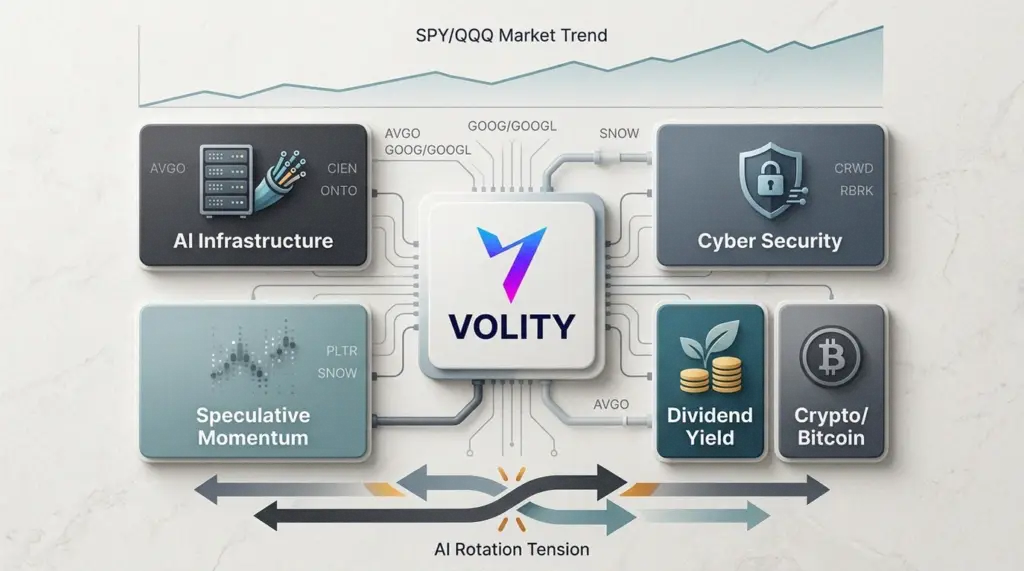
SPY and QQQ are edging higher, but the calm at index level flatters the tape.
Underneath, traders are fighting over four familiar pools of money: AI infrastructure, cyber security, speculative momentum and dividend yield. Bitcoin’s strength has also woken up the crypto equities, with Coinbase once again trading like a leveraged mood ring for digital assets.
However, the market’s favourite word is doing most of the work. “AI” is no longer just a label for chipmakers. It now covers optical networks, power supply, data storage, security software and anything else that helps keep the machine running.
Ai Plumbing Gets a Harder Look
Broadcom, ticker AVGO, remains a central stock in the AI infrastructure trade. Yet its shares slipped after investors questioned AI revenue guidance and fresh downgrade chatter hit sentiment.
That reaction says more about expectations than demand. Broadcom had been priced for near-perfect execution. Any hint of front-loaded orders or uneven customer spending quickly turns into volatility.
For short-term traders, AVGO now offers a clean sentiment test. If buyers defend weakness, the market still believes in the AI data-centre cycle. If not, the stock may need another reset.
Alphabet, through GOOGL and GOOG, faces a different problem. Investors still like the company’s AI reach across search, cloud and custom chips. However, they are less relaxed about the bill.
Heavy data-centre spending, rising chip costs and stock-based pay all weigh on the debate. As a result, Alphabet has become a referendum on how much profit investors will sacrifice for scale.
Meanwhile, Snowflake, ticker SNOW, is being reintroduced to the market. It is no longer just a data warehouse story. Instead, analysts increasingly frame it as an AI-enabled data platform that must prove operating leverage.
That shift matters. Snowflake will now trade on AI product adoption, large customer behaviour and the path to profitability. It is a slow repricing, not a single-day fireworks show.
Ciena, ticker CIEN, offers a quieter version of the same theme. Faster AI data centres need more optical capacity and cleaner routing. Price-target increases around the stock have a practical logic.
It lacks the glamour of GPUs. Still, data cannot sprint through bottlenecks, however powerful the chips become.
Onto Innovation, ticker ONTO, also drew fresh attention after a new Buy initiation with a punchy target. The appeal is simple. Advanced AI chips require tougher wafer inspection and process control.
In this market, that is enough to matter. New coverage, a defined target and a credible link to chip manufacturing can move money fast.
Power and Materials Join the Story
Daqo New Energy, ticker DQ, brings a more speculative edge. The solar polysilicon group has talked up its role in electrical infrastructure for AI data centres.
The angle is not fantasy. AI needs power, and power needs materials. However, Daqo remains a cyclical, China-exposed solar supplier before anything else.
That distinction matters for investors. Traders may chase the AI label, but margins, policy and polysilicon pricing still drive the bus.
Security Turns Into an AI Cost Trade
Palantir, ticker PLTR, has found a timely theme: the cost of AI. Its leadership has criticised inefficient token usage and promoted cheaper deployment.
That message lands well now. Investors have shifted from admiring AI demos to counting AI bills. As a result, Palantir can pitch itself as the company that makes enterprise AI less wasteful.
CrowdStrike, ticker CRWD, still has a strong cyber security franchise, but the stock sold off after earnings, as high-growth names priced for perfection often do.
The bigger story remains intact. AI makes attackers faster, but it also strengthens defence platforms. Traders will watch whether CRWD forms higher lows after the post-print break.
Rubrik, ticker RBRK, fits the same security stack. Street work pointing to roughly 20% upside has helped the data-protection name.
As companies push more information into cloud and AI pipelines, backup and recovery become less optional. Meanwhile, ransomware risk keeps boards attentive and budgets alive.
Planet Labs, ticker PL, shows the other side of growth. The space-data company reported record revenue, but a stock offering around $1.5 billion quickly cooled enthusiasm.
Investors must now weigh ambition against dilution. The product story has appeal. However, fresh supply tests whether buyers truly believe scale can outrun capital needs.
Speculation Refuses to Leave
Bio Green Med Solution, ticker BGMS, jumped more than 170% after a business combination announcement with a Malaysian waste-technology player.
Moves like that rarely trade on calm analysis. They trade on flow, scarcity and the hope of a multi-day squeeze. They belong mainly to fast intraday traders.
Plug Power, ticker PLUG, remains a survival trade wrapped in an energy transition story. A liquidity-focused tax credit sale did little to settle nerves.
Every financing update now raises the same question. How many more deals will the company need before the balance sheet feels durable?
BlackBerry, ticker BB, has also re-entered the momentum conversation. The stock recently reached fresh 52-week highs, then started to back off.
Now the chart matters more than the press release. If BB holds above its breakout area, bulls can argue for healthy profit-taking. If not, another speculative spike may fade.
Coinbase, ticker COIN, is again moving with bitcoin’s pulse. When crypto rallies, equity traders often use COIN as their cleaner brokerage-account expression.
Analyst target changes can intensify that move. However, bitcoin momentum remains the real driver. If BTC cools, COIN usually feels the draft quickly.
Consumer and Income Names Move to Their Own Beat
Lululemon, ticker LULU, is trading through the usual post-earnings argument. Bulls still see a premium brand with loyal customers. Bears see tougher competition and stretched household budgets.
For now, the chart may decide the argument first. Support and resistance around the post-print move will show whether institutions are buying the dip.
PVH, ticker PVH, faces a slower grind. A cluster of lower price targets has added pressure, even without a dramatic company-specific shock.
That pattern can still hurt. When analysts recalibrate together, sentiment often weakens before earnings estimates fully move.
Income trades are also attracting attention. Plains GP Holdings, ticker PAGP, and other yield names, including RHI, GSL and AINV, offer a different pitch.
While growth stocks fight over AI spending, dividend seekers still want cash flow. Midstream energy looks attractive when assets are steady and bond yields wobble.
Still, income does not mean safety. Staffing, shipping, pipelines and business development companies carry very different risks, even when their yields look tempting.
By the Numbers
- 170% plus: BGMS rose after announcing a business combination.
- $1.5 billion: Planet Labs’ stock offering tested appetite after record revenue.
- 20%: Approximate upside flagged in supportive Rubrik research.
- 52-week high: BlackBerry reached that level before pulling back.
- Four trades: AI infrastructure, cyber security, crypto momentum and dividend yield dominate today’s tape.
Related coverage on Volity
- Stocks to Watch: AVGO, CIEN, MARA as Clean Catalysts Win
- Bitcoin Price Dips as ETF Outflows Hit Crypto Markets
- CrowdStrike (CRWD) Leads AI Cyber Rally as Funding Risk Bites
- Bitcoin Price Eyes $73k as Regulation, Stablecoins Bite
- AI Stocks to Watch: NVDA, TSM, CRWV and MRVL in Focus
Key Takeaways
- AI is broadening: Money is moving beyond chips into networks, power, data and security.
- Capex matters: Alphabet shows that investors still care about spending discipline.
- Momentum is fragile: BGMS, BB and PLUG can move violently on thin conviction.
- Crypto leads COIN: Coinbase remains tightly tied to bitcoin’s direction.
- Yield needs scrutiny: Big payouts help, but balance-sheet risk still counts.
The market is not chasing every AI mention blindly. It is sorting between companies that sell real capacity and those borrowing the glow. That sorting process can be messy, sharp and profitable for traders who respect the difference.