You want gold exposure, and you are stuck on one fork: buy a real bar or coin you can hold, or buy a gold ETF that tracks the price from inside your trading app. Neither one wins in the abstract. The right pick depends on how much you are putting in, how long you plan to hold, and whether holding the metal actually matters to you. By the end you will run a simple three-question rule and walk away with a format and a first move.
TL;DR / Quick insight: Physical gold means you own the metal and arrange storage and insurance. A gold ETF means you own a share of a fund that tracks the gold price – no metal to store, but no title to a specific bar either. Savers who want the real thing lean physical; people who want easy buying, selling and a small start lean ETF; active traders chasing a shorter move have a third route, a gold CFD. Practise any of them on a free Volity demo first.
Gold gets framed as a “safe” choice, but that label hides a real decision. The format you choose changes your costs, your access to the money, and what you legally own. Most guides on this are written by bullion dealers whose “verdict” points at whatever they sell. We sell no metal, so this stays neutral.
The one-line difference between the two
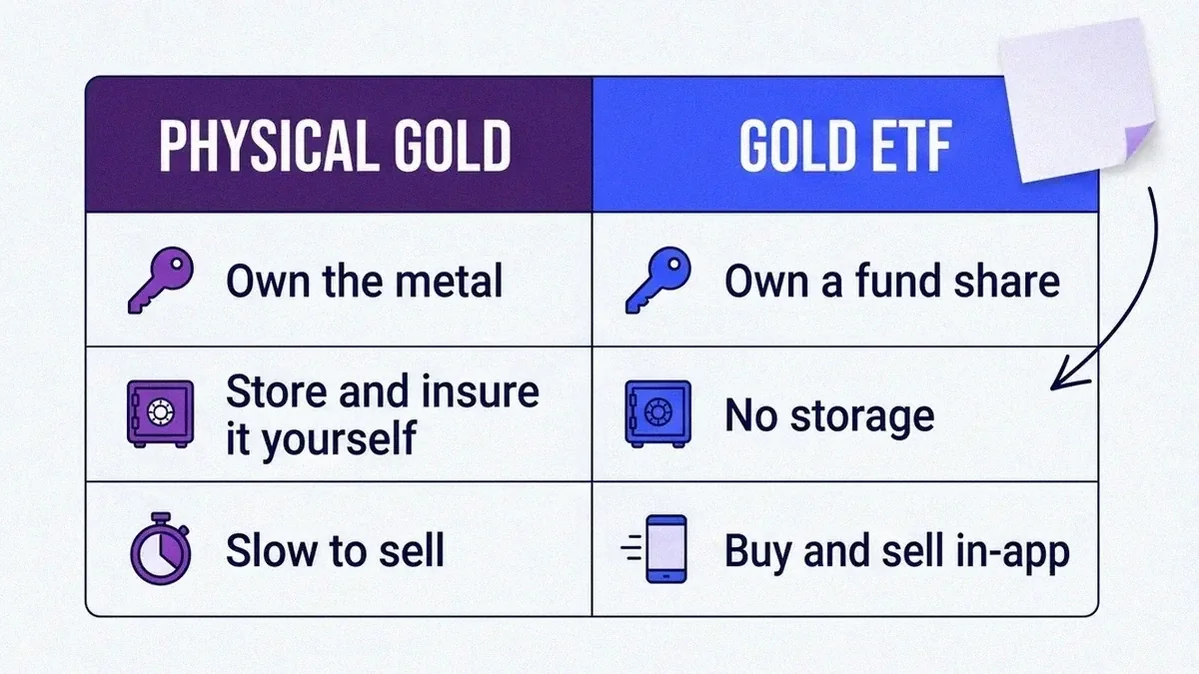
Physical gold is the metal in your hand: a coin or bar that is yours, stored somewhere you control. A gold ETF (Exchange-Traded Fund, a basket you buy and sell like a normal stock) is a share in a fund that holds gold and tracks its price, so your share rises and falls with gold without you ever touching metal.
Think of physical gold as the vinyl record you own and store. A gold ETF is the streaming subscription playing the same music – instant access, no disc to call yours. Before you read on, write down which one you instinctively want and why.
Count the real cost of holding physical gold
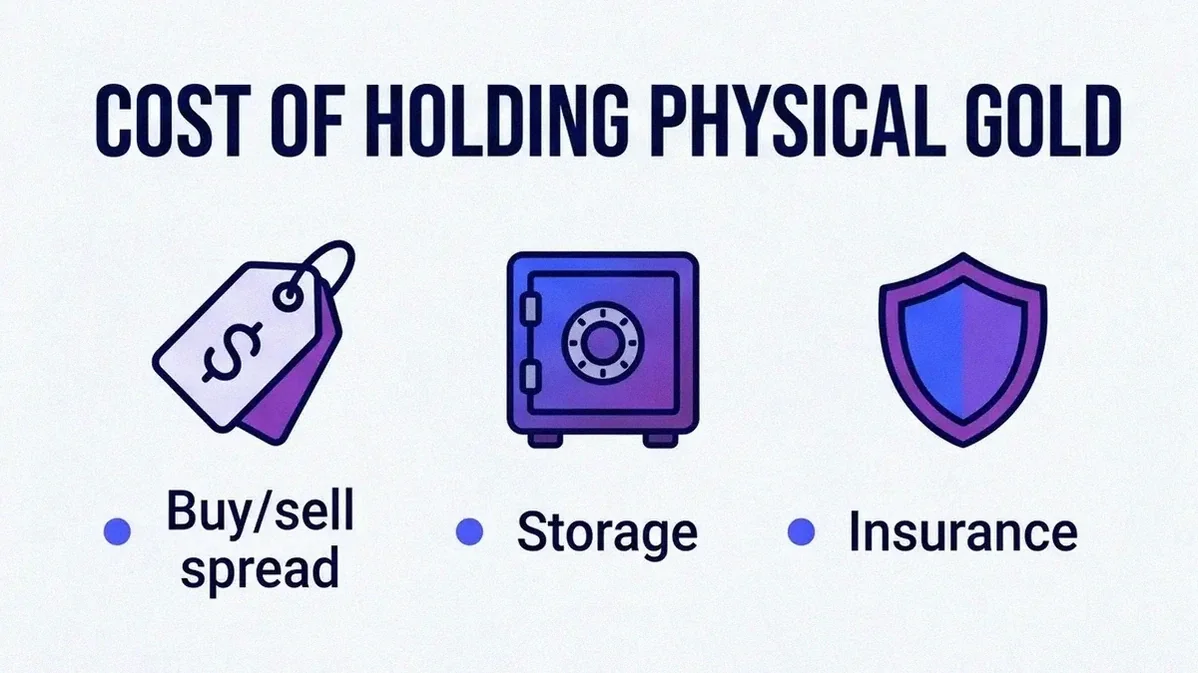
Buying a coin or bar is easy. Holding it is where the costs hide, and beginners tend to miss a few. The buy/sell spread bites first: a dealer sells at one price and buys back lower, so you pay going in and again coming out. Then storage. A safe, a bank box or a vault each carry a cost. Then insurance, because metal at home is exposed to theft, fire and loss. Selling is slow on top of that, since you have to find a buyer.
So do not buy metal until you have answered two questions on paper: where you would store it, and who would buy it back. If either answer is fuzzy, lean ETF.
How a gold ETF works (and whether you really own the gold)
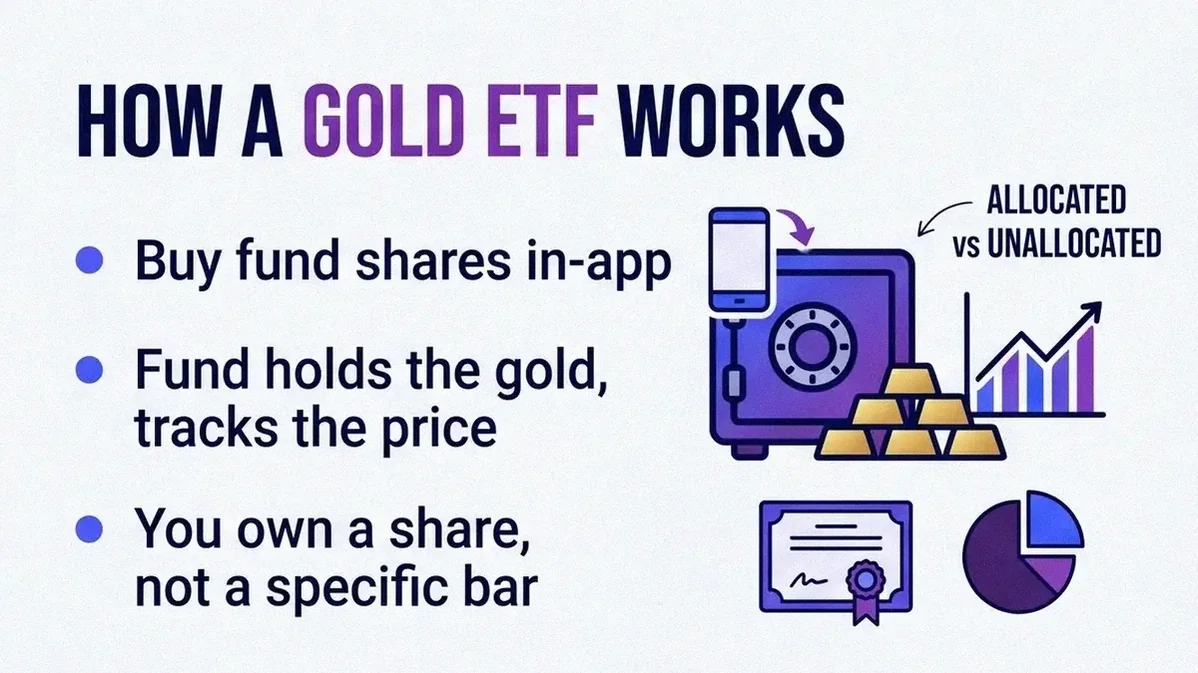
A gold ETF lives inside your trading app. You buy shares during market hours, the price tracks gold closely, and the fund handles the metal. No safe, no insurance, no hunting for a buyer. ETFs sit alongside the funds and shares in the stocks corner of the market, traded as easily as any listed share.
Now the question most dealer blogs dodge. Do you actually own the gold? You own a share of the fund, not legal title to a specific bar. That gap has a name: allocated gold means specific bars recorded as yours, while unallocated gold is a claim on pooled gold. Most retail holders sit closer to unallocated, and turning a unit back into metal is rarely practical.
So settle one thing now. Does physically holding the bar matter to you? Yes pushes you toward physical. No opens the ETF route, or a CFD for short moves.
Physical gold vs gold ETF, side by side
Here is the whole decision on one screen. Read down the rows, tick the one that matters most to you, then check the takeaway below.
| What you compare | Physical gold | Gold ETF |
|---|---|---|
| What you own | The metal – a coin or bar that is yours | A share of a fund tracking the gold price |
| Cost to hold | Buy/sell spread, storage and insurance | The fund’s annual fee, plus broker costs |
| Storage | You arrange it: safe, box or vault | Handled by the fund; nothing to store |
| Liquidity | Find a buyer; selling can take time | Buy or sell in market hours, near the price |
| Ownership | Direct legal title to the metal | Indirect; usually no title to a bar |
| Safety / risk | Theft, loss, spread; plus price risk | Fund and counterparty risk; plus price risk |
| Minimum to start | Higher – whole coins or bars | Lower – you can start small |
Quick read: if the row you ticked was ownership or “I want the bar”, physical takes it. If it was liquidity, storage or minimum to start, the ETF takes it. Both columns still carry price risk either way.
Do not try to win every row. Pick the single row that is your real priority and let that column lead.
The 3-question rule: long-term saver or active trader?
You can settle this in under a minute, and it is the part most guides skip.
The 3-question decision rule:
1. How much? Small starting amount → ETF. Larger committed sum → physical is on the table.
2. How long? Years, buy-and-hold → physical or ETF both work. A shorter move → think CFD.
3. Do you need to hold the bar? Yes → physical. No → ETF or CFD.
A long-term saver who wants the real thing leans physical. A convenience-first investor starting small leans ETF. An active trader belongs in the third lane below. If your answers disagree with each other, a split is the honest result.
The gold CFD route dealer blogs skip
If your answer was “ride a move, not store metal”, there is a route bullion sites never mention. A gold CFD (Contract for Difference – an agreement that pays you the difference between gold’s price when you open and when you close, without owning metal) lets you take a position on the gold price for a shorter move, with no bar and no fund to hold for years.
Here is the honest caveat. A CFD uses leverage, so you control a larger position than the cash you put down. Leverage cuts both ways. It can magnify a gain and just as easily a loss, so it suits deliberate short moves rather than long-term saving.
If a CFD is on your radar, do not open one with real money first. Practise on a free demo and feel how leverage moves your position. For the full menu, see our guide on how to invest in gold for beginners.
Your checklist to choose a gold format and start
Here is the whole article boiled down to a do-this list. Work through it in order.
- Write your gut pick, physical or ETF, and the reason behind it.
- Answer how much. A small start points to an ETF, while a larger sum keeps physical in play.
- Answer how long. Buy-and-hold fits physical or ETF, and a short move points to a CFD.
- Answer the bar question. If holding the metal matters, go physical; if not, an ETF or CFD.
- Read off your format by combining the three answers: physical, ETF, CFD, or a split.
- Open a free demo and practise. Place one practice gold or gold CFD position and watch how it behaves before any real money goes in.
- Go live small. Start with an amount you are comfortable losing, then scale as confidence grows.
With Volity you can do steps six and seven in one account. Gold and gold CFDs sit alongside shares, fractional shares and crypto, commission-free on the Markets account with dynamic spreads from 0.6 pip on Standard (a pip is the smallest increment a market moves in, so a tighter spread means less cost per trade). Every tier includes a free demo. OPEN A FREE VOLITY DEMO and place your first practice position.
Reviewed by: A. Bennett, Volity editorial desk.
Data integrity: gold and ETF mechanics here are general education described qualitatively, with no price, fund fee, premium, storage cost, return or tax figure stated. Volity product details (commission-free Markets trading, spreads from 0.6 pip, leverage up to 1:500 and crypto up to 1:50, a free demo on every tier) are verified against the published fee schedule.
Related Volity guides
- How to invest in gold for beginners
- ETF vs index fund: which to pick
- How much money do you need to start trading?
Frequently asked questions
Is physical gold or a gold ETF better?
Neither one wins in the abstract. It depends on how much you invest, how long you hold, and whether owning the actual bar matters to you. Run the three-question rule above to land on physical, ETF, a CFD, or a split.
Do you actually own the gold in an ETF?
You own a share of a fund that holds gold, not legal title to a specific bar with your name on it. That is the difference between allocated gold (specific bars recorded as yours) and unallocated gold (a claim on pooled gold). Turning a fund unit into metal is rarely practical for retail.
Which is cheaper to hold?
It is a trade-off. An ETF avoids storage and insurance but carries the fund’s annual fee, while physical avoids fund fees but adds storage, insurance and a dealer spread. Match the cost type to your own situation.
Can you convert a gold ETF into physical gold?
For most retail investors, not practically. Some structures let large holders redeem for metal, but that is rarely realistic at ordinary sizes. If holding real metal is the goal, buy physical.
Is there a way to trade gold short-term without storing it?
Yes. A gold CFD lets you take a position on the gold price for a shorter move without owning metal. It uses leverage, which can magnify both gains and losses, so it suits deliberate short-term moves with a plan rather than buy-and-hold saving. Practise on a free demo first.
Is gold itself a safe investment?
Gold gets called “safe”, but it carries price risk. It can fall as well as rise, and no format removes that. What changes between physical and an ETF is your cost, access and ownership, not whether the price drops.
What to do next
Run the rule, read off your format, then practise on a demo before going live small. One Volity account holds it all: shares, fractional shares, crypto, gold and gold CFDs, plus a $0 multi-currency wallet. Check the full fee schedule and account types, then OPEN A VOLITY ACCOUNT when you are ready.
Sources
This guide draws on the following public sources.
- World Gold Council – Gold ETF holdings and fund flow data
- Silver Institute – World Silver Survey, annual supply and demand
- World Gold Council – Gold Demand Trends, quarterly demand and supply data
- LBMA – LBMA Gold Price, the global benchmark and how it is set
- LBMA – LBMA Good Delivery standard for gold bars
- World Gold Council – Historical gold price data and performance
- U.S. Energy Information Administration – EIA petroleum supply, demand and price data
- U.S. Energy Information Administration – EIA natural gas storage, production and price series
- Silver Institute – Silver supply and demand fundamentals