Crypto morning: wedges, inflows and a regulator finally reads the room
Thursday’s crypto market feels restrained rather than sleepy. Prices are holding key floors, while institutional plumbing keeps expanding beneath them.
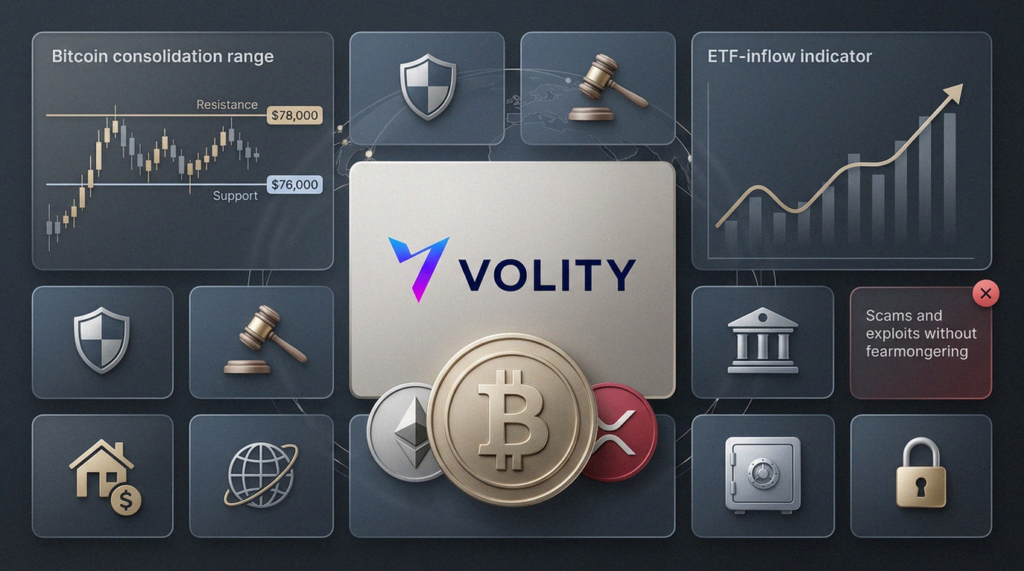
Bitcoin trades in the mid-$70,000s after buyers defended the $76,000 to $76,500 liquidity pocket. However, the recovery above $77,000 lacks much conviction.
Bitcoin coils near a decision point
The four-hour Bitcoin chart has formed a tightening falling wedge. Its lower boundary rises from $76,000, while overhead supply gathers near $78,000.
That pattern can precede an upside break. However, traders still need a close above $78,000 before treating it as more than chart geometry.
- First support: $76,000 to $76,500
- First resistance: $78,000
- Upside levels: $79,500, then $80,300
- Recent ETF flow: roughly $236.5 million of net outflows
ETF selling has softened the rebound. Therefore, Bitcoin remains a range trade until spot demand starts matching derivatives enthusiasm.
For now, the cleaner play sits at the range edges. Chasing candles in the middle risks paying for noise.
Ether holds $2,400, but momentum still drags
Ether has settled around $2,400. Yet it is holding that level rather than convincingly reclaiming it.
Its relative strength index remains bearish, which leaves buyers without a clear momentum signal. Meanwhile, spot demand has stopped a deeper decline.
That creates an awkward middle ground. Bears lack follow-through, but bulls have not forced short covering either.
For longer-term allocators, the question is not whether Ethereum has disappeared. Instead, it is whether the next catalyst comes from network activity or broader market liquidity.
XRP attracts patient ETF money
XRP stands apart from the two largest tokens. United States spot XRP ETFs have recorded 11 consecutive sessions of net inflows.
Those funds have attracted about $170 million since mid-August. Cumulative inflows since last November stand near $1.6 billion.
The timing matters. Investors kept adding while XRP surrendered part of its late-August advance.
That suggests some institutions view weakness as an entry point. It does not guarantee higher prices, although it gives XRP a sturdier bid than many smaller tokens.
However, the asset’s retail ecosystem remains littered with dubious income pitches. Promises of huge daily returns, automated profits and cloud-mining windfalls deserve immediate scepticism.
Washington sketches a route out of the grey zone
The Securities and Exchange Commission has proposed Regulation Crypto Assets. The framework would create defined fundraising routes for token issuers.
Its startup lane would allow raises of up to $5 million across four years. Crucially, it would not restrict participation to accredited investors.
A second fundraising lane would permit up to $75 million during any 12-month period. Tier 2 issuers would need audited accounts and continuing disclosures.
Non-accredited buyers would face a 10% cap of income or net worth under Tier 2. Meanwhile, tokens could avoid resale lockups under the proposed exemptions.
The proposal’s most important feature may be its safe harbour. A token could cease being an investment contract once promised managerial work ends permanently.
That would give project teams a clearer destination than years of legal argument. However, traders should remember that this remains a proposal with a comment period.
Licences tighten globally as institutions build
Australia has set September 30, 2026, as a licensing deadline for crypto firms. Thailand also plans a Travel Rule that would retain transfer records for five years.
Taiwan, meanwhile, is preparing stablecoin rules for possible introduction in the first quarter of 2027. The focus is shifting from exchanges towards settlement infrastructure.
Wyoming has adopted Chainlink Proof of Reserve for FRNT, a regulated product. Therefore, oracle-based verification is moving closer to conventional financial oversight.
Large institutions are following the same direction. Standard Chartered is rolling out institutional Bitcoin and Ether trading in the United Arab Emirates.
Elsewhere, Laser Digital and Keyring are bringing fixed-income instruments onchain through Euler. The pitch is straightforward: make credit and yield products programmable.
Securitize and Socios.com also plan tokenised equity for sports teams. That effort will test whether supporters treat club ownership as an investment or expensive fandom.
Security failures remain the industry’s hard floor
Fresh incidents offer a bracing counterweight to the infrastructure story. Ukraine has shut down an alleged investment scam with reported monthly turnover of up to $1 million.
A Coldcard wallet hacker used THORChain to swap stolen Bitcoin. Meanwhile, Cronos rolled back its chain after a $75 million hack.
The rollback matters beyond Cronos. It shows that some networks will rewrite transaction history when losses become politically intolerable.
Rain also suffered a contract exploit that drained about $1.1 million from card users. Ledger faces a $500 million lawsuit over alleged data breaches and related theft.
Operational security has become an investment variable, not a technical footnote. Custody, governance and recovery policies can change an asset’s risk profile overnight.
Traders still answer to the Federal Reserve
Above every token-specific story sits the Federal Reserve. Growing talk of a September rate increase has returned macro risk to the foreground.
A rate rise would tighten financial conditions and pressure leveraged positions. It could also curb ETF demand and structured-product issuance.
- Bitcoin: Respect $76,000 support and wait for confirmation above $78,000.
- Ether: $2,400 holds, but momentum has not yet turned constructive.
- XRP: Persistent ETF inflows offer relative support during pullbacks.
- Regulation: Clearer rules may favour established platforms and compliant issuers.
- Risk: Treat yield claims, custody arrangements and protocol governance as core diligence.
Today’s tape rewards patience over prophecy. Real capital is gathering around regulated products and market infrastructure, while weak structures keep breaking in public.