Investing in financial products involves risk. Losses may exceed the value of your original investment.
Bitcoin pullback hayes is a core topic for traders in 2026. The complete guide follows.
Crypto market slides on inflation nerves, while Hayes shops for yield
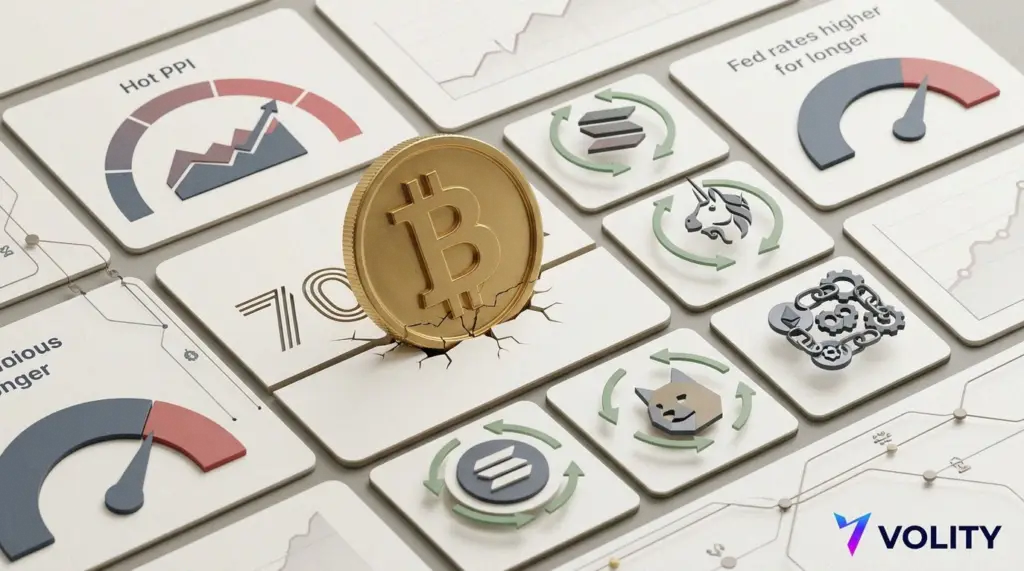
Bitcoin slipped under $70,000 on Thursday after a hotter producer price index print soured the rate-cut mood. Meanwhile, investors listened for reassurance from Federal Reserve chair Jerome Powell and heard none. The familiar trade returned fast: sell the risky bits first and ask questions later.
Bitcoin cracked through $74,000 support, then lost $72,000, before tagging the $70,000 handle. As it fell, the rest of the market followed in a grim, orderly line. However, the day’s story was not only the slide. It was also the buying, led loudly by BitMEX co-founder Arthur Hayes, who used the drawdown to add to decentralised finance tokens.
Sticky inflation re-prices the “easy money” script
Traders had entered the session hoping inflation would keep cooling and allow the Fed to start easing. Instead, producer prices ran hot and revived the fear of a longer stretch of restrictive policy. Crypto behaved less like a new asset class and more like a levered bet on liquidity.
Geopolitics added edge. Tensions around the Strait of Hormuz pushed oil higher, which matters because higher energy costs can leak back into inflation prints. The macro tape felt hostile on two fronts at once.
Across majors, the tone stayed defensive. Solana hovered around the $90 area as traders watched whether that level would hold.
Meanwhile, Uniswap’s read-through worsened as activity and fee chatter cooled. Even meme coins, which often ignore macro, blinked.
Dogecoin slid after the latest Elon Musk post failed to spark follow-through buying.
Hayes rotates into DeFi, with ethfi front and centre
While some long-term holders reportedly reduced exposure, Hayes leaned in. He put about $3.4mn to work across DeFi names, with a highlighted purchase of roughly $485,000 for about 697,000 ETHFI tokens. He also added ENA, PENDLE, and LDO, signalling a shift away from simple directional ETH exposure and towards “yield and rails” trades.
His thesis is simple and provocative. He expects stablecoins to keep growing, with Washington increasingly comfortable with dollar-linked tokens backed by Treasuries. If stablecoin balances expand, then on-chain venues that capture fees and route flow could matter more than chains that merely promise future adoption. However, the same thesis also depends on regulation not lurching back into enforcement-heavy mode.
Hayes has talked up aggressive multi-year upside for ETHFI and ENA into 2028. Traders should treat those numbers as conviction, not a timetable. The positioning message is still clear: he wants exposure to protocols with observable cash flows and buyback mechanics rather than pure narrative beta.
Regulatory headlines offer relief, even as price bleeds
Policy news cut both ways, yet the day’s reading leaned constructive. US agencies continued to signal that clearer lines may be coming, including discussion of exemptions and frameworks. Meanwhile, market infrastructure kept inching forward. Nasdaq pushed ahead with tokenised stock trial plans, and large banks continued to adjust filings tied to Bitcoin ETF plumbing.
Overseas, politicians again floated crypto tax relief and stablecoin rulebooks. Despite the ugly tape, the longer-run “permission structure” for institutions continued to harden.
Security risks and small caps keep punishing complacency
Even in a macro-driven sell-off, operational risk stayed high. Phishing campaigns that mimic developer tools and popular repositories continue to drain wallets, while state-linked groups remain a persistent concern for exchanges and payment rails. Every rally attempt still competes with fear that the next headline is an exploit.
At the fringe, Pi-linked chatter and Ethereum development proposals provided distraction, not support. Meanwhile, traders focused on whether ETH could reclaim momentum after recent ETF inflows improved.
By the numbers
- Bitcoin: broke $74,000 and $72,000, then traded below $70,000 during the slide.
- Hayes allocation: about $3.4mn across DeFi tokens, including roughly $485k into ETHFI.
- ETHFI buy: roughly 697,000 tokens in the highlighted purchase.
- Solana: watched near $90 as a key support zone.
- Dogecoin: traded around $0.165 after a sharp daily drop.
Key takeaways
- Macro still runs crypto. Watch the next inflation prints and Fed messaging more than chain metrics.
- Bitcoin below $70,000 puts the burden on buyers. However, squeezes can start violently if shorts crowd in.
- DeFi may outperform if stablecoin growth resumes. Meanwhile, fees and buyback execution matter more than slogans.
- Treat celebrity-driven meme moves as liquidity events, not trends, unless volume confirms.
- Keep security hygiene tight. Avoid rushed approvals, new extensions, and unknown “fix” links.
For more on this topic see our deep-dives on Bitcoin, Geopolitics and the FOMC: How Headline Risk Triggers Liquidations, Spot Bitcoin ETFs: How Inflows Move the BTC Price, and Bitcoin Crash and Gold Record Highs: How Crypto and Safe Havens Diverge.
What our analysts watch: When BTC dips, three signals tell us whether the rotation is real. First, total-value-locked (TVL) net flows into Ethereum and Solana yield protocols.
Second, perpetual funding rates on BTC turning negative while ETH funding stays positive. Third, the spread between on-chain stablecoin lending rates and 4-week US T-bills.
If on-chain yield is more than 200 basis points above T-bills with TVL rising, rotation is genuine, not just rhetoric.
Frequently asked questions
What is DeFi yield and how does it differ from staking?
DeFi yield refers to interest paid by decentralised lending protocols (Aave, Morpho, Spark) for supplying assets, plus rewards from liquidity provision and yield-aggregator strategies. Staking pays for securing a proof-of-stake network. DeFi yield carries smart-contract and oracle risk on top of market risk; staking carries slashing and validator risk. Investopedia covers the DeFi mechanics in detail.
Why do whales like Hayes rotate into yield tokens during BTC dips?
BTC pullbacks coincide with elevated on-chain volatility, which raises lending demand and pushes DeFi rates up. A whale parking in tokenised yield earns a non-correlated return while waiting for spot BTC to find support, then redeploys when funding flips positive again. This is liquidity management, not directional speculation.
Is DeFi yield safe for retail traders?
The honest answer is that risk varies enormously between protocols. Audited blue-chip lenders with deep TVL behave very differently to new yield tokens chasing triple-digit APRs. The Financial Action Task Force has issued repeated guidance on virtual-asset risk, and US SEC enforcement against fraudulent DeFi schemes is steady. Stick to audited protocols, size positions small, and treat unrealised yield as paper until you withdraw.
How does Volity let me trade BTC and crypto rotations?
Volity provides regulated crypto exposure via UBK Markets (CySEC licence 186/12) with our Saint Lucia and Cyprus entities. You can hold spot BTC, ETH and major altcoins in a single account, and pair them with FX and equities to express macro views without bouncing between unregulated venues.
Related guides
- Bitcoin explained
- Ethereum explained
- Cryptocurrency trading
- Crypto trading platforms
- Best crypto investments
Volity operates a trading platform and also publishes educational and analytical content about trading. The content on this page is for educational purposes only and should not be considered financial advice. Volity may benefit commercially when readers open trading accounts through links on this site.
Our content is produced and reviewed under documented editorial standards; see our comparison and review methodology.