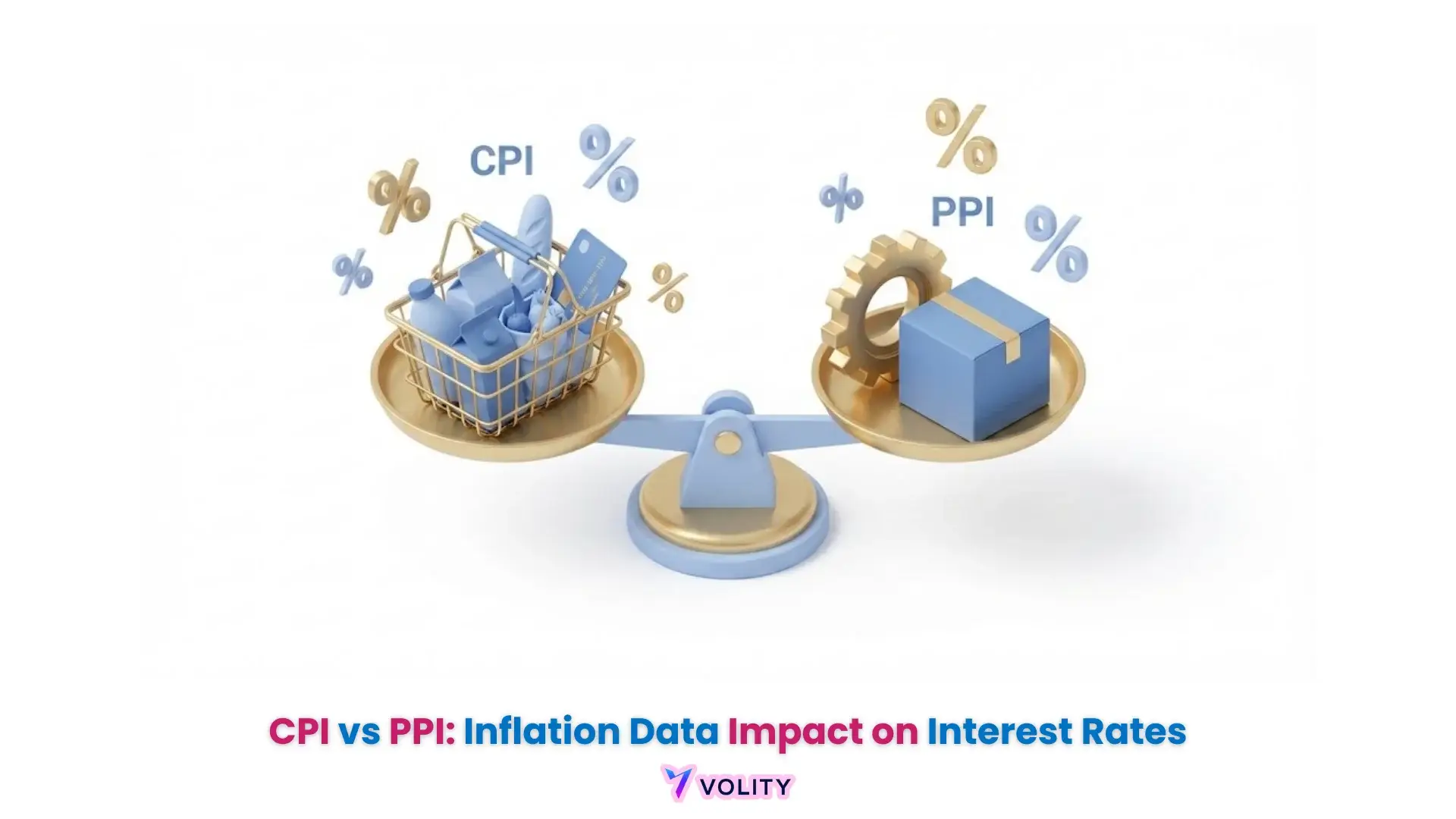
The Consumer Price Index (CPI) and Producer Price Index (PPI) are crucial economic indicators that offer distinct insights into inflationary pressures. Understanding these indices is fundamental for forex traders to anticipate market shifts and refine their strategies. This guide covers how CPI and PPI impact currency pairs, central bank policy, and how to build robust trading strategies around their releases.
While understanding Cpi Vs Ppi Forex Trading is important, applying that knowledge is where the real growth happens. Create Your Free Forex Trading Account to practice with a free demo account and put your strategy to the test.
Why Inflation Data Drives Forex Markets?
Fundamental analysis in forex involves evaluating economic data to predict future currency movements. Forex markets are highly sensitive to economic data releases, with major indices like CPI and PPI causing significant volatility. Economic indicators offer crucial insights into a country’s financial health, directly impacting investor sentiment and currency valuations.
Traders care about economic data because it signals potential shifts in central bank monetary policy, which is a primary driver of currency strength or weakness. Strong economic data, especially regarding inflation, often leads to expectations of higher interest rates, strengthening the domestic currency. The health of an economy, particularly its inflation rate, directly affects a nation’s currency value. When an economy is growing too quickly, leading to rising prices, central banks may intervene to control inflation. This intervention often involves adjusting interest rates, which makes a country’s assets more or less attractive to international investors. Higher interest rates typically strengthen a currency, as investors seek better returns. Conversely, low inflation or deflation can signal a weak economy, potentially leading to lower interest rates and a weaker currency.
The Consumer’s Inflation Story
The Consumer Price Index (CPI) is a vital economic indicator that reflects the cost of living for consumers. It measures the average change over time in the prices paid by urban consumers for a market basket of consumer goods and services. This index provides a comprehensive view of inflationary pressures experienced by households. Traders closely monitor CPI releases because the data can significantly influence monetary policy decisions and, consequently, forex trading opportunities.
What is the Consumer Price Index (CPI)?
The Consumer Price Index (CPI) measures the average change over time in the prices paid by urban consumers for a market basket of consumer goods and services. This index serves as a key gauge of inflation at the retail level. It tracks the purchasing power of a country’s currency and informs policymakers about price stability. The CPI primarily represents the spending habits of urban consumers, which constitute a significant portion of the population.
How CPI is Calculated and What it Measures
CPI is calculated by taking price changes for each item in a predetermined market basket of goods and averaging them. This basket includes categories such as housing, transportation, food and beverages, medical care, and education. The percentage change in the CPI from one period to another indicates the inflation rate. Traders often watch the main components like housing and energy, as these can be highly volatile. For instance, a sharp rise in housing costs can significantly impact the overall CPI reading.
Headline vs. Core CPI
Headline CPI refers to the overall Consumer Price Index, which includes all items in the market basket. Core CPI, however, excludes volatile food and energy prices. Economists and traders often focus on Core CPI to get a clearer picture of underlying inflationary trends. Food and energy prices can fluctuate wildly due to seasonal factors or geopolitical events, making the headline number less reliable for long-term policy decisions. A high Core CPI often indicates persistent inflation, which can lead central banks to consider interest rate hikes.
The Producer’s Inflation Story
The Producer Price Index (PPI) offers a different, yet equally crucial, perspective on inflation. This index tracks price changes from the perspective of domestic producers. It provides early signals of potential future inflationary pressures that may eventually reach consumers. Traders use PPI data to anticipate changes in the Consumer Price Index and adjust their forex trading strategies accordingly.
What is the Producer Price Index (PPI)?
The Producer Price Index (PPI) measures the average change over time in the selling prices received by domestic producers for their output. This index captures price changes at the wholesale level prices, before goods and services reach consumers. It monitors inflationary pressures from the supply side of the economy. PPI is a critical economic indicator for understanding the costs faced by businesses.
How PPI is Calculated and Its Stages of Production
PPI is calculated based on price changes across various stages of production: crude materials, intermediate goods, and finished goods. For example, an increase in commodity prices like oil or metals would first appear in the crude materials PPI. These cost increases then filter through to intermediate goods and eventually to finished goods. This multi-stage measurement provides insight into supply chain costs and their potential impact on future retail prices.
Core PPI Insights
The Producer Price Index often acts as a leading economic indicator for CPI. Increases in producer costs frequently get passed on to consumers, influencing future CPI readings. Core PPI excludes volatile food and energy prices, similar to Core CPI. This focus on core components helps in discerning underlying trends in producer prices, providing a more stable forecast of future inflation. A rising Core PPI can signal that consumers will soon face higher prices.
Ready to Elevate Your Trading?
You have the information. Now, get the platform. Join thousands of successful traders who use Volity for its powerful tools, fast execution, and dedicated support.
Create Your Account in Under 3 MinutesKey Differences and Their Interplay for Traders
While both the Consumer Price Index and Producer Price Index measure inflation, they do so from distinct points in the economic chain. Understanding these differences and their interplay is crucial for forex traders.
CPI vs. PPI: A Side-by-Side Comparison
The primary difference between CPI and PPI lies in whose perspective on price changes they represent: the consumer or the producer. The table below outlines their key distinctions.
| Aspect | Consumer Price Index (CPI) | Producer Price Index (PPI) |
| Perspective | Buyer (Urban Consumers) | Seller (Domestic Producers) |
| Measurement | Retail level prices for goods/services | Wholesale level prices for output |
| Scope | Final goods and services purchased | Goods at various stages of production |
| Coverage | Household expenditures | Producer revenues |
| Market Impact | Direct on consumers, often immediate FX reaction | Indirect, leading indicator for CPI, less immediate FX reaction |
Leading vs. Lagging Signals
PPI can act as a leading indicator for CPI, as increases in producer costs often get passed on to consumers, influencing future CPI readings. This relationship is vital for traders. While PPI signals potential future inflation, CPI tends to have a greater immediate market impact due to its direct relevance to consumers and its role in central bank mandates. When CPI data is released, it often causes more significant currency volatility because it directly reflects the cost of living and influences interest rate hikes. Analyzing both indices together provides a comprehensive view of inflationary pressures, with PPI offering a glimpse into the pipeline and CPI confirming the actual impact on the broader economy.
How CPI and PPI Data Move Currency Pairs?
CPI and PPI data are powerful drivers in forex markets, directly influencing currency pairs through their impact on inflation and monetary policy. Traders meticulously analyze these releases to anticipate potential shifts in central bank actions. The interplay between inflation data and central bank responses creates significant trading strategy opportunities and risks.
Monetary Policy and Central Bank Reactions
Central banks, such as the Federal Reserve, are mandated to maintain price stability. Higher-than-expected CPI or PPI data can lead central banks to consider raising interest rates to combat inflation, which typically strengthens the domestic currency in forex markets. Conversely, lower-than-expected inflation data might suggest a need for interest rate cuts or other accommodative monetary policy measures to stimulate economic growth. These monetary policy decisions by central banks are a primary catalyst for currency movements.
Direct Impact on Currency Values
The chain reaction from inflation data to currency values is straightforward. When inflation data (CPI or PPI) comes in higher than market expectations, it signals that the central bank might raise interest rates to cool down the economy. Higher interest rates make a country’s currency more attractive to foreign investors seeking better returns, leading to increased demand and a stronger currency. Conversely, weaker-than-expected inflation data can weaken a currency as expectations for rate hikes diminish.
A Trader’s Focus
The US Dollar (USD) is particularly sensitive to US CPI and PPI releases due to its status as a global reserve currency and the significant impact of US monetary policy. Major currency pairs like EUR/USD, GBP/USD, and USD/JPY often exhibit pronounced volatility following these releases. Traders focusing on these pairs must pay close attention to US inflation data, as unexpected deviations from forecasts can lead to rapid price swings.
Trading Strategies & Risk Management for Inflation Data Releases
Trading CPI and PPI news requires a disciplined approach, integrating both analytical preparation and robust risk management. The high market volatility around these releases can offer significant opportunities but also poses substantial risks, so effective trading strategy involves anticipating potential market reactions and safeguarding capital.
Setting Expectations
Before any CPI or PPI release, forex traders engage in thorough pre-release analysis. This involves checking consensus forecasts from economists, reviewing previous readings, and understanding analyst expectations. The key is to compare the ‘actual’ data against the ‘forecast.’ A significant deviation from the forecast, rather than the absolute number itself, is what typically triggers the most pronounced currency volatility. For example, if CPI is expected at 0.3% month-over-month and comes in at 0.5%, the currency reaction will likely be much stronger than if it met the 0.3% expectation.
Trading the Reaction
Once inflation data is released, traders can implement various post-release strategies. Some traders attempt to ‘fade the spike,’ betting against the initial, often exaggerated, market reaction. Others employ a ‘breakout strategy,’ waiting for the market to establish a clear direction after the initial volatility subsides. A ‘wait-and-see’ approach is also common, especially for less experienced traders, allowing the market to digest the news before committing to a trade. Using Forex News Trading Tools, such as real-time economic calendars and news feeds, is crucial for timely decision-making.
Managing Risk and Trading Psychology During News Events
Managing risk is paramount during high-impact news events. The increased market volatility can lead to rapid and unpredictable price swings, often resulting in ‘fake-outs’ where prices briefly move in one direction before reversing sharply. To mitigate this, traders should always use stop-losses to limit potential losses and consider reducing their position size. Behavioral economics teaches that emotional decisions, such as FOMO (Fear Of Missing Out) or revenge trading, are common pitfalls. Avoiding over-leveraging and refraining from trading during peak volatility, especially for inexperienced traders, are critical risk management techniques. A disciplined mindset helps in avoiding irrational actions that can severely impact a trading account.
Turn Knowledge into Profit
You've done the reading, now it's time to act. The best way to learn is by doing. Open a free, no-risk demo account and practice your strategy with virtual funds today.
Open a Free Demo AccountCommon Trader Challenges and Advanced Insights
Moving beyond headline numbers and managing trader psychology are as crucial as the data itself for forex traders. Many traders struggle to distinguish between market ‘noise’ and genuine signals during CPI and PPI releases. This section delves into nuanced analysis and behavioral economics principles, which often differentiate successful traders from others. Understanding the ‘why’ behind market reactions and controlling emotions are key to navigating these high-stakes events.
Traders often get ‘faked out’ by initial CPI/PPI reactions because they focus solely on the first reported number. A more advanced approach involves dissecting the data into its specific components. For instance, within CPI, housing and services components tend to be stickier and have a more lasting impact than volatile food and energy prices. Similarly, in PPI, observing price changes in crude and intermediate goods can provide earlier signals of future inflationary pressures compared to finished goods. Analyzing these sub-components helps in distinguishing temporary fluctuations from underlying trends. Furthermore, recognizing the psychological traps, such as the urge to chase rapid price movements, is vital. Professional traders understand that patience and adherence to a predefined trading strategy are more valuable than reacting emotionally to initial market noise.
Bottom Line
Mastering CPI vs PPI is essential for forex traders navigating inflationary pressures. The Consumer Price Index tracks retail level prices, directly impacting consumers and often causing immediate currency volatility due to its influence on central bank monetary policy decisions. Meanwhile, the Producer Price Index measures wholesale level prices, acting as a leading economic indicator for future CPI readings. Effective trading strategy involves analyzing both headline and core CPI/PPI data, understanding their interplay, and managing the psychological challenges of high-impact news events. By integrating these economic indicators with robust risk management, traders can make more informed decisions and improve their performance in the forex market.
Key Takeaways
- CPI measures retail inflation, directly impacting consumers and central bank policy.
- PPI tracks wholesale prices, serving as a leading indicator for future CPI changes.
- Both indices drive currency volatility through their influence on interest rate expectations.
- Effective trading involves analyzing both headline and core data, managing risk, and understanding market psychology.
- Traders must compare actual data to forecasts and employ robust risk management during releases.