Candlestick patterns are visual representations of historical price action and do not guarantee future market behavior. Trading Forex, Crypto, and Commodities involves substantial risk of loss. Always confirm signals with secondary indicators and never risk more than you can afford to lose. Past performance is not indicative of future results. Capital at risk.
Bullish candlestick patterns identify specific price chart formations that signal potential upward momentum and trend reversals. These patterns reveal buyer control through candle bodies and wicks, and the Bullish Engulfing and Hammer are the two most widely traded of them. Identifying these signals at key support levels enables traders to time long entries with higher precision.
Bullish candlestick patterns deliver the visual evidence required to identify a shift in market control from sellers to buyers. These formations reveal specific price triggers that, read in the right context, signal a shift in control from sellers to buyers. In 2026, the integration of volume-price analysis (VPA) has become essential for validating these patterns against high-frequency market noise.
Mastering the mechanics of patterns like the Morning Star or Bullish Engulfing allows traders to anticipate reversals before they become apparent on lagging indicators. By combining these visual signals with key support zones and momentum oscillators, you can develop a robust framework for timing long entries across Forex, Crypto, and Commodities. This guide examines the top-performing patterns and the verification rules required for consistent execution.
While understanding Bullish Candlestick Patterns is important, applying that knowledge is where the real growth happens. Create Your Free Forex Trading Account to practice with a free demo account and put your strategy to the test.
What are the most reliable bullish candlestick patterns in 2026?
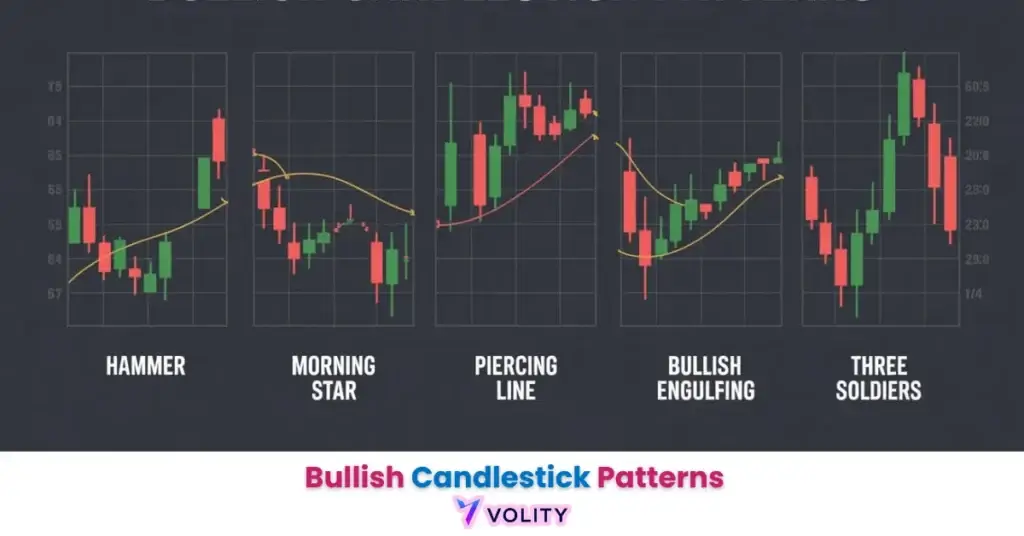
The most reliable bullish candlestick patterns are the Morning Star, Bullish Engulfing and Hammer, in that order. The Morning Star identifies a three-candle reversal formation where a large bearish candle is followed by a small doji (indecision) candle, then a large bullish candle that closes well into the bearish candle’s body. It is the most dependable of the three because the three-candle structure forces the market to show exhaustion, indecision and then commitment in sequence, and it is at its strongest when it forms at an established demand zone.
The Bullish Engulfing pattern reveals the power of a large bullish candle body completely “swallowing” the previous bearish candle’s range. The Hammer is a candle with a long lower wick, signalling the market’s rejection of lower prices; it is the weakest of the three on its own because it is a single candle. Three White Soldiers identify sustained, high-conviction buying pressure through three consecutive bullish candles with minimal pullback, each closing near its high. The trend reversal signals in Forex framework provides comprehensive analysis of how these patterns integrate with broader reversal mechanics. The Morning star reference sets out the structural definition of the three-candle formation.
💡 KEY INSIGHT: The Morning Star is the most dependable bullish reversal formation, and it is at its strongest at the end of an extended downtrend rather than inside a range.
Ready to Elevate Your Trading?
You have the information. Now, get the platform. Join thousands of successful traders who use Volity for its powerful tools, fast execution, and dedicated support.
Create Your Account in Under 3 MinutesHow do you accurately identify a bullish reversal signal?
Identifying a bullish reversal signal requires a multi-step verification of the pattern’s structure, its location relative to support, and the preceding trend direction. The preceding trend test identifies whether the market has been in a defined downtrend before the pattern appears, bullish patterns only signal reversals after a clear decline, not after sideways consolidation. The support test measures whether the pattern’s low aligns with a recognized support level (horizontal resistance, Fibonacci retracement, or prior swing low); a pattern that forms at a level the market has already respected is a materially better signal than the same pattern printing in the middle of nowhere.
Candle geometry measures the relationship between the pattern’s body size and wick length to confirm buyer strength. A Hammer with a long lower wick (3x the body height) signals more powerful rejection of lower prices than a Hammer with a short wick. Confirmation candles require waiting for price to break above the pattern’s high, the professional standard for entry rather than premature trading before the pattern structure completes. The Predicting Forex Movements: The 3-Layer Framework guide explains how to layer these identification steps into a coherent reversal-detection system.
How does volume confirm a bullish pattern’s strength?
Volume confirmation identifies the level of institutional commitment behind a bullish pattern, with a 2.0x volume spike acting as the 2026 benchmark for high-probability setups. Volume-Price Analysis (VPA) matches candle size with trading activity, when a large bullish candle prints on average or below-average volume, it reveals weak conviction and a higher likelihood of a “bull trap” reversal. The 2.0x rule requires doubling the average 20-period volume; when a bullish pattern appears on volume exceeding this threshold, it demonstrates strong institutional “footprint” and validates buyer control.
Anomalies in volume reveal hidden signals: a large bullish candle on low volume often precedes a reversal because weak buying pressure suggests that retail excitement rather than professional accumulation drove the move. Accumulation signals appear when rising volume accompanies the formation of “Three White Soldiers,” confirming that a trend shift from distribution to accumulation is underway. The Mastering Crypto Spot Trading: Buy & Sell Digital Assets Confidently resource explains how crypto markets amplify volume-confirmation mechanics due to their continuous 24/7 trading environment.
Look for a volume multiple of at least 2.0x the 20-period average. A bullish pattern forming on high volume reveals a much stronger institutional ‘footprint’ than one on low volume.
Why a single success rate is the wrong thing to look for
Published win rates for candlestick patterns vary enormously between studies, because the result depends on choices the headline number hides: which instrument, which timeframe, how the formation was defined in code, what counted as a win and how long the position was held. Two careful studies of the same pattern can differ by tens of percentage points on those choices alone, which is why a precise-looking figure quoted without its methodology tells you nothing.
What is stable across every version of the test is the ordering rather than the level. Three-candle formations outperform two-candle formations, two-candle formations outperform single candles, and all of them improve when they form at a level that already mattered and on volume that confirms real participation. Use the pattern as a filter on a level you had already marked. The candlestick pattern reference catalogues each formation by structure rather than by claimed accuracy.
Turn Knowledge into Profit
You have done the reading, now it is time to act. The best way to learn is by doing. Open a free, no-risk demo account and practice your strategy with virtual funds today.
Open a Free Demo AccountWhat is the difference between reversal and continuation bullish patterns?
The primary difference between reversal and continuation patterns is their role in either flipping a downtrend or confirming the strength of an existing move. Reversal patterns like the Hammer, Bullish Engulfing, and Piercing Line appear at the end of a downtrend and signal an absolute shift in market direction, they answer the question “where does the downtrend end?” Continuation patterns like Rising Three Methods and Bullish Flag appear mid-uptrend during a temporary pullback and signal that the uptrend will resume after a consolidation pause, they answer “will the uptrend continue?”
Structural differences reveal how to distinguish them visually: reversal patterns typically feature dramatic shifts in candle direction or size (small to large, bearish to bullish), while continuation patterns involve small consolidation candles within a larger move that maintains the overall trend direction. Strategy shifts follow these distinctions: reversal trades target larger risk-reward ratios (1:3 to 1:5) because they are riskier entries that must travel far to offset false signals, while continuation trades hit more often but pay less per trade, because they are lower-risk entries inside an established trend. The optimal timeframes for technical patterns guide explains how timeframe selection impacts whether you identify reversals or continuations at the same price level.
Why do bullish candlestick patterns fail in choppy markets?
Bullish candlestick patterns often fail in choppy markets because low liquidity and lack of trend direction create “false signals” that trap optimistic buyers. The “bull trap” occurs when a bullish pattern breaks the pattern high but immediately reverses sharply, hitting stop-losses placed just below the pattern low and generating rapid losses for traders who entered prematurely. Context is critical: patterns fail when the broader market is in a distribution phase (sideways price action where buyers and sellers are balanced) because neither force has the momentum to sustain a directional move.
Timeframe traps identify the 5-minute chart as the most dangerous timeframe for pattern traders because high-frequency trading algorithms flood short timeframes with noise that mimics reversal patterns but resolves in the opposite direction. Risk management rules mandate placing a stop-loss below the pattern’s low as a definitive exit trigger, if the pattern structure breaks, the original thesis is invalid and capital must be preserved. A real Forex example illustrates this failure mode: a Bullish Engulfing formed on the GBP/USD 1-hour chart during a sideways consolidation range, initially breaking above the range high. However, the broader market lacked conviction, and the pattern failed to sustain, price reversed and hit the stop-loss placed 20 pips below the pattern’s low. Past performance is not indicative of future results. This outcome demonstrates why context and market regime identification are essential before relying on any single pattern. The Smarter Risk Management in Forex Trading guide establishes protective frameworks for managing pattern failures.
WARNING: Patterns on timeframes lower than 15 minutes are highly susceptible to high-frequency trading ‘noise.’ Professional traders prioritize the 4-hour and Daily charts to filter out false bullish signals.
Key Takeaways
- Bullish candlestick patterns identify potential upward reversals, and the Morning Star is the most dependable of them.
- The Bullish Engulfing pattern is most effective when it appears at established support levels with a 2.0x volume spike.
- Volume confirmation is the most critical metric for validating buyer control, as low-volume patterns often result in bull traps.
- Higher timeframes like the 4H and Daily charts are far more dependable for pattern identification than intraday 5-minute charts.
- Bullish reversal patterns occur at trend bottoms, while continuation patterns signal a pause in an ongoing upward move.
- Risk management rules mandate placing a stop-loss below the pattern’s low to protect capital from high-frequency market noise.
Frequently Asked Questions
This article contains references to bullish candlestick patterns and Volity, a regulated CFD trading platform. This content is produced for educational purposes only and does not constitute financial advice or a recommendation to buy or sell any financial instrument. Always verify current regulatory status and platform details before using any trading service. Some links in this article may be affiliate links.
What our analysts watch: Three filters that lift bullish-pattern win rates from chart-pattern noise to genuinely informative signals. Pattern location relative to the larger trend (a bullish reversal at a 200-period moving-average bounce is a different setup from the same pattern printing inside a sideways range; the location is half the signal). Confirmation close (waiting for the next bar close beyond the pattern high is the difference between trading the pattern and trading anticipation; the confirmation close is the one adjustment that improves results across every major bullish pattern, at the cost of a slightly later entry). Volatility regime (patterns inside compressed-volatility periods carry tighter stops and clearer follow-through; patterns inside high-volatility regimes require wider stops that many traders fail to size correctly).
Volity operates a trading platform and also publishes educational and analytical content about trading. The content on this page is for educational purposes only and should not be considered financial advice. Volity may benefit commercially when readers open trading accounts through links on this site.
Our content is produced and reviewed under documented editorial standards; see our comparison and review methodology.