Economic data releases like CPI and PPI cause extreme market volatility and significant slippage. Initial price reactions are often exaggerated and can reverse sharply within minutes. Never trade high-impact news without a clear risk management plan and appropriate stop-loss orders. Past performance is not indicative of future results. Capital at risk.
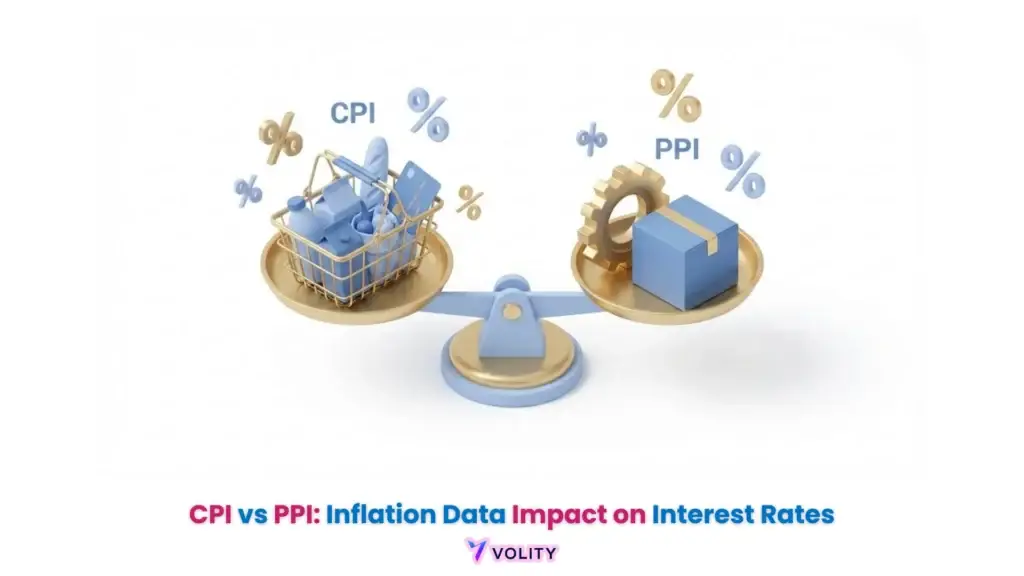
CPI and PPI identify the primary measures of inflation, tracking price changes at the consumer and producer levels respectively. US annual CPI inflation ran at 3.5% in June 2026, down from 4.2% in May, while producer prices rose 5.5% year on year over the same month. Reading PPI as the leading series is what lets forex traders anticipate central bank rate shifts and position for USD volatility.
CPI (Consumer Price Index) and PPI (Producer Price Index) identify the twin engines of inflationary data that drive global currency valuations. US headline CPI stood at 3.5% year on year in June 2026, the first decline in five months after 4.2% in May, with energy still up 15.7% on the year (United States Inflation Rate, data from the US Bureau of Labor Statistics). By measuring price changes from both the buyer’s and seller’s perspectives, these indices provide the foundational evidence required for central bank interest rate decisions.
The 2026 forex landscape is defined by heightened sensitivity to energy-driven inflation, which has moved headline CPI far more than core over the past year. As the Producer Price Index acts as the ‘pressure cooker’ for the broader economy, understanding its pass-through effect into consumer retail prices is the most critical skill for fundamental analysts. This guide identifies the structural differences between CPI and PPI and reveals the strategic benchmarks for trading their high-impact releases.
While understanding CPI and PPI Data is important, applying that knowledge is where the real growth happens. Create Your Free Forex Trading Account to practice with a free demo account and put your strategy to the test.
Why Inflation Data Drives Forex Markets in 2026?
Inflation data identifies the primary catalyst for central bank monetary policy, where rising prices reveal a need for higher interest rates and a tight monetary policy to preserve the domestic currency’s purchasing power. The purchasing power link explains why 2026 traders view inflation as the ‘erosion’ of currency value that requires higher yields to offset declines in real purchasing power. Federal Reserve policy benchmarks show the 2% inflation target remains the ‘holy grail’ for the Federal Reserve in early 2026.
Interest rate expectations shift on the surprise rather than the level, so a small beat against consensus on Core CPI can move the whole implied rate path even when the print itself looks unremarkable. Capital flows respond immediately; higher inflation data frequently strengthens the USD as investors seek the security of higher-yielding US Treasury bonds. currency strength. Learn how DXY movements affect forex pairs and broader market sentiment in 2026." class="internal-link" href="https://volity.io/forex/us-dollar-index-dxy/">US Dollar Index (DXY): 2026 Forecast tracks how inflation data translates into currency strength across the global economy.
Ready to Elevate Your Trading?
You have the information. Now, get the platform. Join thousands of successful traders who use Volity for its powerful tools, fast execution, and dedicated support.
Create Your Account in Under 3 MinutesLeading vs. Lagging Signals: The PPI to CPI Pass-Through
The relationship between CPI and PPI identifies as a supply-chain pipeline, where the Producer Price Index reveals early cost pressures that verifiably reach consumers in the subsequent months. The “pressure cooker” analogy explains how PPI is the ‘heat’ in the pipes and CPI is the final ‘whistle’ of inflation, rising PPI signals future consumer prices. Supply chain transmission is why a producer-level energy shock shows up in grocery prices weeks later rather than immediately: diesel and freight are inputs to almost every consumer good.
Divergence risks identify scenarios where CPI remains flat while PPI surges, signaling future profit margin compression for corporations, businesses absorb costs rather than passing them immediately. Core PPI insights reveal the importance of excluding volatile food and energy; this ‘sticky’ inflation is what central banks fear most. Technical vs Fundamental Analysis: Which Is Better? explains how traders incorporate fundamental data into technical entry strategies.
Watch the ‘Finished Goods’ component of the PPI. It is the component closest to the retail shelf, so it is the earliest usable read on where the consumer series is heading over the following one to three months.
2026 US Inflation Analysis: The Energy Component
Energy is what has driven the headline series through 2026. In the June 2026 release, energy costs were 15.7% higher than a year earlier, down from 23.5% in May, and gasoline was up 26.7% against 40.5% the month before. On a monthly basis energy fell 5.7% in June after rising 3.9% in May, 3.8% in April and 10.9% in March, which is the shape of a shock passing through the index (United States Inflation Rate).
The component split matters more to a forex desk than the headline. In June 2026 shelter inflation eased to 3.3% from 3.4% and food to 3.0% from 3.1%, while annual core inflation, which strips out food and energy, fell to 2.6% from 2.9%. A headline moving on energy while core moderates is the combination that lets a central bank look through the print. Forex Economic Calendar: How to Trade News provides the schedule for future inflation releases and their historical market impact.
💡 KEY INSIGHT: the 2026 energy move has made Headline CPI far more volatile than Core. Annual core inflation eased to 2.6% in June 2026 while the headline was still running at 3.5%, which is the scenario in which a central bank looks through the headline spike.
2026 US Inflation Performance and Market Benchmarks
The June 2026 releases show the shape of the year: a headline series still elevated by energy, a core series easing, and producer prices running ahead of consumer prices.
| Index Type | Annual Change (Y/Y) | Monthly Change (M/M) |
| Headline CPI | 3.5% (June 2026) | -0.4% month on month |
| Core CPI | 2.6% (June 2026) | 0.0% month on month |
| Producer prices | 5.5% (June 2026) | Down from 6.0% in May |
| Energy (CPI component) | +15.7% (June 2026) | -5.7% month on month |
| Shelter (CPI component) | +3.3% (June 2026) | +0.1% month on month |
All figures are the June 2026 releases published by the US Bureau of Labor Statistics, as carried on United States Inflation Rate and United States Producer Prices Change.
Turn Knowledge into Profit
You have done the reading, now it is time to act. The best way to learn is by doing. Open a free, no-risk demo account and practice your strategy with virtual funds today.
Open a Free Demo AccountTrading inflation releases identifies a high-volatility strategy that requires comparing ‘Actual’ data against ‘Forecast’ consensus to execute profitable market entries. The deviation rule reveals that a 0.1% surprise in Core CPI often moves the market more than a 1.0% expected move in Headline, the market cares about surprises, not magnitude. Fading the spike identifies psychological over-reaction to initial data and positioning for the 30-minute mean reversion as smart money takes profits.
SMC concepts utilize ‘Fair Value Gaps’ and ‘Liquidity Sweeps’ to identify where institutional bots place their orders. Timeframe selection shows M5 and M15 charts as the preferred windows for inflation release execution, capturing the whipsaw before longer-term trends establish. 10 best forex trading strategies explores systematic approaches to news trading and fundamental analysis.
WARNING: Avoid chasing the initial spike on the release. Liquidity sweeps concentrate in the first 60 seconds after the number prints, which is why waiting for the 5-minute candle close is the safer execution.
Central Bank Policy: The Fed’s 2026 Interest Rate Outlook
Central bank policy identifies the 2% inflation target as the primary decision-making threshold for determining the timing of 2026 interest rate cuts. The 2026 energy-driven headline spike is exactly the kind of shock that pushes an easing cycle back, because a central bank will not cut into a rising headline print even when core is behaving. Real interest rates reveal how subtracting inflation from the nominal rate identifies the true ‘tightness’ of monetary policy.
Wage-push concerns ease when the services side of the index cools, which is the part of inflation a central bank can actually influence with rates. Global rotation responds to US inflation data; higher rates strengthen the USD through the ‘Dollar Smile’ theory, encouraging carry trades into EM assets. Interest Rate Trading in Forex: A Complete Guide explains how to profit from rate expectations and central bank policy shifts.
Consumer price index sets out how the index is constructed as a weighted average of a household market basket.
United States Inflation Rate carries the current and historical BLS series with the component breakdown.
Producer price index explains what the wholesale series measures and why it leads the consumer series.
Key Takeaways
- CPI (Consumer Price Index) identifies the retail-level cost of living, serving as the Federal Reserve’s primary indicator for interest rate adjustments.
- PPI (Producer Price Index) identifies wholesale price changes and leads the consumer series, typically by one to three months.
- US Headline CPI ran at 3.5% year on year in June 2026, down from 4.2% in May, with energy still 15.7% higher than a year earlier.
- Core inflation (excluding food and energy) identifies the underlying trend, and eased to 2.6% Y/Y in June 2026 from 2.9% the month before.
- Forex market volatility identifies the ‘Actual vs. Forecast’ deviation as the #1 driver of rapid USD price movements during data releases.
- Rate-cut expectations move with the headline series, so an energy-driven spike delays easing even while core inflation is falling.
Frequently Asked Questions
This article contains references to CPI and PPI economic indicators, US monetary policy, and forex trading strategies, and mentions Volity, a regulated CFD trading platform. This content is produced for educational purposes only and does not constitute financial advice or a recommendation to trade any currency pair or financial instrument. Economic data trading is inherently risky and subject to sharp reversals. Always use appropriate stop-loss orders and risk management when trading economic releases. Some links in this article may be affiliate links.
What our analysts watch: Inflation-data positioning rewards traders who read the structural breakdown rather than the headline number, and three reads concentrate the signal. Core CPI services excluding shelter, often called supercore, which is the Fed-favored measure of underlying domestic inflation pressure and the one that drives durable Fed-policy expectations. PPI final-demand services, which leads the services component of CPI by typically one quarter and provides early warning of upcoming CPI surprises. Cross-component coherence between CPI and PPI on goods inflation, where divergence (rising goods CPI with falling goods PPI, or the reverse) signals margin compression or expansion at the retail layer that affects equity and corporate-credit positioning alongside forex. The forex reaction to inflation surprises has migrated from the headline number to the component breakdown over recent cycles, which is why the institutional desks read the full release rather than the surface print. Volity desk tracks inflation-data positioning under CySEC 186/12 oversight via UBK Markets with entities in Saint Lucia and Cyprus.