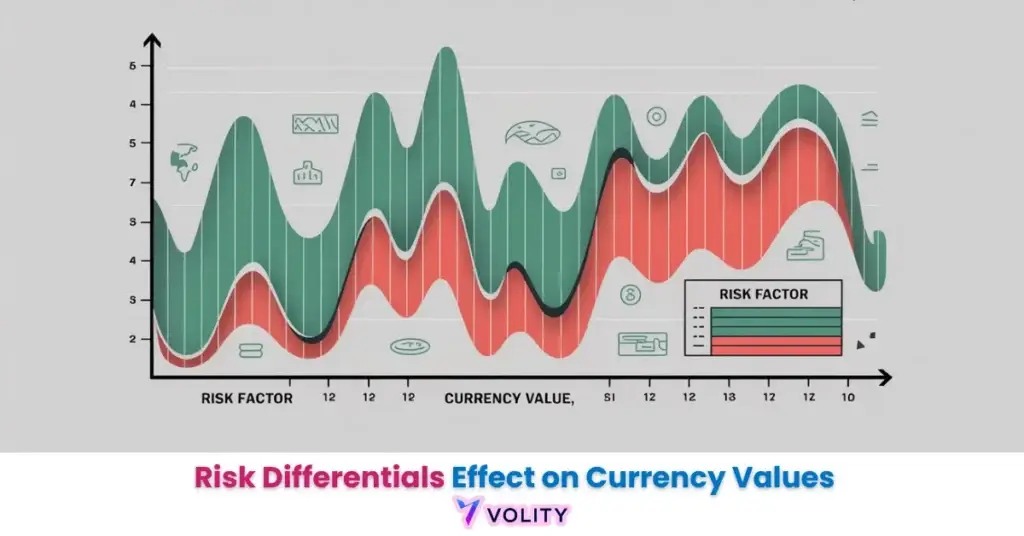
Risk differential analysis involves macroeconomic forecasting and geopolitical assessment, both of which are inherently uncertain. Historical relationships between risk differentials and currency movements can break down during crisis periods or policy reversals. A currency offering high yield due to elevated risk differential exposure may experience sudden capital flight that overwhelms interest rate compensation. Leverage amplifies losses when geopolitical shocks or rating downgrades trigger rapid depreciation. Capital at risk in all leveraged trading.
Risk differentials describe the gap in perceived economic and political risk between two nations, serving as the primary gating item for international capital flows. When the risk differential widens against a currency, capital exits the local economy in favor of “safe havens,” leading to immediate depreciation. In 2026, these differentials are being redefined by climate resilience and geopolitical debt burdens.
Risk differentials function as the global “filtering system” for institutional capital seeking safe-haven or high-growth environments. These variations in perceived stability dictate whether a currency experiences capital flight or accumulation. It remains the most influential factor in determining the long-term direction of exchange rates.
The macroeconomic landscape is increasingly shaped by supervisors requiring banks to price climate-related financial risk explicitly. As a result, the risk gap between advanced economies and emerging markets is narrowing, fundamentally shifting the traditional “safe-haven” narrative.
While understanding Risk Differentials is important, applying that knowledge is where the real growth happens. Create Your Free Forex Trading Account to practice with a free demo account and put your strategy to the test.
What are risk differentials and how do they drive currency demand?
Risk differentials are the measurable variations in economic, political, and fiscal stability between two countries that determine the relative appeal of their currencies. This fundamental principle explains why certain currencies strengthen during crisis periods while others collapse. The differential creates an asymmetry in capital demand.
The “Flight to Quality” mechanism reveals why capital moves from high-risk to low-risk regimes during volatility. When geopolitical tensions rise or economic data deteriorates, institutional investors systematically exit riskier currencies and accumulate safe-haven currencies like the US dollar, Swiss franc, and Japanese yen. The behaviour is well documented, though it is a tendency rather than a rule and it does not fire on every episode of stress.
Determinants of risk include inflation instability, political uncertainty, and fiscal deficits. A country with high and unstable inflation faces a higher risk premium than one with inflation anchored near its central bank’s target. Political unrest increases regime uncertainty. Large and persistent fiscal deficits signal growing debt burdens. These factors combine to create the overall risk differential.
The 2026 perspective identifies how “Security Risk” from geopolitical rearmament is re-pricing the Euro. The European Commission’s Spring 2025 forecast puts the euro area debt ratio at around 89% of GDP in 2024, rising to about 91% by 2026, with defence spending among the pressures behind the increase (European Commission, Spring 2025 Economic Forecast). A rising debt path widens the risk differential against EUR/USD and weighs on the currency.
Risk as the gating item for development capital
Risk differentials are a primary barrier to the investment required to meet global sustainability goals. The Capital as a Force for Good report series puts the total cost of the UN Sustainable Development Goals in the hundreds of trillions of dollars and the shortfall in the tens of trillions, and the “SDG Financing Gap” reflects investor hesitation to move capital from stable advanced economies to emerging markets. Political instability, weak regulatory frameworks, and climate vulnerability create risk differentials that prevent this capital transfer.
Why North-centric wealth remains hesitant to move to the Global South reveals the persistence of risk-aversion. Advanced economy investors demand risk premiums (high yields) to compensate for EM exposure. When those yield premiums don’t materialize, capital doesn’t flow. The risk differential acts as a barrier, not because EM economies are inherently riskier, but because investors perceive them as such.
Ready to Elevate Your Trading?
You have the information. Now, get the platform. Join thousands of successful traders who use Volity for its powerful tools, fast execution, and dedicated support.
Create Your Account in Under 3 MinutesHow do sovereign risk differentials impact the EUR/USD in 2026?
Divergent fiscal tolerances between EU member states identifies a widening sovereign risk differential that puts downward pressure on the Euro’s global valuation. The Eurozone is not a single fiscal entity, its 20 member nations have vastly different debt burdens and political stability. This structural heterogeneity creates the risk differential that undermines the currency.
Italy vs. Germany illustrates the impact of debt-to-GDP disparities on EU unity. Italy carries a debt ratio more than double Germany’s. When geopolitical stress emerges (like the rearmament pivot), investors discriminate between these economies. Capital flows from Italian assets to German assets, creating a risk premium that widens the EUR/USD spread. The Euro, being a shared currency, feels the weighted average of all member risks.
Rearmament costs reveal how NATO defence outlays are straining national budgets. At the 2025 Hague Summit, NATO Allies committed to investing 5% of GDP a year in defence by 2035, of which at least 3.5% goes to core defence requirements (NATO, Defence investment and NATO’s 5% commitment). That replaces the 2% Wales guideline and applies to Germany, France and every other Ally alike. These expenditures increase fiscal deficits, pushing debt ratios higher. The burden falls unequally on economies with already-elevated debt loads, widening the risk differential within the Eurozone itself.
Monetary policy pivot between the US and Eurozone creates contrasting risk profiles. The US maintains “high-for-longer” interest rates, supporting dollar strength through real return superiority. The Eurozone pursues a “stagnation buffer”, accepting low growth with moderate rates to avoid triggering debt crises. This policy divergence widens the risk differential as investors demand higher dollar returns to compensate for lower Eurozone growth.
The US and European shares of global output have both fallen over the past half century as emerging economies have grown, shifting the long-term risk-growth differential. Yet paradoxically, the US dollar strengthens during crises despite relative economic decline. This apparent contradiction resolves through the liquidity and reserve currency status that the dollar maintains regardless of comparative economic performance.
Climate risk and the narrowing of AE vs. EM differentials
Climate-related risk differentials identify that advanced economies face increasing fiscal shocks that are stabilizing the relative risk profile of emerging market currencies. This represents a fundamental reversal of the historical pattern where EM currencies always traded at wider risk spreads than AE currencies.
Supervisors are pushing banks to price climate risk explicitly. The Basel Committee has issued principles for the management and supervision of climate-related financial risks requiring banks to identify, measure and disclose those risks and supervisors to check that they do, though the Basel framework sets no green or brown capital add-on. The pressure therefore runs through pricing, disclosure and credit appetite rather than through capital ratios, and it falls hardest on carbon-intensive sectors concentrated in advanced economies.
Climate resilience emerges as the new criterion for currency valuation. Nations implementing verifiable green hydrogen frameworks, renewable energy commitments, and ESG-aligned sovereign bonds attract capital specifically because their risk profile is improving relative to climate-exposed advanced economies. Some EM currencies are becoming “safe-havens” for ESG capital as investors flee climate-burdened AE sectors.
How this shows up on a chart: when a commodity exporter publishes a credible transition framework at the same time as a large advanced economy absorbs a run of climate-driven insurance losses, the risk differential between them narrows and the commodity currency tends to firm. The sequence is what matters, not a particular pip count. Past performance is not indicative of future results.
Transition costs impact local liquidity as carbon-intensive sectors undergo re-pricing. Japan’s electricity utilities face massive retooling costs. Germany’s industrial base confronts energy transition burdens. These costs show up in fiscal stress and currency weakness. By contrast, countries with abundant renewable resources and early-mover advantages see currency strength as capital rotates toward these safer exposures.
The impact of bank vs. non-bank risk on market liquidity
Narrowing risk differentials between traditional banks and non-bank deposit takers (NBDTs) identifies an intensifying competition for retail liquidity in 2026. This shift has profound implications for currency carry trades and institutional funding costs.
| Risk Indicator | Typical range | High-Risk Signal | Low-Risk Signal | Impact on Currency |
| Sovereign CDS | 45 – 85 bp (Major) | > 150 bp | < 25 bp | Bearish if rising |
| Debt-to-GDP | ~91% (euro area, 2026) | > 120% | < 60% | Bearish if >100% |
| CPI Inflation | 2.5% – 3.5% | > 8.0% | < 2.0% | Volatile |
| Real Interest Rate | 1.5% – 2.5% | Negative | > 4.0% | Bullish if stable |
| ESG Risk Score | 70/100 (Avg) | < 40/100 | > 90/100 | Bullish (Long-term) |
Indicative ranges for orientation only, not a published benchmark set. Euro area debt ratio from the European Commission Spring 2025 Economic Forecast.
Sovereign CDS spreads provide the most liquid measure of credit risk. When CDS spreads widen above 150 basis points, institutional capital becomes hesitant to hold that currency except at extremely high yield compensation. A narrowing spread below 25 basis points signals low-risk confidence and attracts capital.
Non-bank deposit takers now compete directly with traditional banks for retail deposits. This democratization of finance reduces the traditional “bank safety premium” that had inflated banking system risk differentials. As NBDT funding becomes accepted, the perceived risk of traditional currency regimes narrows, affecting international capital flows.
When do risk differentials fail to explain price action?
Market sentiment and liquidity rebalancing identify instances where short-term capital flows override the fundamental logic of risk differentials. Understanding when fundamental analysis breaks down is critical for traders.
The “Safe-Haven Paradox” describes why the USD sometimes rises even when US risk is increasing. During extreme panic (like the 2008 financial crisis), investors didn’t care about US risk, they needed liquidity. The US dollar, being the most liquid asset globally, attracted capital regardless of fundamental deterioration. This paradox persists in 2026 whenever acute stress periods emerge.
Geopolitical shocks like the 2026 “Rearmament Pivot” force capital moves regardless of yield considerations. When military tensions escalate unexpectedly, institutional traders exit risk assets in real-time, abandoning fundamental risk differential logic. The repricing happens in minutes, driven by headlines rather than spreadsheets.
Future expectations explain why the market sometimes prices in a 2027 rate cut while today’s risk spread appears bullish for the currency. If traders believe the central bank will cut rates in 2027, they don’t care about 2026 yield advantages, they’re anticipating depreciation. This forward-looking behavior disconnects short-term price action from contemporary risk differentials.
Strategic trading tips for the 2026 risk environment
Effective trading strategies in 2026 identifies the alignment of sovereign credit updates with technical price levels for high-conviction entries. Combining macro risk assessment with technical analysis produces higher-probability trades.
Tracking S&P Global and Moody’s sovereign rating cycles provides advance warning of major currency shifts. Rating agencies publish reviews on fixed schedules. If a rating downgrade appears imminent, savvy traders frontrun the decision. This systematic monitoring of rating calendars supplements price-based technical analysis.
Mapping global yield spreads to institutional money flow reveals the magnitude of capital repositioning. When yield spreads between government bonds widen substantially, institutional rebalancing accelerates. The forex economic calendar highlights major economic releases that shift risk perception.
Filtering risk setups with RSI and moving average crosses ensures you’re not chasing moves based solely on macro ideology. If the risk differential favors a currency but RSI is overbought and price is above the 20-period moving average, the trade is likely late. Technical confirmation prevents entry at exhaustion levels.
Turn Knowledge into Profit
You have done the reading, now it is time to act. The best way to learn is by doing. Open a free, no-risk demo account and practice your strategy with virtual funds today.
Open a Free Demo AccountKey Takeaways
- Risk differentials are the primary drivers of capital flows, determining the relative strength of one currency against another in the 2026 market.
- Geopolitical rearmament has expanded the security risk premium for the euro area, whose aggregate debt ratio the European Commission projects at about 91% of GDP by 2026.
- Supervisory expectations on climate-related financial risk are pushing banks to price that risk explicitly, which narrows the gap between advanced and emerging market currencies.
- Sovereign CDS spreads provide a real-time measure of a country’s creditworthiness and are a leading indicator of imminent currency depreciation.
- The Dollar Smile theory explains why the US dollar remains the premier safe-haven asset during global crises, regardless of domestic US risk levels.
- Institutional money flows are increasingly gated by ESG and sustainability scores, making climate resilience a core component of 2026 valuation.
Frequently Asked Questions
This article contains references to risk differentials and currency valuation with Volity, a regulated CFD trading platform. This content is produced for educational purposes only and does not constitute financial advice or a recommendation to execute any specific trading strategy. Macroeconomic analysis and geopolitical assessment are inherently uncertain; always verify broker regulations and maintain adequate risk management discipline before trading. Some links in this article may be affiliate links.