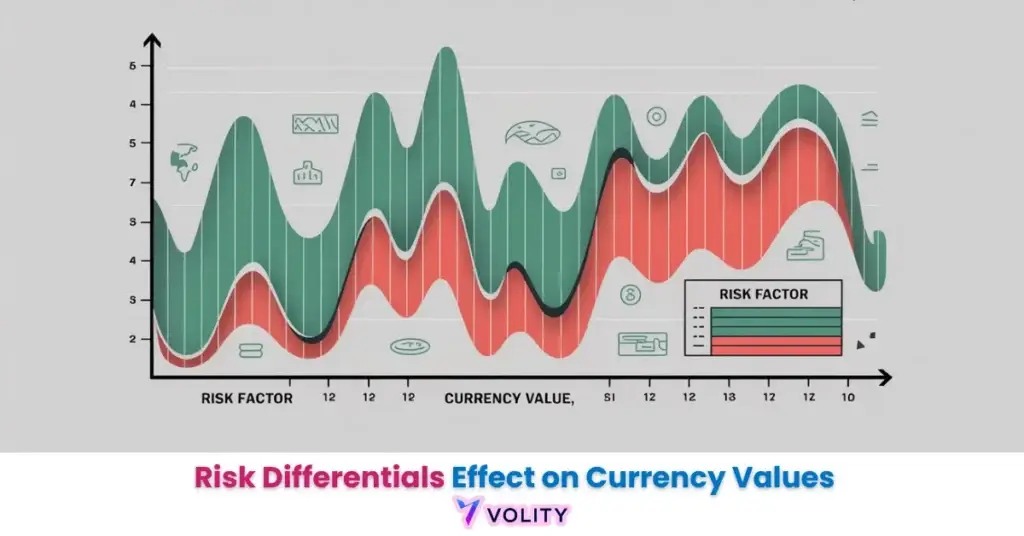
L’analyse des différentiels de risque implique des prévisions macroéconomiques et une évaluation géopolitique, toutes deux intrinsèquement incertaines. Les relations historiques entre différentiels de risque et mouvements de devises peuvent se rompre durant les périodes de crise ou les revirements de politique. Une devise offrant un rendement élevé en raison d’une exposition élevée au différentiel de risque peut connaître une fuite soudaine de capitaux qui submerge la compensation par les taux d’intérêt. Le levier amplifie les pertes lorsque des chocs géopolitiques ou des dégradations de notation déclenchent une dépréciation rapide. Capital à risque dans tout trading avec levier.
Les différentiels de risque décrivent l’écart de risque économique et politique perçu entre deux nations, servant de principal critère filtrant pour les flux de capitaux internationaux. Lorsque le différentiel de risque s’élargit au détriment d’une devise, les capitaux quittent l’économie locale au profit des « valeurs refuges », entraînant une dépréciation immédiate. En 2026, ces différentiels sont redéfinis par la résilience climatique et les charges de dette géopolitiques.
Les différentiels de risque fonctionnent comme le « système de filtrage » mondial pour les capitaux institutionnels en quête d’environnements refuges ou à forte croissance. Ces variations de stabilité perçue dictent si une devise connaît une fuite ou une accumulation de capitaux. Cela reste le facteur le plus influent pour déterminer la direction à long terme des taux de change.
Le paysage macroéconomique de 2026 est de plus en plus défini par la transition vers la revalorisation du crédit alignée sur le climat selon Bâle III. En conséquence, l’écart de risque entre les économies avancées et les marchés émergents se resserre, modifiant fondamentalement le récit traditionnel de la « valeur refuge ».
Comprendre Risk Differentials est important, mais la vraie progression commence en appliquant ces connaissances. Créez votre compte de trading forex gratuit pour vous entraîner sur un compte démo gratuit et mettre votre stratégie à l’épreuve.
Que sont les différentiels de risque et comment pilotent-ils la demande de devises ?
Les différentiels de risque sont les variations mesurables de stabilité économique, politique et budgétaire entre deux pays qui déterminent l’attrait relatif de leurs devises. Ce principe fondamental explique pourquoi certaines devises se renforcent durant les périodes de crise tandis que d’autres s’effondrent. Le différentiel crée une asymétrie dans la demande de capitaux.
Le mécanisme de « fuite vers la qualité » révèle pourquoi les capitaux passent des régimes à haut risque aux régimes à faible risque durant la volatilité. Lorsque les tensions géopolitiques s’intensifient ou que les données économiques se détériorent, les investisseurs institutionnels quittent systématiquement les devises plus risquées et accumulent les devises refuges comme le dollar américain, le franc suisse et le yen japonais. Ce comportement mécanique est entièrement prévisible, les périodes de crise déclenchent toujours cet exode.
Les déterminants du risque incluent l’instabilité de l’inflation, l’incertitude politique et les déficits budgétaires. Un pays dont la volatilité de l’IPC dépasse 8 % (comme certains marchés émergents) fait face à une prime de risque plus élevée qu’un environnement stable à 2-3 %. Les troubles politiques accroissent l’incertitude du régime. Les déficits budgétaires supérieurs à 10 % du PIB signalent des charges de dette croissantes. Ces facteurs se combinent pour créer le différentiel de risque global.
La perspective de 2026 identifie comment le « risque sécuritaire » du réarmement géopolitique revalorise l’euro. La dette publique de la zone euro devrait passer à 89,8 % du PIB en 2026 en raison d’augmentations historiques des dépenses de défense (QuantBeckman Macro Analysis, 2026). Cette détérioration structurelle élargit le différentiel de risque au détriment de l’EUR/USD, exerçant une pression baissière sur la devise.
Le critère filtrant de 123 000 milliards de dollars
Les différentiels de risque représentent le principal obstacle aux 123 000 milliards de dollars d’investissements requis pour les objectifs mondiaux de durabilité d’ici 2035. Le « déficit de financement des ODD » reflète la réticence des investisseurs à déplacer des capitaux des économies avancées stables vers les marchés émergents. L’instabilité politique, les cadres réglementaires faibles et la vulnérabilité climatique créent des différentiels de risque qui empêchent ce transfert de capitaux.
La raison pour laquelle la richesse concentrée au Nord reste hésitante à se déplacer vers le Sud global révèle la persistance de l’aversion au risque. Les investisseurs des économies avancées exigent des primes de risque (rendements élevés) pour compenser l’exposition aux marchés émergents. Lorsque ces primes de rendement ne se matérialisent pas, les capitaux n’affluent pas. Le différentiel de risque agit comme une barrière, non parce que les économies émergentes sont intrinsèquement plus risquées, mais parce que les investisseurs les perçoivent comme telles.
Prêt à faire passer votre trading au niveau supérieur ?
Vous avez les connaissances. Il vous manque la plateforme. Rejoignez des milliers de traders qui choisissent Volity pour ses outils puissants, son exécution rapide et son support dédié.
Créez votre compte en moins de 3 minutesComment les différentiels de risque souverain impactent-ils l’EUR/USD en 2026 ?
Les tolérances budgétaires divergentes entre les États membres de l’UE identifient un différentiel de risque souverain qui s’élargit et exerce une pression baissière sur la valorisation mondiale de l’euro. La zone euro n’est pas une entité budgétaire unique, ses 20 nations membres ont des charges de dette et des stabilités politiques très différentes. Cette hétérogénéité structurelle crée le différentiel de risque qui fragilise la devise.
L’Italie face à l’Allemagne illustre l’impact des disparités de dette sur PIB sur l’unité de l’UE. L’Italie porte une dette à 140 % du PIB tandis que l’Allemagne maintient 60 %. Lorsqu’un stress géopolitique émerge (comme le pivot vers le réarmement), les investisseurs discriminent entre ces économies. Les capitaux passent des actifs italiens aux actifs allemands, créant une prime de risque qui élargit l’écart EUR/USD. L’euro, étant une devise partagée, ressent la moyenne pondérée de tous les risques de ses membres.
Les coûts du réarmement révèlent comment les dépenses de défense de l’OTAN pèsent sur les budgets nationaux. L’Allemagne s’est engagée à 2 % du PIB en dépenses de défense, soit environ 80 milliards d’euros par an. La France fait face à des charges similaires. Ces dépenses augmentent les déficits budgétaires, poussant les ratios de dette à la hausse. La charge pèse inégalement sur les économies aux niveaux de dette déjà élevés, élargissant le différentiel de risque au sein même de la zone euro.
Le pivot de politique monétaire entre les États-Unis et la zone euro crée des profils de risque contrastés. Les États-Unis maintiennent des taux d’intérêt « plus élevés plus longtemps », soutenant la force du dollar par la supériorité du rendement réel. La zone euro poursuit un « tampon de stagnation », acceptant une faible croissance avec des taux modérés pour éviter de déclencher des crises de dette. Cette divergence de politique élargit le différentiel de risque à mesure que les investisseurs exigent des rendements en dollars plus élevés pour compenser la plus faible croissance de la zone euro.
La part des États-Unis dans le PIB mondial a chuté de 14 % depuis 1970, tandis que l’Europe a décliné de 7 %, déplaçant le différentiel risque-croissance à long terme (Force for Good, 2026). Pourtant, paradoxalement, le dollar américain se renforce durant les crises malgré ce déclin économique relatif. Cette contradiction apparente se résout par la liquidité et le statut de monnaie de réserve que le dollar conserve indépendamment de sa performance économique comparative.
Le risque climatique et le resserrement des différentiels EA vs ME
Les différentiels de risque liés au climat identifient que les économies avancées font face à des chocs budgétaires croissants qui stabilisent le profil de risque relatif des devises des marchés émergents. Cela représente un renversement fondamental du schéma historique où les devises émergentes se négociaient toujours à des spreads de risque plus larges que les devises des économies avancées.
L’intégration de Bâle III force les banques à revaloriser le risque « vert vs non vert ». Les banques attribuent désormais des exigences de capital plus élevées aux secteurs à forte intensité carbone et aux actifs « bruns ». Ce changement réglementaire pénalise les industries traditionnelles des économies avancées, infrastructures fossiles, construction automobile, production industrielle, qui y sont disproportionnellement concentrées. Les économies émergentes aux secteurs « bruns » moins développés font face à des pénalités de capital plus faibles, resserrant le différentiel de risque.
La résilience climatique émerge comme le nouveau critère de valorisation des devises. Les nations mettant en œuvre des cadres vérifiables d’hydrogène vert, des engagements en énergies renouvelables et des obligations souveraines alignées ESG attirent des capitaux précisément parce que leur profil de risque s’améliore par rapport aux économies avancées exposées au climat. Certaines devises émergentes deviennent des « valeurs refuges » pour les capitaux ESG à mesure que les investisseurs fuient les secteurs des économies avancées plombés par le climat.
Exemple de trading réel : L’Australie a mis en œuvre un cadre vérifiable d’hydrogène vert en 2026, tandis que les États-Unis faisaient face à une série de crises d’assurance liées au climat en Floride/Texas. Le resserrement du différentiel de risque a conduit à un rallye de 300 pips de l’AUD à mesure que les capitaux recherchaient une exposition « résiliente » aux matières premières. Les performances passées ne préjugent pas des résultats futurs.
Les coûts de transition impactent la liquidité locale à mesure que les secteurs à forte intensité carbone subissent une revalorisation. Les compagnies d’électricité du Japon font face à d’énormes coûts de rééquipement. La base industrielle de l’Allemagne affronte les charges de la transition énergétique. Ces coûts apparaissent sous forme de stress budgétaire et de faiblesse de la devise. À l’inverse, les pays dotés de ressources renouvelables abondantes et d’avantages de précurseur voient leur devise se renforcer à mesure que les capitaux se tournent vers ces expositions plus sûres.
L’impact du risque bancaire vs non bancaire sur la liquidité du marché
Le resserrement des différentiels de risque entre les banques traditionnelles et les preneurs de dépôts non bancaires (NBDT) identifie une intensification de la concurrence pour la liquidité retail en 2026. Ce changement a de profondes implications pour les carry trades de devises et les coûts de financement institutionnel.
| Indicateur de risque | Référence mondiale 2026 | Signal haut risque | Signal faible risque | Impact sur la devise |
| CDS souverain | 45 – 85 pb (majeures) | > 150 pb | < 25 pb | Baissier si en hausse |
| Dette sur PIB | 89,8 % (zone euro) | > 120 % | < 60 % | Baissier si > 100 % |
| Inflation IPC | 2,5 % – 3,5 % | > 8,0 % | < 2,0 % | Volatil |
| Taux d’intérêt réel | 1,5 % – 2,5 % | Négatif | > 4,0 % | Haussier si stable |
| Score de risque ESG | 70/100 (moy.) | < 40/100 | > 90/100 | Haussier (long terme) |
Source : données compilées à partir du Schroders Global Risk Outlook (2025) et des audits de flux de capitaux de Wellington Management (2026).
Les spreads de CDS souverains fournissent la mesure la plus liquide du risque de crédit. Lorsque les spreads de CDS s’élargissent au-dessus de 150 points de base, les capitaux institutionnels deviennent hésitants à détenir cette devise sauf à une compensation de rendement extrêmement élevée. Un spread qui se resserre sous 25 points de base signale une confiance à faible risque et attire les capitaux.
Les preneurs de dépôts non bancaires concurrencent désormais directement les banques traditionnelles pour les dépôts retail. Cette démocratisation de la finance réduit la traditionnelle « prime de sécurité bancaire » qui avait gonflé les différentiels de risque du système bancaire. À mesure que le financement par les NBDT devient accepté, le risque perçu des régimes de devises traditionnels se resserre, affectant les flux de capitaux internationaux.
Quand les différentiels de risque n’expliquent-ils pas l’action des prix ?
Le sentiment de marché et le rééquilibrage de liquidité identifient les cas où les flux de capitaux à court terme l’emportent sur la logique fondamentale des différentiels de risque. Comprendre quand l’analyse fondamentale se rompt est critique pour les traders.
Le « paradoxe de la valeur refuge » décrit pourquoi l’USD monte parfois même lorsque le risque américain augmente. Durant une panique extrême (comme la crise financière de 2008), les investisseurs ne se souciaient pas du risque américain, ils avaient besoin de liquidité. Le dollar américain, étant l’actif le plus liquide au monde, attirait les capitaux indépendamment de la détérioration fondamentale. Ce paradoxe persiste en 2026 chaque fois que des périodes de stress aigu émergent.
Les chocs géopolitiques comme le « pivot du réarmement » de 2026 forcent des mouvements de capitaux indépendamment des considérations de rendement. Lorsque les tensions militaires s’intensifient de manière inattendue, les traders institutionnels quittent les actifs risqués en temps réel, abandonnant la logique fondamentale du différentiel de risque. La revalorisation se produit en minutes, pilotée par les gros titres plutôt que par les feuilles de calcul.
Les anticipations futures expliquent pourquoi le marché valorise parfois une baisse de taux en 2027 alors que le spread de risque actuel paraît haussier pour la devise. Si les traders croient que la banque centrale baissera ses taux en 2027, ils ne se soucient pas des avantages de rendement de 2026, ils anticipent une dépréciation. Ce comportement prospectif déconnecte l’action des prix à court terme des différentiels de risque contemporains.
Conseils de trading stratégiques pour l’environnement de risque de 2026
Les stratégies de trading efficaces en 2026 identifient l’alignement des mises à jour de crédit souverain avec les niveaux techniques de prix pour des entrées à forte conviction. Combiner l’évaluation du risque macro avec l’analyse technique produit des transactions à plus forte probabilité.
Suivre les cycles de notation souveraine de S&P Global et Moody’s fournit un avertissement précoce des grands changements de devises. Les agences de notation publient des revues selon des calendriers fixes. Si une dégradation de notation paraît imminente, les traders avisés devancent la décision. Cette surveillance systématique des calendriers de notation complète l’analyse technique basée sur les prix.
Cartographier les écarts de rendement mondiaux par rapport aux flux d’argent institutionnel révèle l’ampleur du repositionnement des capitaux. Lorsque les écarts de rendement entre obligations d’État s’élargissent substantiellement, le rééquilibrage institutionnel s’accélère. Le calendrier économique forex met en évidence les publications économiques majeures qui déplacent la perception du risque.
Filtrer les configurations de risque avec le RSI et les croisements de moyennes mobiles garantit que vous ne poursuivez pas les mouvements sur la seule base d’une idéologie macro. Si le différentiel de risque favorise une devise mais que le RSI est en surachat et que le prix est au-dessus de la moyenne mobile à 20 périodes, la transaction est probablement tardive. La confirmation technique évite l’entrée à des niveaux d’épuisement.
Transformez vos connaissances en profit
Vous avez lu, il est temps d’agir. La meilleure façon d’apprendre, c’est en pratiquant. Ouvrez un compte démo gratuit et sans risque et entraînez votre stratégie avec des fonds virtuels dès aujourd’hui.
Ouvrir un compte démo gratuitPoints clés
- Les différentiels de risque sont les principaux moteurs des flux de capitaux, déterminant la force relative d’une devise face à une autre sur le marché de 2026.
- Le réarmement géopolitique a élargi la prime de risque sécuritaire pour la zone euro, les ratios dette sur PIB approchant 90 % dans plusieurs économies clés.
- Les cadres alignés sur le climat selon Bâle III forcent une revalorisation du risque de crédit, resserrant l’écart entre les devises des économies avancées et émergentes.
- Les spreads de CDS souverains fournissent une mesure en temps réel de la solvabilité d’un pays et sont un indicateur avancé d’une dépréciation imminente de la devise.
- La théorie du sourire du dollar explique pourquoi le dollar américain reste l’actif refuge de premier plan durant les crises mondiales, indépendamment des niveaux de risque domestiques américains.
- Les flux d’argent institutionnel sont de plus en plus filtrés par les scores ESG et de durabilité, faisant de la résilience climatique une composante centrale de la valorisation de 2026.
Foire aux questions
Cet article contient des références aux différentiels de risque et à la valorisation des devises avec Volity, une plateforme de trading de CFD réglementée. Ce contenu est produit à des fins éducatives uniquement et ne constitue pas un conseil financier ni une recommandation d’exécuter une stratégie de trading spécifique. L’analyse macroéconomique et l’évaluation géopolitique sont intrinsèquement incertaines ; vérifiez toujours les réglementations du courtier et maintenez une discipline de gestion du risque adéquate avant de trader. Certains liens de cet article peuvent être des liens affiliés.