Réponse rapide
Le capex IA est l’énorme dépense d’investissement que les entreprises technologiques injectent dans l’infrastructure IA comme les centres de données, les puces et l’énergie pour construire et faire tourner des modèles d’IA. Cet essor stimule la demande pour les fabricants de puces et l’énergie mais soulève des questions sur les rendements et les limites de puissance. Pour les traders, le capex IA façonne les perspectives des actions technologiques, des fabricants de puces et des marchés de l’énergie.
Investir dans des produits financiers comporte des risques. Les pertes peuvent dépasser la valeur de votre investissement initial.
Le discours du marché est bruyant. Vos contrôles doivent l’être davantage.
Les grandes capitalisations technologiques tirent désormais une grande partie du rendement des indices. Au début de 2025, les 10 plus grandes entreprises du S&P 500 représentaient près de 40 % de l’indice, égalant, voire dépassant, l’ère des dot-com [1].
Pendant ce temps, le rapport sur l’emploi américain de juillet n’a ajouté que 73 000 emplois. Plus important encore, il a supprimé 258 000 emplois du total de mai-juin via des révisions. Cela a suffi à modifier à la fois le débat sur les baisses de taux et le taux d’actualisation dans les modèles de portefeuille [2].
Parallèlement, l’IA a fait de la construction de centres de données l’une des charges électriques à la croissance la plus rapide au monde. En 2024, ces sites ont consommé environ 415 TWh d’électricité, et la demande continue d’augmenter rapidement [3]. Les installations hyperscale nécessitent souvent des connexions de plus de 100 MW. Par conséquent, l’énergie, et non les GPU, devient la véritable limite [4]. De nombreuses prévisions tablent désormais sur un doublement de la demande mondiale en électricité des centres de données d’ici 2030 [5].
La politique commerciale ajoute une pression supplémentaire. En 2024, les États-Unis ont étendu les tarifs douaniers de la Section 301 aux semi-conducteurs, aux batteries et plus encore [6]. Puis, en août 2025, Washington a élargi ces mesures à plusieurs partenaires. En conséquence, les chaînes d’approvisionnement technologiques font face à des coûts plus élevés et à davantage d’incertitude [7].
La vague de dépenses d’investissement est réelle, et irrégulière
Pour des idées d’exposition plus larges, consultez notre guide sur les cryptos IA, les infrastructures DePIN et notre stratégie d’allocation d’actifs.
- Alphabet a relevé ses prévisions de dépenses d’investissement pour 2025 à environ 85 milliards de dollars, citant les serveurs et les nouveaux centres de données [8].
- Meta a projeté 66-72 milliards de dollars en 2025, incluant les contrats de location-financement pour l’infrastructure IA [9].
- Microsoft maintient son plan axé sur l’IA d’environ 80 milliards de dollars, bien que le rythme ralentisse [10].
- Amazon a un objectif de dépenses d’investissement d’environ 100 milliards de dollars, principalement pour AWS et les puces personnalisées [11].
Des dépenses d’investissement d’une telle ampleur deviennent une force macroéconomique. Elles façonnent la demande des services publics, la production industrielle, les commandes de semi-conducteurs et même l’utilisation des sols pour les centres de données. Elles créent également un risque lié aux titres individuels. Si un hyperscaler retarde ses dépenses, l’effet peut se répercuter sur plusieurs chaînes d’approvisionnement à la fois.
Pourquoi la « reconnaissance de formes » se heurte toujours à la physique, et au compte de résultat
Les grands modèles de langage sont de puissants outils de reconnaissance de formes. Cependant, ils ne progressent que jusqu’à ce qu’ils atteignent des limites en termes de données, de calcul et d’énergie.
Ce n’est pas seulement de la théorie. En 2021, Bender et ses collègues ont mis en garde contre les rendements décroissants des modèles toujours plus grands [13]. À l’inverse, les « lois d’échelle » de 2020 ont convaincu beaucoup de personnes que plus grand signifiait toujours meilleur [14]. Aujourd’hui, même des leaders comme Yann LeCun affirment que de nouvelles architectures seront nécessaires pour le prochain bond en avant [13].
Pour les investisseurs, la leçon est claire : ne valorisez pas des rendements élevés perpétuels uniquement sur la taille du modèle. Exigez plutôt la preuve de l’économie unitaire, d’un avantage en matière de données et d’un accès stable à l’énergie.
Un manuel pratique pour les directeurs des investissements et les gestionnaires de portefeuille
1) Dimensionnement des positions pour le risque de concentration
Fixez des limites claires sur l’exposition aux mégacapitalisations dans votre mandat.
Testez par scénario une baisse de 20-30 % des leaders de l’IA si les dépenses d’investissement ralentissent ou si des retards énergétiques surviennent.
Incluez les chocs tarifaires dans ces tests pour modéliser des coûts d’importation plus élevés.
Équilibrez l’exposition en combinant des avoirs pondérés par la capitalisation avec des titres équipondérés ou de moyenne capitalisation [1].
2) Faites de l’énergie un point de diligence, pas une case à cocher ESG
Demandez aux partenaires les dates d’interconnexion, les conditions d’achat d’énergie et les plans de secours.
Modélisez les retards de projet en fonction de l’accès au réseau, des besoins de refroidissement et de l’approvisionnement en eau [3][4][5].
3) Traduisez le risque tarifaire en chiffres réels
Faites correspondre vos coûts aux lignes tarifaires.
Quantifiez les changements de coût rendu et la part que vous pouvez répercuter sur les clients.
Planifiez les délais de réapprovisionnement avant que les changements de politique ne frappent [6][7].
4) Surveillez les signaux de discipline des dépenses d’investissement
Suivez : le revenu par dollar de dépenses d’investissement, l’utilisation des accélérateurs, la conversion de trésorerie et la vitesse de monétisation de l’IA.
Écoutez le langage des prévisions : l’augmentation de 10 milliards de dollars d’Alphabet, la fourchette de 66-72 milliards de dollars de Meta, le ralentissement de Microsoft, le plan d’environ 100 milliards de dollars d’Amazon portent tous des signaux [8][9][10][11].
5) Gardez une poche d’actifs contracyclique
Les banques centrales sont restées acheteuses nettes d’or au T2 2025 malgré un rythme plus lent [12].
Dimensionnez les allocations en fonction de vos besoins de liquidité et de votre mandat.
Signaux qui comptent
- Mises à jour du réseau : approbations ou reports près des sites de centres de données [3][5].
- Calendriers tarifaires : avis de l’USTR et réponses des partenaires [6][7].
- Cadence des dépenses d’investissement : augmentations ou réductions trimestrielles des plans de dépenses [8][9][10][11].
- Données sur l’emploi : masse salariale et révisions comme celle de juillet de +73k/-258k [2].
Conclusion pour le second semestre 2025
Les dépenses d’investissement dans l’IA sont une marée puissante. Cependant, les limites énergétiques et la politique commerciale forment le rivage qui définira sa portée.
Par conséquent, récompensez les entreprises qui convertissent leurs dépenses en rendements de trésorerie, et non seulement en lancements de modèles. De plus, diversifiez-vous en vous éloignant de tout récit unique en mélangeant l’exposition entre les capitalisations boursières et les régions.
Volity
Volity donne aux investisseurs les outils pour agir sur ce manuel avec une exécution de qualité institutionnelle et un accès aux marchés mondiaux, où tout volume trouve de l’agilité. La plateforme offre un trading professionnel et fiable avec un accès sans effort, abordable et transparent à travers les classes d’actifs.
Références
[1] Au début de 2025, les 10 plus grandes entreprises du S&P 500 représentaient près de 40 % de l’indice.
[2] BLS : masse salariale de juillet 2025 +73k ; révisions nettes mai-juin -258k.
[3] Estimation AIE : électricité des centres de données ≈ 415 TWh en 2024.
[4] AIE : les grands centres de données hyperscale nécessitent souvent des connexions de plus de 100 MW.
[5] AIE : la demande mondiale des centres de données pourrait doubler d’ici 2030.
[6] USTR : extensions de 2024 aux VE, batteries, semi-conducteurs.
[7] 1 août 2025 : les actions tarifaires américaines étendues à davantage de partenaires.
[8] Alphabet T2 2025 : prévisions de dépenses d’investissement ≈ 85 milliards de dollars.
[9] Meta T2 2025 : 66-72 milliards de dollars de dépenses d’investissement (incl. location-financement).
[10] Microsoft FY25 : ~ 80 milliards de dollars de dépenses d’investissement IA, croissance plus lente.
[11] Amazon 2025 : ~100 milliards de dollars de dépenses d’investissement.
[12] WGC : banques centrales acheteuses nettes d’or, T2 2025.
[13] Bender et al. (2021) : critique des « Stochastic Parrots ».
[14] Kaplan et al. (2020) : lois d’échelle pour les modèles neuronaux.
Par Alexander Bennett, bureau de recherche Volity.
Ce que surveillent nos analystes : Trois lectures ancrent une vision sérieuse des actions du cycle de l’IA qui filtre le discours plus bruyant. Le ratio dépenses d’investissement sur flux de trésorerie opérationnel à travers la cohorte des hyperscalers vous indique quels bilans absorbent la construction par rapport à ceux qui s’endettent pour elle ; le point d’inflexion se situe lorsque le ratio dépasse 60 % pendant deux trimestres consécutifs. Le débit des files d’attente d’interconnexion de PJM et ERCOT par rapport à la demande annoncée des centres de données révèle où se trouve le véritable goulot d’étranglement du réseau, qui est désormais la contrainte de dépenses d’investissement contraignante plutôt que la disponibilité des puces. Et le rendement du flux de trésorerie disponible sur les noms des fournisseurs d’outils par rapport au rendement des bons du Trésor à long terme sépare les sociétés à croissance structurelle des trades de momentum de fin de cycle qui se réévaluent lors du prochain choc macroéconomique.
Questions fréquemment posées
Quelle est l’ampleur réelle de la vague de dépenses d’investissement dans l’IA, en chiffres audités pour 2025 ?
Les dépenses d’investissement déclarées pour l’année civile 2025 par les quatre plus grands hyperscalers américains ont dépassé 300 milliards de dollars, les taux trimestriels de mi-2025 suggérant que l’année civile 2026 sera encore plus élevée avant toute pause cyclique. La série de discussions sur la finance et l’économie de la Réserve fédérale héberge des documents de travail qui placent la poussée des dépenses d’investissement dans un contexte macroéconomique par rapport aux cycles d’investissement historiques. La lecture structurelle pour les allocateurs : des dépenses d’investissement de cette ampleur avancent généralement de deux à trois ans la demande d’équipements électriques, d’emballages avancés et de services de réseau, et les carnets de commandes des fournisseurs d’outils sont l’indicateur avancé le plus clair.
À quoi ressemble réellement la contrainte énergie-réseau en 2026 ?
Les files d’attente d’interconnexion américaines chez PJM et ERCOT détiennent désormais des agrégations de demande de centres de données de plusieurs gigawatts, avec des retards qui dépassent le débit d’approbation des quatre trimestres glissants. La couverture d’Investopedia sur l’économie des centres de données passe en revue la structure des coûts, avec une introduction claire sur la façon dont l’énergie est désormais le coût marginal dominant. L’implication pratique pour la sélection d’actions : les noms qui possèdent ou contractent une capacité énergétique à long terme à des tarifs inférieurs au réseau se négocient à des multiples de prime significatifs, et cette prime s’est maintenue à travers plusieurs réinitialisations trimestrielles.
Comment les traders particuliers doivent-ils dimensionner l’exposition aux CFD du cycle de l’IA selon les règles de l’UE ?
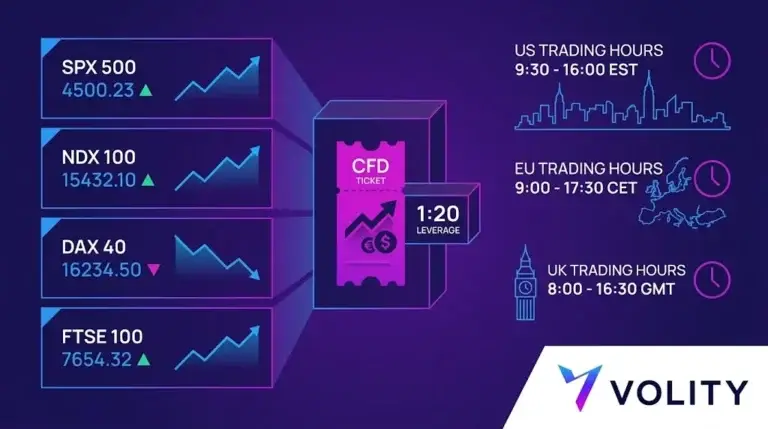
Le cadre d’intervention sur les produits de l’ESMA pour les CFD de détail établit la base de référence de l’UE pour les avertissements sur les risques, les plafonds de levier (5:1 sur les actions individuelles, 20:1 sur les indices majeurs), la protection contre les soldes négatifs et la divulgation standardisée. Le CME publie également des données sur le régime de volatilité des indices boursiers que les bureaux institutionnels utilisent pour dimensionner les positions à travers le panier corrélé à l’IA. Volity, accessible via UBK Markets et supervisé par la CySEC sous la licence 186/12, liste des CFD sur indices boursiers et actions individuelles liquides avec des fonds clients ségrégués et une divulgation de détail standardisée.
Guides connexes
- Meilleures actions IA pour l’investissement
- Investir en actions pour les débutants
- Meilleures plateformes de trading d’actions en Europe
- Meilleures plateformes de trading
- Gestion des risques
Volity exploite une plateforme de trading et publie également du contenu éducatif et analytique sur le trading. Le contenu de cette page est uniquement à des fins éducatives et ne doit pas être considéré comme un conseil financier. Volity peut bénéficier commercialement lorsque les lecteurs ouvrent des comptes de trading via les liens présents sur ce site.
Notre contenu est produit et révisé selon des standards éditoriaux documentés ; consultez notre méthodologie de comparaison et de revue.