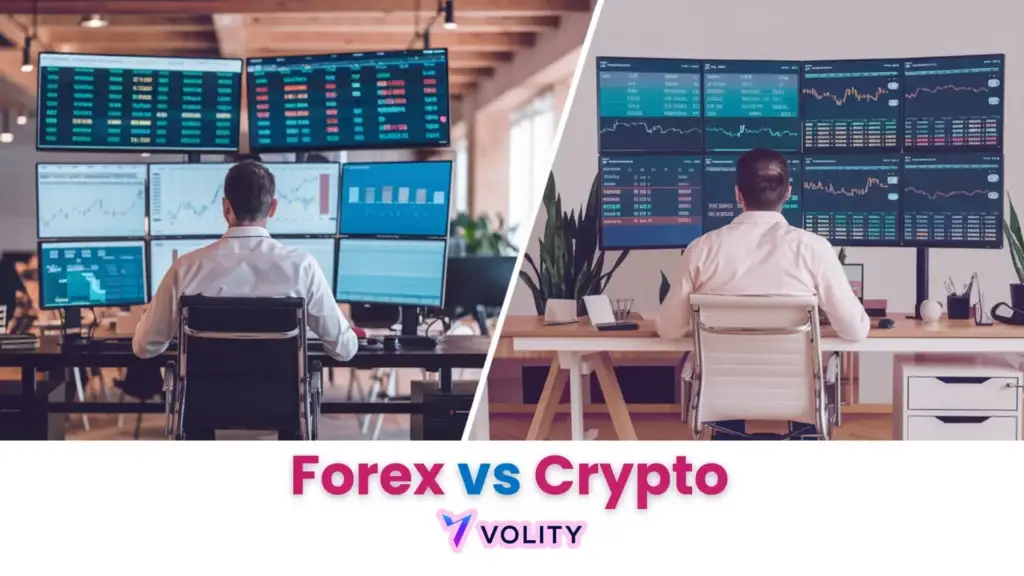
Le trading du forex et de la crypto représente des profils de risque fondamentalement différents qui ne peuvent pas être comparés directement sans comprendre leurs environnements réglementaires distincts. Le levier du forex est strictement limité (1:30 pour les particuliers), tandis que le levier crypto peut atteindre 1:100+ sur les plateformes non réglementées, exposant les traders à une liquidation quasi instantanée. La volatilité crypto est statistiquement 3 à 5 fois plus élevée que celle des principales paires de forex, rendant le dimensionnement de position standard du forex catastrophiquement dangereux lorsqu’il est appliqué aux actifs numériques. Le marché crypto fonctionne 24h/24, 7j/7, 365j/an sans coupe-circuits, ce qui signifie qu’un choc géopolitique peut provoquer un krach éclair de 20 % en quelques minutes, alors que les coupe-circuits institutionnels préviennent des scénarios similaires dans le forex. Capital à risque dans tout trading à effet de levier.
La distinction principale entre le trading du forex et de la crypto en 2026 réside dans l’ampleur de la liquidité et l’intensité de la volatilité des prix. Le forex reste le plus grand marché financier du monde avec un volume quotidien de 9,6 billions de dollars, offrant stabilité et réglementation profonde. En revanche, le marché crypto, bien qu’il mûrisse vers une capitalisation totale de 2,8 billions de dollars, offre une accessibilité 24h/24 et 7j/7 et des opportunités « convexes » à forte volatilité grâce à la finance décentralisée (DeFi) et aux actifs tokenisés.
Forex vs. crypto trading est devenu un débat fondamental pour les participants du marché moderne cherchant à optimiser leur allocation de capital en 2026. Cette comparaison met en lumière les différences structurelles entre un système centralisé basé sur le fiat et une économie décentralisée pilotée par la blockchain. Comprendre ces distinctions est essentiel pour sélectionner un marché qui s’aligne sur votre tolérance au risque spécifique et vos objectifs financiers.
Le paysage financier de 2026 est de plus en plus défini par la convergence de ces deux classes d’actifs à travers les ETF institutionnels et le fiat numérique. À mesure que des cadres réglementaires comme MiCA apportent de nouveaux niveaux de clarté, les traders doivent évaluer s’il faut prioriser la liquidité profonde du forex ou le potentiel de forte croissance du secteur crypto.
Comprendre Crypto est important, mais la vraie progression commence en appliquant ces connaissances. Créez votre compte de trading crypto gratuit pour vous entraîner sur un compte démo gratuit et mettre votre stratégie à l’épreuve.
Quelles sont les différences fondamentales entre le trading du forex et de la crypto ?
Le trading du forex et de la crypto se distingue par leur technologie sous-jacente, la participation au marché et la nature centralisée vs. décentralisée de leurs opérations. Le marché du forex fonctionne comme un réseau décentralisé de banques et de courtiers mondiaux tradant des devises adossées aux gouvernements, tandis que le trading crypto se déroule à la fois sur des plateformes d’échange centralisées (CEX) et des protocoles décentralisés (DEX) gérant des jetons numériques basés sur la blockchain. Ces différences structurelles créent des modèles de risque, des heures de trading et des caractéristiques de liquidité complètement différents qui définissent l’expérience du trader sur chaque marché.
Les distinctions opérationnelles entre le forex et la crypto sont fondamentales et affectent chaque aspect du trading. Le forex fonctionne pendant les heures ouvrables à travers les pôles régionaux, Sydney, Tokyo, Londres, New York, créant des cycles de 24 heures prévisibles qui ferment le week-end. La crypto fonctionne en continu 24h/24, 7j/7, 365j/an sans coupe-circuits ni arrêts de trading, ce qui signifie qu’une crise géopolitique à 3h00 du matin un dimanche peut déclencher une cascade de liquidations avant qu’un quelconque trader particulier ne se réveille pour surveiller ses positions. Les actifs du forex (les devises) tirent leur valeur des économies nationales soutenues par les banques centrales, tandis que les jetons crypto tirent leur valeur de l’utilité du protocole, de l’adoption du réseau ou, dans de nombreux cas, de la pure spéculation.
Les structures de participation au marché diffèrent considérablement entre les deux écosystèmes :
- La participation au forex est dominée par les traders institutionnels, des multinationales couvrant le risque de change, des banques centrales intervenant sur les marchés, des fonds de pension rééquilibrant et des sociétés de trading propriétaire professionnelles exécutant des algorithmes quantitatifs
- La participation à la crypto reste fortement influencée par les « baleines » particulières (des individus fortunés avec des positions de plusieurs millions de dollars), des sociétés de capital-risque natives de la crypto et une vague émergente d’adoption institutionnelle via les ETF au comptant
- Le contrôle décentralisé vs. centralisé signifie que la tarification du forex découle du marché interbancaire où des milliers de milliards d’ordres établissent la découverte des prix, tandis que la tarification crypto est fortement influencée par la profondeur du carnet d’ordres des plateformes et les transactions blockchain individuelles
Selon CoinMarketCap, la capitalisation boursière totale des cryptomonnaies avoisine 2,8 billions de dollars, portée par l’approbation de divers ETF au comptant dans les juridictions mondiales. Cette croissance représente une acceptation institutionnelle, mais la capitalisation du marché crypto ne représente encore que 3 % du volume quotidien du forex, une comparaison d’échelle qui révèle la différence structurelle entre ces marchés.
Structure du marché : centralisé vs. décentralisé
Le marché du forex est un réseau décentralisé de gré à gré (OTC) de banques mondiales, tandis que le trading crypto repose sur un hybride de plateformes d’échange centralisées et de protocoles décentralisés pair-à-pair. Le marché interbancaire du forex établit la tarification par des accords directs de banque à banque, il n’y a pas de « plateforme centrale » fixant les prix. Au lieu de cela, des millions de cotations provenant de milliers de teneurs de marché s’agrègent en un prix de consensus décentralisé. Cette structure crée une liquidité profonde où tout trader peut exécuter un ordre de 100 millions de dollars avec un impact minimal sur le marché.
Les plateformes d’échange décentralisées (DEX) offrent aux participants du marché de 2026 des options de trading non dépositaires où ils conservent le contrôle total de leurs actifs numériques tout au long de la transaction. Cependant, la liquidité des DEX reste fragmentée sur des centaines de plateformes et de pools de trading, ce qui signifie que les gros ordres crypto subissent souvent un slippage massif par rapport à leurs équivalents forex. La structure de marché hybride, combinant la commodité des plateformes centralisées avec la transparence des protocoles décentralisés, crée une dynamique de risque unique dans la crypto qui n’a pas d’équivalent sur le marché mature du forex.
Prêt à faire passer votre trading au niveau supérieur ?
Vous avez les connaissances. Il vous manque la plateforme. Rejoignez des milliers de traders qui choisissent Volity pour ses outils puissants, son exécution rapide et son support dédié.
Créez votre compte en moins de 3 minutesAnalyse de la liquidité : comparer le marché du FX de 9,6 billions de dollars aux actifs numériques
La liquidité du marché identifie la facilité avec laquelle un actif peut être converti en liquidités sans impacter son prix de marché. Le marché du forex fonctionne comme un « océan » de liquidité où un volume quotidien de 9,6 billions de dollars permet des ordres institutionnels massifs avec zéro slippage sur les principales paires. Un trader exécutant un ordre de 10 millions de dollars sur EUR/USD lors du chevauchement Londres-New York connaît une exécution au prix exact du marché, car des ordres d’achat et de vente suffisants existent pour absorber la transaction sans bouger le marché.
La liquidité crypto se concentre fortement dans les actifs de premier rang, Bitcoin (BTC) et Ethereum (ETH), les « altcoins » souffrant souvent de carnets d’ordres minces et d’un slippage élevé pendant la volatilité du marché. Les deux plus grandes cryptomonnaies gèrent environ 50 à 70 milliards de dollars de volume quotidien (2026), ce qui signifie qu’un ordre de 1 million de dollars pourrait connaître une concession de prix de 0,5 à 2 % rien que pour s’exécuter. Pour les traders détenant des positions plus longtemps que quelques minutes, ce slippage se cumule en coûts de transaction qui dépassent tous les profits.
Les stablecoins (USDT et USDC) fonctionnent comme les principaux fournisseurs de liquidité pour l’économie crypto, jouant le même rôle que les réserves de liquidités dans le forex. Lorsqu’un trader sort d’une position en altcoin, il convertit souvent en stablecoins plutôt qu’en fiat traditionnel, gardant le capital au sein de l’écosystème crypto. Selon l’Enquête triennale des banques centrales du BIS, avril 2025, le volume quotidien mondial du forex a atteint 9,6 billions de dollars, soit une hausse de 28 % par rapport aux 7,5 billions enregistrés trois ans plus tôt. Cette échelle dépasse largement la capacité de la crypto à absorber de gros ordres institutionnels.
Profils de volatilité
La volatilité des prix identifie la fréquence et l’ampleur des variations de prix d’un actif sur une période donnée. La volatilité du forex reste généralement inférieure à 1 % par jour pour les principales paires comme EUR/USD, permettant aux traders d’utiliser un levier élevé (1:30) avec un risque gérable. Un trader utilisant un levier de 30:1 peut supporter un mouvement de marché de 2 % avant de connaître une baisse de compte de 60 %, un seuil qui prévient la liquidation forcée dans des conditions de marché normales. La volatilité crypto opère dans un spectre complètement différent, avec des fluctuations quotidiennes standard de 3 % à 15 %, rendant le levier élevé extrêmement dangereux pour les participants particuliers.
La mécanique mathématique de la volatilité démontre pourquoi les ratios de levier ne peuvent pas être transférés entre les marchés. Un compte de 1 000 $ avec un levier de 30:1 sur EUR/USD (contrôlant 30 000 $ de notionnel) peut tolérer un mouvement de 2 % d’EUR/USD avant la liquidation. Le même compte de 1 000 $ avec un levier de 30:1 sur Bitcoin (contrôlant 30 000 $ de notionnel) ne peut tolérer qu’un mouvement de 0,65 % de Bitcoin avant la liquidation. Lorsque Bitcoin fluctue de 5 % en une heure, un événement courant en 2026, le compte est liquidé plusieurs fois.
La « convexité » de la crypto représente le potentiel de hausse asymétrique qui définit l’attrait des actifs numériques. Bitcoin et Ethereum ont historiquement connu des rallyes de plus de 50 % pendant les cycles haussiers, créant des opportunités de constitution de patrimoine que les principales paires de forex ne peuvent égaler. Un trader détenant EUR/USD peut générer des rendements annuels de 5 à 10 % grâce à une analyse technique disciplinée et à des opérations de carry. Un trader détenant Bitcoin pendant un marché haussier de 12 mois peut générer des rendements de plus de 100 %. Cette convexité explique pourquoi les investisseurs tolérants au risque acceptent le risque de drawdown extrême associé à la crypto.
Exemple réel de trading : un trader a alloué 1 000 $ aux deux actifs lors d’un basculement de marché « risk-on » en mars 2026. La paire EUR/USD a bougé de 0,8 % (offrant un gain de 8 $ sur le notionnel de levier de 30 000 $), tandis que Bitcoin a bondi de 12 % (offrant un gain de 120 $ sur le notionnel de levier de 30 000 $), illustrant le « delta » supérieur de la crypto pendant les régimes haussiers. Les performances passées ne préjugent pas des résultats futurs.
Le paysage réglementaire de 2026
L’environnement réglementaire de 2026 identifie la transition d’un « Far West » spéculatif vers une classe d’actifs institutionnalisée pour les devises numériques. La réglementation du forex a mûri sur plus de 50 ans, avec des organismes établis comme la FCA, l’ASIC et la CySEC créant des plafonds de levier uniformes, des fonds clients ségrégés et une résolution des litiges standardisée. La réglementation crypto reste fragmentée entre les juridictions mais se consolide rapidement autour de cadres comme MiCA de l’UE, qui crée des normes contraignantes pour tous les États membres.
| Caractéristique | Réglementation forex | Réglementation crypto (2026) | Impact pour l’investisseur |
| Pôles principaux | FCA, ASIC, CySEC | MiCA (UE), FCA (R.-U.), VARA | Niveau de protection |
| Fonds ségrégés | Obligatoires (banques de premier rang) | Obligatoires pour les licenciés VASP | Risque de contrepartie |
| Limites de levier | Strictes (1:30 particuliers) | 1:2 à 1:20 (régional) | Risque de liquidation |
| Déclaration fiscale | Standardisée (selon la juridiction) | Déclaration on-chain automatisée | Facilité de conformité |
| Résolution des litiges | Médiateur/national | Émergente (limitée) | Capacité de recours |
Le ESMA : règlement sur les marchés de crypto-actifs (MiCA) établit la ségrégation obligatoire des fonds des clients et des limites de trading conçues pour prévenir les krachs éclair. Cependant, la réglementation crypto reste nettement moins mature que la réglementation du forex, la réglementation crypto mondiale évoluant encore de façon fragmentée plutôt que par une autorité statutaire unifiée. Cet écart réglementaire crée des avantages de trading professionnels pour ceux qui comprennent la conformité MiCA, mais il laisse aussi les participants particuliers sans le niveau de protection que les courtiers forex doivent fournir.
Lequel est le plus rentable
Les métriques de rentabilité identifient les rendements ajustés au risque historiques et projetés pour chaque marché sur un horizon d’investissement standard. Le « roi de la stabilité », le forex, excelle à fournir un revenu constant et à faible risque grâce aux opérations de carry et au suivi de tendance. Un trader exécutant une stratégie disciplinée de risque de 2 % par transaction sur EUR/USD peut générer de manière fiable des rendements annuels de 8 à 12 % avec un stress psychologique minimal. Cette performance stable reflète la structure de marché mature, la liquidité profonde et la faible volatilité qui caractérisent le trading institutionnel 24 heures sur 24.
Le « moteur de croissance », la crypto, a surperformé toutes les devises fiat sur le cycle 2017-2025, avec un taux de croissance annuel composé (TCAC) sur 10 ans du Bitcoin dépassant 50 %. Un trader qui aurait détenu Bitcoin tout au long de son histoire aurait connu une multiplication de patrimoine par des facteurs de plus de 10 000. Cependant, cette performance s’est accompagnée de multiples drawdowns de plus de 80 % qui ont liquidé les comptes de tous sauf des traders les plus résilients psychologiquement. Le rôle du levier modifie considérablement ce calcul, la plus faible volatilité du forex permet au levier d’amplifier les rendements en toute sécurité, tandis que le levier crypto crée un risque de liquidation qui efface les gains.
Les traders professionnels en 2026 utilisent de plus en plus la « rotation inter-actifs », déplaçant les profits crypto vers des « valeurs refuges » du forex comme l’USD ou le CHF pendant les marchés baissiers des actifs numériques. Cette stratégie capture la hausse de la crypto tout en faisant tourner le capital avant les corrections majeures. Cette pratique reflète la reconnaissance que les deux actifs remplissent des fonctions de portefeuille différentes : le forex fournit un revenu fiable et une gestion du risque, tandis que la crypto fournit une hausse asymétrique pendant les régimes de croissance.
Transformez vos connaissances en profit
Vous avez lu, il est temps d’agir. La meilleure façon d’apprendre, c’est en pratiquant. Ouvrez un compte démo gratuit et sans risque et entraînez votre stratégie avec des fonds virtuels dès aujourd’hui.
Ouvrir un compte démo gratuitPuis-je trader à la fois le forex et la crypto sur la même plateforme ?
Les plateformes de trading multi-actifs identifient l’efficacité opérationnelle de la gestion des expositions fiat et numériques à travers une seule interface de courtage. L’essor des courtiers CFD (contrat sur la différence) en 2026 a permis aux traders d’accéder à EUR/USD et BTC/USD dans un seul tableau de bord avec des comptes sur marge unifiés. Cette commodité opérationnelle permet à un trader de détenir une position longue EUR/USD et une position longue Bitcoin, les deux transactions contribuant à un seul calcul d’exigence de marge.
Le compromis critique est que la commodité d’une plateforme unique se fait au prix du sacrifice de l’« auto-conservation » pour les positions crypto. Un trader détenant Bitcoin chez un courtier CFD ne contrôle pas réellement les clés privées, il détient un contrat sur le mouvement du prix. Cette distinction compte lors d’événements de stress extrême où les plateformes d’échange centralisées (y compris les courtiers CFD) ont historiquement gelé les retraits pendant les krachs de marché, piégeant les traders dans des positions qu’ils ne peuvent pas clôturer. La véritable auto-conservation crypto nécessite de retirer les actifs vers un portefeuille personnel, ce qui augmente la friction opérationnelle mais élimine le risque de contrepartie.
Points clés
- Le trading du forex reste le plus grand marché financier du monde, gérant 9,6 billions de dollars de volume quotidien avec une stabilité de qualité institutionnelle.
- Le trading crypto offre une accessibilité supérieure 24h/24, 7j/7, 365j/an, permettant une participation mondiale en dehors des heures bancaires traditionnelles.
- La liquidité du marché du forex garantit un slippage quasi nul, tandis que la liquidité crypto reste largement concentrée dans les actifs de premier rang comme BTC et ETH.
- La volatilité des prix dans la crypto est statistiquement 3 à 5 fois plus élevée que celle des principales paires de forex, créant à la fois un potentiel de profit plus élevé et un risque de ruine accru.
- La surveillance réglementaire pour le forex est mature et standardisée, tandis que le paysage crypto de 2026 est défini par le nouveau cadre MiCA.
- Les stratégies de trading hybrides qui combinent la stabilité du fiat avec la croissance des actifs numériques sont le choix privilégié des portefeuilles institutionnels de 2026.
Foire aux questions
Cet article contient des références au trading du forex, au trading de cryptomonnaies et à Volity, une plateforme de trading de CFD réglementée. Ce contenu est produit uniquement à des fins éducatives et ne constitue pas un conseil financier ni une recommandation de trader des actifs forex ou crypto. Les profils de risque, les caractéristiques de liquidité et les cadres réglementaires du forex et de la crypto diffèrent fondamentalement ; les traders doivent mener des recherches indépendantes adaptées à leur tolérance au risque avant de sélectionner l’une ou l’autre classe d’actifs. Certains liens de cet article peuvent être des liens d’affiliation.