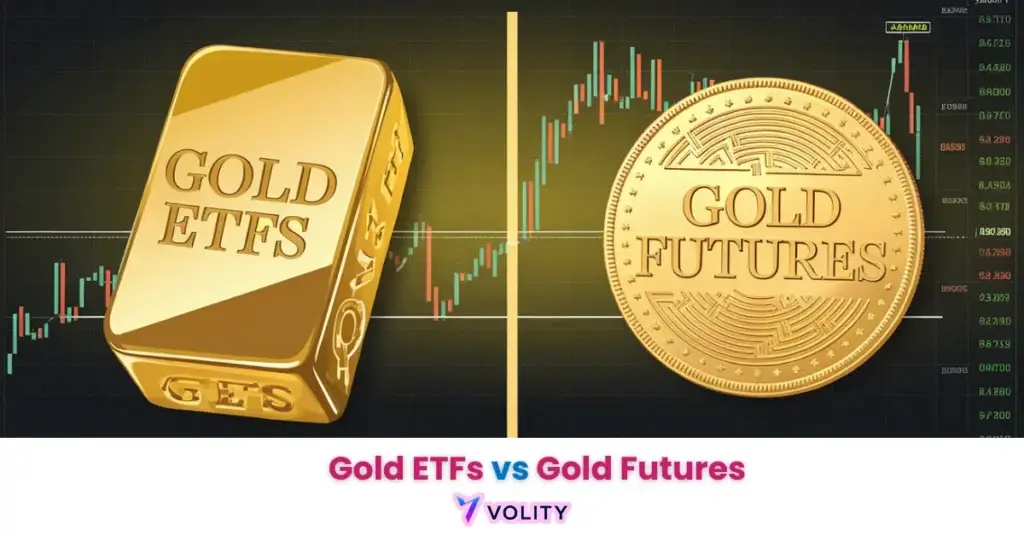
Gold ETFs and gold futures are investment vehicles with different risk profiles and structural characteristics. ETFs provide 1:1 exposure but carry expense ratios; futures offer leverage but can result in losses exceeding your initial deposit through margin calls or forced liquidation. Futures contracts expire and require active management. Past performance is not indicative of future results. Capital at risk. Consult a licensed financial advisor before choosing between these instruments.
Gold ETFs provide 1:1 spot price exposure through standard brokerage accounts, making them ideal for long-term allocation. In contrast, gold futures utilize significant leverage and require active margin management, serving tactical traders and hedgers. In 2026, the choice depends on holding period: ETFs eliminate margin call risk, while futures offer superior capital efficiency for short-term price discovery.
Gold ETFs function as a simplified gateway for retail and institutional investors seeking to replicate the spot price of gold within a traditional equity brokerage account. These funds identify the most efficient way to hold physical bullion by pooling capital into large-scale, audited vaulting systems. They serve as a foundational component for the modern 60/40 portfolio seeking inflation protection in 2026. Investors often ask whether a major low-cost provider issues one directly; the guide to the Vanguard gold ETF explains why Vanguard routes gold exposure through a mining-equity fund rather than a physical tracker.
The 2026 market landscape distinguishes between the passive nature of ETF shares and the contractual obligations of futures agreements. Traders utilize these instruments differently: ETFs are used for strategic multi-year wealth preservation, while futures are employed to manage short-term volatility or to execute complex basis trades.
While understanding Gold ETFs vs Gold Futures is important, applying that knowledge is where the real growth happens. Create Your Free Crypto Trading Account to practice with a free demo account and put your strategy to the test.
What are the fundamental differences between Gold ETFs and Gold Futures?
Gold ETFs are fund-based securities that represent fractional ownership of physical bullion, whereas gold futures are derivative contracts obligating the future exchange of the metal. ETF shareholders enjoy fractional ownership of the underlying vault assets held by custodians like HSBC and Brinks. Futures market participants are contractual counterparties to the CME exchange and its clearing mechanism, with no direct ownership claim on the physical metal.
The key structural difference lies in trading venues and leverage access. ETFs trade on stock exchanges (NYSE/NSE) during regular market hours using standard brokerage accounts, while futures trade on dedicated commodity exchanges (CME/COMEX) with 24-hour electronic access. ETFs provide 1:1 exposure with no leverage, you control an amount of gold equivalent to your purchase price. Gold futures employ the CME’s 9.0% percentage-based margin system, allowing traders to control 100-ounce contracts (notional value $460,000) with only $41,400 of initial margin. IAU holds a significant cost advantage with a 0.25% expense ratio compared to GLD’s 0.40% in 2026 (BlackRock/State Street, 2026).
The Concept of Notional Value
Notional value is the total dollar amount of gold controlled by a single contract or share position. A single standard gold futures contract (GC) controls 100 troy ounces, which at $4,600/oz equals a $460,000 notional value despite requiring only $41,400 in initial margin. By contrast, an individual GLD share represents a fractional claim on the fund’s bullion and costs approximately $235 per share, with the full $235 required to purchase each share.
Ready to Elevate Your Trading?
You have the information. Now, get the platform. Join thousands of successful traders who use Volity for its powerful tools, fast execution, and dedicated support.
Create Your Account in Under 3 MinutesWhy do Gold ETFs sometimes underperform the spot gold price?
Tracking error identifies the numerical divergence between an ETF’s performance and the actual movement of the physical gold spot price. While ETFs are designed to track gold spot prices closely, they accumulate small performance gaps due to expenses and operational costs. The annual expense ratios of 0.25%-0.40% are deducted daily from the fund’s Net Asset Value (NAV), creating a measurable drag on long-term returns.
Cash drag and physical storage fees erode long-term ETF returns relative to direct physical bullion ownership. Each ETF requires vault storage, insurance, and administration costs that are ultimately borne by shareholders through the fund’s fee structure. Over a 10-year period, a 0.15% fee gap between IAU and GLD has resulted in a 5.2% performance difference (24/7 Wall St, 2026). Creation and redemption baskets, the mechanism by which large institutional investors add or remove shares from the fund, cause minor price premiums or discounts when supply-demand imbalances occur. These premiums typically resolve within days, but they create temporary tracking error for investors transacting during these windows. For current Spot Gold Price comparisons, you can verify the NAV discount or premium in real time.
How does the 2026 Percentage-Based Margin affect futures traders?
The percentage-based margin system is a dynamic collateral framework that automatically adjusts required deposits based on gold’s current market price. On January 13, 2026, the CME transitioned from fixed-dollar margin requirements (e.g., a flat $25,000 per contract) to a percentage-based system set at 9.0% of notional contract value. This architectural change means that as gold prices rise, your required collateral automatically increases, a critical risk management feature during extreme volatility.
The transition from fixed to percentage-based margins creates distinct capital requirement scenarios. At $4,600/oz, a standard 100-ounce contract has a notional value of $460,000, requiring $41,400 in margin (9.0%). If gold rallies to $5,000/oz, the same contract now has a $500,000 notional value and requires $45,000 in margin, an automatic $3,600 adjustment. This proportional structure prevents margin requirements from becoming obsolete during price spikes. The risk of margin calls intensifies during volatility: a 5% drop in gold prices (from $4,600 to $4,370) reduces your equity by 50% on the initial $41,400 collateral, potentially triggering forced liquidation if you lack additional capital.
Real trading example: An investor bought 1 contract at $4,600/oz in May 2026 using the 9.0% margin rule, requiring $41,400 of initial capital. The price rose to $4,710/oz, generating an $11,000 profit ($110 × 100 oz) on just $41,400 of initial capital, a 26.5% return on equity. This demonstrates the leverage potential of futures while illustrating the inverse relationship: at $4,710/oz with a 9.0% margin requirement, maintaining the position now requires $42,390 in margin. Past performance is not indicative of future results. The leverage magnifies both gains and losses, and small adverse moves can eliminate profits rapidly.
What is the impact of roll yield in a contango market?
Roll yield benchmarks identify the cost or benefit associated with maintaining a long-term position in the gold futures market. When the futures market displays contango, a normal market structure where forward prices are higher than spot, long-term holders face a recurring cost. As the expiring front-month contract approaches its delivery date, traders “roll” their position forward to the next available delivery month, typically locking in a small loss equal to the basis between the old and new contracts.
The table below illustrates the current contango structure and its impact on position holders:
| Metric | 2026 Value / State | Impact on Long Holder |
| Market Structure | Normalized Contango | Negative Roll Yield |
| Spot Gold Price | ~$4,700/oz | Base Value |
| Front-Month Future | ~$4,725/oz | Roll Basis |
| Annual Roll Cost | ~1.8% – 2.2% | Performance Drag |
| Q1 2026 Structure | Extreme Backwardation | Positive Roll Yield (Rare) |
Sources: May 12, 2026, CME term structure and Investing.com reporting
Normalization toward $4,725/oz from spot $4,700/oz reflects the healthy cost-of-carry structure: storage fees, insurance, and the Fed Funds rate. Every time you roll forward one month, you realize this small cost, which compounds to 1.8%-2.2% annually. This creates a persistent performance headwind for long-term futures holders compared to ETF investors, who have no rolling costs. Rare backwardation episodes, such as Q1 2026, create positive roll yield when spot prices exceed forward prices, benefiting long holders temporarily.
Portfolio Synergy: When to use both ETFs and Futures?
Institutional asset allocation represents a hybrid strategy that utilizes ETFs for core holdings and futures for tactical risk management. The optimal structure separates the strategic 80-90% core position (held in IAU or GLD for long-term wealth preservation) from the tactical 10-20% overlay (implemented via futures to hedge Fed policy risk or to capture technical retracements). This bifurcated approach allows institutions to capture both the passive wealth preservation of ETFs and the dynamic hedging capabilities of futures without overconcentration in either instrument.
Institutional portfolios using 90% core ETF exposure and 10% futures overlay benefit from the mathematical advantages of both: the simplicity and low costs of ETFs provide the foundation, while futures allow precise duration control and beta adjustments without selling the core position. Tax treatment creates an additional consideration: in the UK, gains on both gold futures and gold ETFs are generally subject to Capital Gains Tax, while certain legal-tender bullion coins such as Britannias and Sovereigns are CGT-exempt. This distinction makes holding structure and residency important for active traders with substantial gains. Gold vs S&P 500 allocations that include gold should follow this hybrid structure: maintain 70-80% in physical or ETF form, allocate 10-15% to tactical futures positions, and reserve 5-10% for real-time portfolio rebalancing.
Turn Knowledge into Profit
You have done the reading, now it is time to act. The best way to learn is by doing. Open a free, no-risk demo account and practice your strategy with virtual funds today.
Open a Free Demo AccountThe Future of Gold Proxies: Tokenization vs. Traditional Wrappers
Tokenized gold represents the evolution of the precious metals market by combining blockchain transparency with physical vaulting. Emerging instruments like PAXG (Paxos Trust Company Gold) and XAUT (Tether Gold) issue tokens on blockchains where each token represents one troy ounce of audited physical gold held in institutional vaults. These hybrid vehicles offer 24/7 trading liquidity (like futures) while maintaining physical backing (like ETFs).
The 2026 liquidity landscape increasingly favors tokenized gold for institutional participants seeking cross-border settlement and real-time delivery capabilities. PAXG and XAUT trade with significantly tighter bid-ask spreads than traditional GLD or IAU shares outside traditional market hours, and they bypass the traditional ETF custodian structure entirely. This evolution suggests that the future gold market may consolidate around three primary wrappers: ETFs for buy-and-hold retail investors, futures for active speculators and hedgers, and tokenized gold for institutions requiring 24/7 settlement and transparent on-chain reserves. Tokenized Gold platforms are gaining adoption rapidly, and Blockchain in Finance infrastructure improvements are making them increasingly viable alternatives to traditional CME contracts.
Key Takeaways
- Gold ETFs offer 1:1 spot price exposure and are ideal for long-term strategic allocation within standard brokerage accounts.
- Gold futures provide significant leverage through a 9.0% percentage-margin system, making them suitable for tactical trading and hedging.
- IAU (iShares Gold Trust) is the cost leader in 2026 with an expense ratio of 0.25%, compared to GLD’s 0.40%.
- Roll yield becomes a persistent cost for long-term futures holders during contango markets, averaging 2% annually in 2026.
- The new CME margin rules established in January 2026 ensure that collateral requirements scale automatically with gold’s market price.
- Tracking error in ETFs is primarily driven by annual management fees and the physical costs of vaulting and insurance.
Frequently Asked Questions
This article contains references to gold ETFs, gold futures, and Volity, a regulated CFD trading platform. This content is produced for educational purposes only and does not constitute financial advice or a recommendation to buy or sell any financial instrument. Always verify current regulatory status and platform details before using any trading service. Some links in this article may be affiliate links.
Related reading: complete gold trading guide.