Crypto daily: bitcoin whiplash, Ripple’s IPO tease, and regulators on the march
Crypto markets look tired, but not broken. Bitcoin is fighting back towards $61,000 after a sharp ETF-led wobble. Meanwhile, XRP traders are staring at Ripple’s boardroom gossip and wondering why the token still sulks.
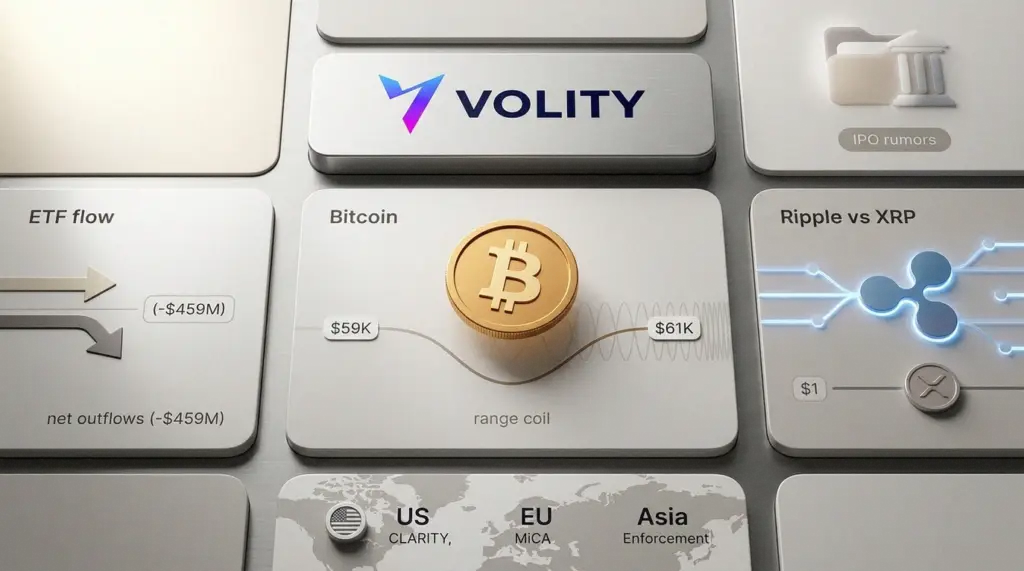
The broader tape carries that uneasy pre-inflation feel. Equities have slipped for several sessions, though dip buyers keep appearing near the lows. Crypto followed the same script. Bitcoin fell from about $63,000 to below $59,000, then clawed back into a narrow $60,000 to $61,000 band.
However, volume remains thin. That matters. A quiet range after forced selling often sets the stage for the next hard move. Traders should treat this as a coiled market, not a calm one.
Bitcoin
Spot bitcoin ETFs remain the cleanest read on institutional demand. Recent sessions brought roughly $459 million in net outflows. That pressure helped trigger hundreds of millions of dollars in liquidations across crypto futures.
Still, the selling has not turned disorderly. Buyers continue defending the high-$50,000s and low-$60,000s. Meanwhile, the crypto Fear and Greed Index sits close to extreme fear, which often marks better entries than exits.
For now, BTC traders have two obvious levels. A sustained break below $59,000 would invite another liquidation wave. However, a push back through $63,000 would suggest ETF selling has lost its bite.
By the numbers
- BTC range: roughly $59,000 to $63,000 after the latest flush.
- ETF flows: about $459 million in recent net outflows.
- XRP spot: mostly trapped near $1.10 to $1.30.
- AAVE move: up about 17% from recent lows.
- Pi unlock: about 1.21 billion tokens due to become transferable in 2026.
XRP
Ripple has had the kind of corporate year token loyalists once prayed for. It boasts regulatory clarity, institutional relationships and a growing stablecoin push. In Japan, Ripple and SBI have rolled out RLUSD after local approval.
Yet XRP trades as if the boardroom news belongs to another asset. The token sits near the low-$1 area, down sharply from its late-2025 level near $1.84. Earlier strength into the mid-$1.40s also faded quickly.
The problem is simple, if awkward. Banks may like Ripple’s plumbing without needing XRP as fuel. Many payment corridors can use fiat settlement or RLUSD instead. Enterprise adoption does not automatically create token demand.
That gap explains the market’s stubborn mood. ETF launches have not brought the flood of sticky money bulls expected. Meanwhile, on-chain usage still needs to prove that XRP is more than a trading vehicle.
Ripple’s IPO tease
Brad Garlinghouse has added fresh intrigue. Ripple’s chief executive suggested XRP holders might receive a “special arrangement” if the company goes public. Valuation chatter has put a possible listing near $40 billion to $50 billion.
However, Ripple has not presented a filing. Monica Long has also said the company does not need an IPO soon. That gives the rumour heat, but not much structure.
Traders should ask one blunt question. Would any IPO-linked benefit flow to XRP holders, or only to equity owners? Regulators would also inspect any token benefit that looked like shadow equity.
Until documents appear, the IPO story remains sentiment fuel. It can move a thin market quickly. However, it cannot support a durable valuation without legal detail.
XRP levels
Technicians are watching the $1.07 area closely. A decisive break below it could deepen selling, especially if broader crypto weakens. Meanwhile, crowded short positioning raises the chance of a fast squeeze on good news.
Medium-term forecasts remain more sober than social media suggests. Conservative models cluster around $1.70 to $3 over the next few years. More bullish analysts see $3 to $6 by 2030 if regulation improves and real usage rises.
There are louder calls for $8, $15 or even higher. However, those cases require nearly everything to work. XRP would need friendly laws, strong ETF demand and meaningful bridge-asset adoption.
For now, serious traders should track flows, usage and support levels. Viral price targets do not settle trades.
AAVE and Ethereum
While majors chop sideways, AAVE is showing a little muscle. The token has bounced about 17% from recent lows. It now tests a nine-month descending trendline, helped by fresh bank coverage and a distant $3,500 bull case for 2030.
A clean break would matter. It would suggest institutions can re-rate blue-chip DeFi, not just bitcoin proxies. However, failed breakouts in this tape can punish late buyers quickly.
Ethereum looks less distinct. ETH has held near $1,600, helped by visible dip-buying from large wallets. Still, it trades like high-beta bitcoin. Rates, ETF flows and regulation continue to dominate its personality.
Regulation
In Washington, the CLARITY Act remains the market’s key legislative drama. The bill aims to separate crypto commodities from securities. However, Senate timing now threatens the hoped-for July vote.
That delay matters most for institutions. Funds can tolerate volatility better than legal fog. A cleaner framework would broaden participation, even where individual tokens already have partial clarity.
Europe, meanwhile, is moving from debate to implementation. Coinbase has chosen Luxembourg as its MiCA base, positioning itself for the bloc’s unified licensing regime. Binance, by contrast, keeps searching for viable approval routes after years of regulatory friction.
The message is getting harder to miss. Compliance is becoming a competitive moat, not a cost centre. Exchanges that secure licences early may win listings, banking ties and institutional order flow.
Asia is also tightening. Indonesia wants crypto influencers certified before giving financial advice. South Korea has fined Bithumb over data practices. In China, a court handed down a death sentence in a crypto-linked laundering case involving about $7 million.
That last case is extreme. Still, it shows how harshly Beijing views unauthorised capital movement through digital assets.
AI agents and proof of personhood
A quieter theme is also building beneath the daily price noise. AI agents are moving towards crypto rails for payments, contracts and automated execution. In the United States, arbitration structures now seek to clarify how agents act for humans in disputes.
At the same time, proof-of-personhood systems are gaining attention. Projects want to separate real users from bots, farms and fake engagement. Identity rails may become as important as payment rails.
For markets, the trading angle is practical. Better identity tools could reduce wash trading and fake user growth. Meanwhile, legally recognised agents could bring more automated activity on-chain.
Speculation corner
The market’s wild end remains feral. Pump.fun-style token factories keep producing coins that vanish almost as quickly as they launch. About 69% of such tokens effectively die on day one, as liquidity and buyers disappear.
MemeCore offered another warning. The token plunged about 75% after old manipulation allegations resurfaced. In these names, the chart can change faster than the Telegram mood.
Pi Network faces a different test. Roughly 1.21 billion Pi tokens are due to become transferable in 2026. Unless demand arrives with force, that supply could weigh heavily on price.
Trading takeaways
- Respect the BTC box: $59,000 to $63,000 remains the near-term battlefield.
- Separate Ripple from XRP: corporate wins do not automatically create token demand.
- Watch ETF flows: slower outflows could support a relief rally.
- Prefer quality DeFi: AAVE’s trendline matters more than fresh meme launches.
- Trade regulation like macro: CLARITY, MiCA and Asian enforcement can move risk appetite fast.
This market rewards patience. Liquidity still moves, but it punishes sloppy entries. As a result, the best trade may be waiting for the range to break, then letting others chase first.