Momentum traders bid up big tech, while gold flirts with records
US equities pushed higher into the afternoon, and the tape felt clean rather than frantic. The S&P 500 ETF SPY gained 0.8%, while the Nasdaq 100 ETF QQQ led with a 1.2% rise. Meanwhile, gold kept stealing glances at the record book, with the metal hovering near $2,942 an ounce and the SPDR Gold Shares GLD tracking the move.
However, the more interesting story for traders was not the headline percentages. It was the way money behaved. Buyers stayed present on minor dips, and sellers struggled to press momentum names below morning support. Therefore, the day rewarded the oldest play in the book: wait for strength, buy the pullback, then sell into extension.
QQQ acted like the day’s steering wheel. Mega-cap tech and AI-linked names held the bid, and that steadiness matters. When QQQ drifts higher with shallow pullbacks, index liquidity often becomes a tailwind for intraday breakouts elsewhere. Meanwhile, SPY ground up in a broader, less dramatic fashion, which tends to suit disciplined risk sizing.
Gold’s rally carried a different flavour. Traders pointed to tariff delays and growing chatter about rate cuts as supportive conditions. Yet the key detail was price, not the narrative. Gold at these levels attracts trend followers and profit takers in equal measure. Therefore, continuation setups tend to work best on controlled pullbacks, not on first-touch highs.
What traders watched today
- QQQ stayed firm on dips, and traders talked about a developing golden-cross structure.
- SPY climbed with a steadier profile, which often hides multiple sector rotations beneath the surface.
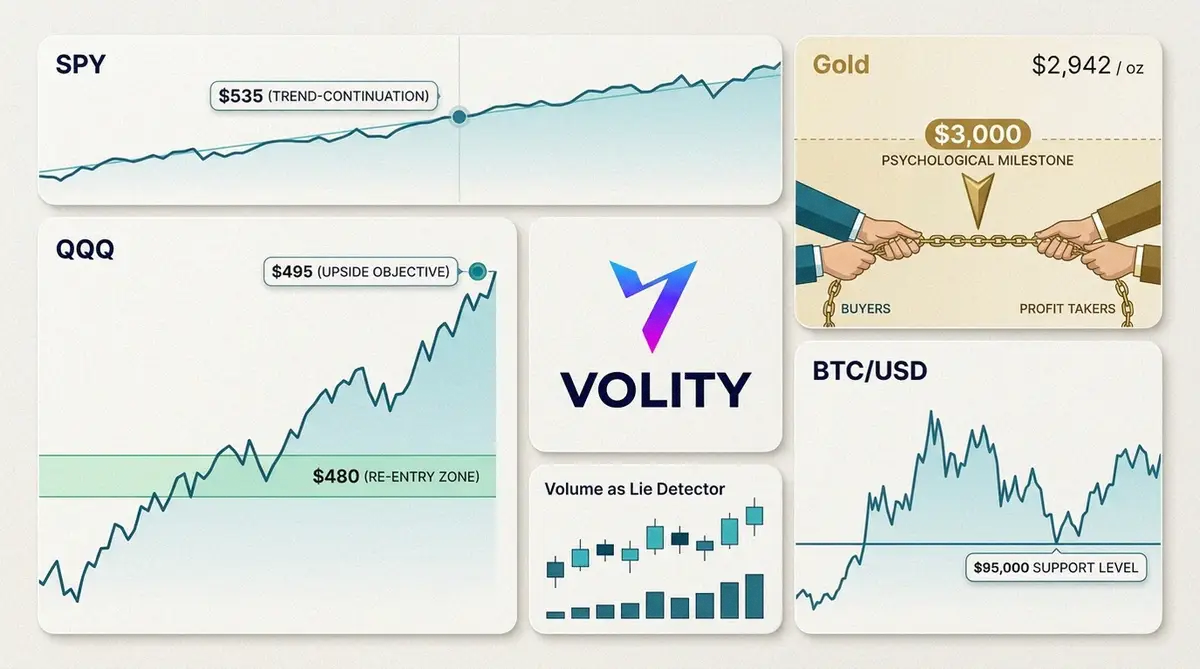
- GLD tracked spot gold near $2,942, keeping $3,000 as the obvious psychological magnet.
- BTC/USD was discussed as holding $95,000 support, reinforcing the broader risk-on tone.
- DIA sat in the background as a potential rotation vehicle if traders trim tech exposure.
Setups in focus into the close
QQQ remained the cleanest momentum proxy. Traders looked for dips towards $480 as a potential re-entry zone, with $495 cited as an upside objective. However, the more practical rule was simpler. If the ETF held above its last intraday higher low, dip-buyers kept the advantage. If it lost that level on volume, the move risked turning into an afternoon fade.
SPY drew attention around the $535 area as a line-in-the-sand for trend continuation. It is not a magic number. Yet round zones often become self-fulfilling when enough traders anchor to them. Therefore, any late-day push through resistance without broad participation would have looked fragile.
GLD offered a different tempo. Trend traders prefer gold when it marches higher in steps, not spikes. Therefore, the cleaner continuation trade usually comes after a pullback that respects the prior breakout area, rather than chasing the first print near a record.
Screening, without the theatre
Momentum traders kept it basic. They favoured names up 5%+ on at least 2x typical volume, and they cared most about the first hour’s structure. Pennants, gap pullbacks, and fresh five-day highs still do most of the work. Meanwhile, the risk plan stayed tight. Enter after a break, place a stop below the last meaningful low, and aim for roughly a 1:2 reward-to-risk.
By the numbers
- SPY: +0.8% on the session
- QQQ: +1.2% on the session
- Gold: testing near $2,942 per ounce
- BTC: traders referenced $95,000 support
Key takeaways for tomorrow’s playbook
- Prefer pullback entries in QQQ-style leaders, rather than chasing green candles late.
- Watch whether SPY holds above its last higher low, because that often signals breadth stability.
- Treat gold near records as a two-way zone, and demand a tidy setup before sizing up.
- Use volume as the lie detector, because weak breakouts fail fast in the final hour.
- Keep stops mechanical, since momentum rewards speed and punishes hesitation.
Risk still sits in the background like a draught through a cracked window. Momentum can pay quickly. It can also reverse quicker, especially into the close when liquidity thins and headlines travel faster than charts.