Volity daily: turning themes into trades
The tape has shifted from heroic AI buying to a choppier, more defensive mood. Tech still leads the story, however the market is no longer paying up blindly. That matters because crowded winners tend to fall fastest when indices lose their footing.
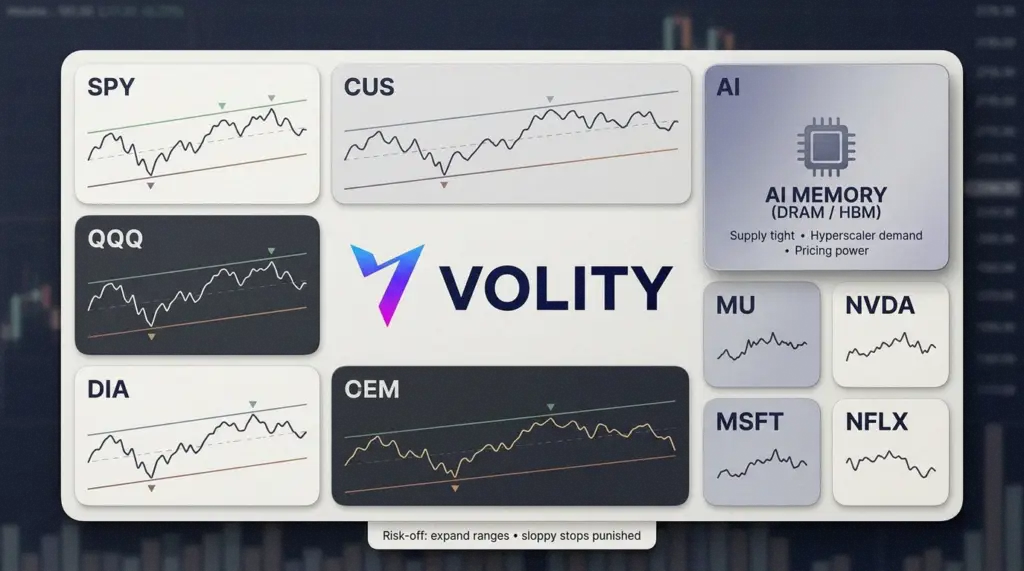
For today, treat SPY, QQQ and DIA as the control panel. If recent swing lows hold, traders can look for selective rebounds. If they break, meanwhile, high-beta AI names may overshoot on the downside before buyers return.
Market tone
Type: macro position
Bias: short-term risk-off, medium-term opportunistic
Index action remains fragile. Expanding intraday ranges are useful for disciplined traders, yet they punish loose stops. Every single-name trade should begin with the same question: is the index tape helping or fighting?
Watch the daily and weekly charts around prior lows and major moving averages. A clean hold can invite fast relief rallies. However, repeated failures near resistance often turn into lower highs, especially in QQQ.
For investors, defensive rotation deserves attention. Staples, utilities and healthcare usually catch flows when the Dow and S&P 500 break support. Meanwhile, AI and software leaders can move more than the market in both directions.
Memory trade
Tickers: MU, Samsung, SK Hynix
Type: swing or position
Bias: structurally bullish, tactically cautious
The strongest long-term theme remains the AI memory cycle. This is not just a tidy slogan. DRAM and HBM supply is tight, while server demand keeps locking in capacity.
Industry expectations still point to shortages and elevated pricing into 2026-2027. Some forecasts put DRAM contract price increases at 50-60% into early 2026. The revenue tailwind for memory suppliers looks more durable than a normal chip bounce.
Samsung, SK Hynix and Micron dominate the DRAM and HBM markets. Meanwhile, all three have better pricing power when hyperscalers chase AI capacity at the same time.
Still, investors should respect the cycle. Memory stocks can look cheap near peaks and expensive near bottoms. The cleaner approach is a basket, not a heroic single-name bet.
- Traders: look for high-volume flushes into prior support, then demand a reclaim.
- Investors: scale into MU and Korean leaders over time, not in one dip.
- Risk label: long-term AI infrastructure theme, with violent short-term drawdowns.
Microsoft setup
Ticker: MSFT
Type: swing or position
Bias: tactically cautious, long-term constructive
Microsoft has corrected as investors question the cost of the AI buildout. Revenue and earnings remain solid, however data-centre spending now faces a tougher margin debate.
That debate matters because Microsoft is no fringe AI proxy. It sits across cloud, enterprise software, security and model distribution. Weakness in MSFT can sour sentiment across the whole AI complex.
Short-term traders should ignore stale price anchors and watch the current support zone. A failed bounce under resistance, followed by a break of recent lows, favours continuation shorts.
However, a capitulation flush can set up the other side. If volume surges, price undercuts a prior low, and buyers reclaim it, a reflex bounce becomes tradeable.
Longer-term investors can use weakness more patiently. Scale in gradually, because margin pressure from AI spending may last longer than bulls expect.
Leadership check
Tickers: NVDA, MSFT, QQQ
Type: swing or position
Bias: secular constructive, tactically selective
The AI trade still has earnings behind it. Unlike the empty promises of weaker cycles, chip, cloud and infrastructure names are producing real revenue.
Even so, leadership stocks now need cleaner entries. NVDA remains the hardware and software hinge for AI infrastructure. Meanwhile, QQQ often decides whether good news gets bought or sold.
Use pullbacks towards major moving averages, post-news consolidations and failed breakdowns as potential entries. However, avoid chasing vertical moves after crowded headlines. The best AI trades now require patience, not applause.
Netflix trade
Ticker: NFLX
Type: day or short-term swing
Bias: aggressive mean-reversion long only
Netflix is a technical and event-driven trade, not a fresh long-term thesis. The key marker is the recent 52-week low.
If buyers defend that zone on volume, an oversold bounce can develop quickly. However, a clean break without a swift reclaim argues for standing aside or considering shorts.
Headline risk matters here. M&A chatter or surprise strategic news can wreck both sides intraday. This belongs in the aggressive bucket, with strict risk around the prior low.
Gap trades
Tickers: PRIM, ZION, APGE
Type: day or short-term swing
Bias: short-term negative, reaction-dependent
Guidance cuts, executive exits and analyst downgrades often create gap-down opens. However, the edge rarely sits in the news itself. It sits in the first response.
Use PRIM as the template. If the stock opens weak, bounces feebly and keeps making lower intraday highs, continuation shorts have the cleaner path.
However, a sharp reversal on volume changes the story. If price closes near the day’s high, trapped shorts may fuel a squeeze.
The same logic applies to ZION and APGE. If the chart was already weak, a downgrade can accelerate the trend. If the stock was deeply sold off, meanwhile, watch for capitulation and reversal.
Investors should wait at least another quarter after a serious reset. One bad print may be noise. Two often becomes a trend.
Event names
Tickers: JFIN, CBRS, NKE
Type: day or event-driven
Bias: pure tape-driven
These are not theme positions. They are earnings or announcement trades, where direction usually depends on the first hour.
JFIN belongs in the speculative China fintech bucket. If a strong move holds on heavy volume, trend-day longs can work. However, a gap up that fades hard points to a short setup.
CBRS brings extra event risk around its first earnings cycle. Expect wide spreads, rapid gaps and possible halts. Waiting for the post-release trend may beat trading the opening spike.
NKE remains a sentiment test. A reset followed by a rally above support can hint at a bottoming process. However, a miss, weaker guidance and a support break argue against bottom-fishing.
Relative strength
Several smaller names fit better as sentiment and relative-strength monitors than full themes. They can work, however they need confirmation from volume and price.
- IBM: lower-beta tech with policy, AI and dividend angles. Watch range highs on volume.
- KFY: relative strength after earnings. Tight holds above the gap favour continuation.
- PODD: bullish medtech initiation. Buyable only if post-note strength actually holds.
- BE: tied to Nasdaq and clean-energy sentiment. Support matters more than the story.
- AMC/MSGE: overbought mean-reversion only. Wait for momentum loss before shorting.
For VST, CRH, ROK and GNRC, treat television mentions as attention sparks. They are not theses. Follow only when volume and technical strength confirm the move.
By the numbers
- 2026-2027: expected window for tight HBM and DRAM conditions.
- 50-60%: possible DRAM contract price rise into early 2026.
- 52-week low: key reference point for NFLX bounce attempts.
- First hour: decisive window for JFIN, CBRS and NKE.
- 3 indices: SPY, QQQ and DIA set the risk frame.
Key takeaways
- Use the index tape as the filter before taking single-name AI risk.
- Memory remains the cleanest long-term AI infrastructure exposure, but entries matter.
- Microsoft is a margin-debate trade short term, not a broken franchise call.
- Netflix and downgrade names require hard levels, not conviction.
- Event trades are tape-only. If the first-hour signal is muddy, stay out.