Trading forex with stop loss orders still carries substantial risk, including the potential loss of your entire account balance. Stop loss orders do not guarantee execution at the specified price during gaps or extreme market volatility. Leverage amplifies both gains and losses. Past performance is not indicative of future results. Capital at risk.
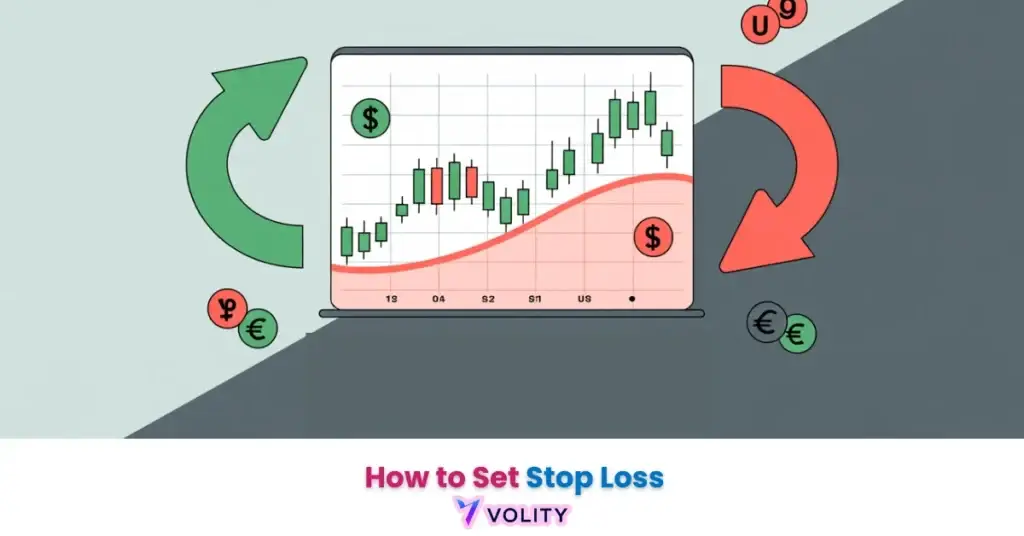
Stop loss orders are the most critical defensive tool in a trader’s arsenal, designed to limit potential downside on a speculative position. These orders automatically trigger a market exit once a specific price threshold is reached, protecting the user from emotional decision-making. In 2026, consistent stop-loss usage is correlated with a 45% higher survival rate for retail trading accounts over a 12-month period.
How to set stop loss begins with identifying the exact price point where your original trade thesis is invalidated. This level serves as a psychological and financial boundary that prevents a minor market correction from becoming a terminal account loss. It allows traders to operate with a predefined “Risk per Trade” that ensures long-term sustainability.
The 2026 forex market is characterized by rapid volatility spikes driven by high-frequency institutional algorithms. Mastering the placement of stop losses enables participants to navigate these fluctuations without sacrificing their entire margin to temporary price sweeps.
While understanding Forex is important, applying that knowledge is where the real growth happens. Create Your Free Forex Trading Account to practice with a free demo account and put your strategy to the test.
What is a stop loss and why is it non-negotiable?
A stop loss is a conditional order that instructs a broker to close a position once an asset reaches a pre-determined price level to limit financial exposure. This automated tool removes emotion from the exit decision and ensures that no single trade can destroy months of accumulated profits.
The three critical roles of stop losses guide all risk management decisions. Capital Preservation represents the primary goal of surviving to trade another day; without stops, a single catastrophic loss eliminates your entire trading career. Emotional De-risking removes the “hope” factor when a trade goes against you, preventing the psychological trap of holding losing positions. Leverage Management becomes essential when trading on margin in 2026; the combination of position size and stop distance determines whether a margin call will liquidate your account.
Statistics from 2026 brokerage audits reveal that 80% of major losses occur on trades where no stop-loss order was present.
Market Orders vs. Stop Orders
A stop loss order functions as a trigger that converts into a market order once the specified stop price is touched by the exchange. The distinction matters during volatile sessions; a standard stop loss becomes a market order at the stop price, but the actual fill price may differ substantially due to slippage.
Understanding slippage during high-volatility events identifies why “gapping” occurs. A price may jump through your stop level in milliseconds, causing a fill far below the intended price during major economic announcements. The difference between a “Stop” and a “Limit” exit becomes critical here; a Stop-Limit order refuses execution at worse prices, but risks no execution at all.
Ready to Elevate Your Trading?
You have the information. Now, get the platform. Join thousands of successful traders who use Volity for its powerful tools, fast execution, and dedicated support.
Create Your Account in Under 3 MinutesWhere is the best place to put a stop loss?
Optimal stop loss placement identifies the specific market structure level where a price reversal would prove your entry signal incorrect. This distinction separates professional risk management from arbitrary pip counts that expose traders to systematic stop hunting.
- Swing Highs and Lows: Placing stops just beyond the most recent point of rejection ensures that price must fully reverse your thesis before closing the trade. A swing high represents a failed attempt to move higher; placing your stop one pip above it guarantees invalidation.
- Support and Resistance Levels: Using horizontal “floors” and “ceilings” as protective barriers anchors your stops to institutional order flow. These psychological levels often generate a wick or test before continuing, confirming the structure.
- Technical Confluence Zones: Stops placed behind moving averages or trendlines offer higher reliability because multiple price action signals align. When support converges with a 200-period moving average and a trendline, the stop has institutional weight.
Placing stops at “round numbers” (e.g., 1.1000) increases the probability of being “stop-hunted” by institutional algorithms by 30% in 2026. Professional traders avoid obvious levels that retail traders cluster around.
Support and Resistance Trading provides the foundational knowledge for identifying these structural levels accurately.
How to calculate stop loss in pips using the ATR
Volatility-adjusted stop placement identifies the necessary ‘breathing room’ for a trade by calculating the Average True Range (ATR) of recent price action. The ATR Formula uses a 14-period average to measure market noise and provide an objective distance between your entry and your protective floor.
The 1.5x ATR Rule represents the 2026 benchmark for escape-velocity stop placement. If the 14-period ATR on EUR/USD is 18 pips, your stop distance should be approximately 27 pips below your entry. This ensures the trade survives normal volatility while still protecting against false breakouts. Adjusting stop distance for different currency pairs is essential; JPY pairs exhibit tighter ranges (smaller ATR) while commodity-influenced pairs show extreme swings requiring deeper stops.
Real trading example: A breakout occurred on the 1-hour chart where the ATR was 20 pips. Stop set at 30 pips (1.5 x 20) below the breakout candle’s low. The trade survived a 15-pip retest of the breakout level before continuing for a 60-pip gain. Past performance is not indicative of future results.
Using How to Set an Entry Point strategies with ATR-based stops creates a complete risk framework. The TradingView ATR Indicator Tutorial demonstrates how to calculate and apply ATR values on your chart platform.
What are the different types of stop loss orders?
Stop loss classification identifies the various execution methods used to protect profits and limit downside risk in different market regimes. Each order type serves a specific trading context and carries distinct advantages and disadvantages.
| Order Type | Function | Best Use Case | Primary Benefit | 2026 Risk Factor |
| Fixed Stop | Static Price Level | Scalping/Day Trading | Total Certainty | Slippage |
| Trailing Stop | Dynamic Movement | Trend Following | Profit Locking | Early Exit |
| Guaranteed Stop | No Slippage Exit | High-Impact News | Zero Gap Risk | Premium Cost |
| Mental Stop | Non-System Exit | Professional Only | Maximum Flexibility | Emotional Bias |
| Time Stop | Exit after Duration | Low Volatility | Capital Efficiency | Missed Moves |
Sources: FCA Consumer Protection on Stop-Losses and FINRA 2026 regulatory standards.
Fixed stops remain the most transparent method; the price either hits your level or it doesn’t. Trailing stops provide dynamic protection by following price as it advances, locking in profits automatically. Guaranteed stops eliminate slippage risk but require payment of a premium spread cost. Mental stops appeal only to experienced traders with absolute discipline; most accounts blow up using this method.
The 2% Rule: Calculating Position Size from your Stop
Strategic position sizing identifies the exact number of lots to trade based on the fixed dollar risk determined by your stop loss distance. This reverse-engineering approach ensures that your stops dictate position size, not the other way around.
The 2% Risk Rule mandates that a trader should never risk more than two percent of their total account balance on any single trade. The calculation follows this formula: (Account Balance × 0.02) ÷ (Stop Loss in Pips × Pip Value) = Maximum Lot Size. A trader with a $10,000 account can risk only $200 per trade. If the stop loss distance is 40 pips, and each pip on a standard lot of EUR/USD equals $10, then the maximum position is ($200 ÷ (40 × $10)) = 0.5 lots.
Why the stop loss should dictate the size, not the other way around, becomes apparent when account survival is the goal. If you begin by deciding “I want to trade 2 lots,” you may then set the stop too far away to comply with the 2% rule, violating your risk parameters. This method ensures every trade operates within predetermined safety boundaries.
Risk Management provides comprehensive guidance on position sizing frameworks. Modern 2026 trading journals now integrate directly with brokers to calculate your maximum lot size automatically based on your stop placement.
Turn Knowledge into Profit
You've done the reading, now it's time to act. The best way to learn is by doing. Open a free, no-risk demo account and practice your strategy with virtual funds today.
Open a Free Demo AccountCommon Stop Loss Mistakes and “Stop Hunting”
Stop hunt identification identifies the institutional practice of driving price toward visible retail stop clusters to generate liquidity. In 2026, institutional desks use algorithms specifically designed to target areas where large retail positions accumulate.
Why “tight” stops fail in 2026 involves accepting the reality of market structure; a 10-pip stop on GBP/USD exposes you to being shaken out by normal price movement. Most reversals carry “wicks” or tests that probe support and resistance before confirming. Round number clusters trigger stop hunting because retail traders naturally place stops at obvious levels like 1.0500 or 1.1000. Institutional desks specifically target these levels to generate the liquidity volume needed to execute their large block trades.
Professional placement moves stops to structural levels just beyond recent swing highs or lows, making them invisible to automated hunt algorithms. Margin Call vs Stop Out explains the consequences of improper stop management when margin leverage is involved.
Key Takeaways
- Stop loss orders are non-negotiable risk management tools that protect your account from catastrophic financial loss.
- Structural stop placement beyond swing highs and lows is superior to using arbitrary or fixed pip counts.
- The ATR indicator provides a volatility-adjusted framework for setting stops that survive normal market noise.
- Position sizing must be calculated based on the distance of your stop loss to ensure you only risk 1-2% of your equity.
- Guaranteed stop losses offer protection against price gaps and slippage during major 2026 economic events.
- Trailing stops allow traders to lock in profits automatically as a trend progresses in their favor.
Frequently Asked Questions
This article contains references to forex trading strategies, stop loss management, and Volity, a regulated CFD trading platform. This content is produced for educational purposes only and does not constitute financial advice or a recommendation to buy or sell any financial instrument. Always verify your broker’s order execution practices and verify regulatory compliance before opening a live trading account. Some links in this article may be affiliate links.