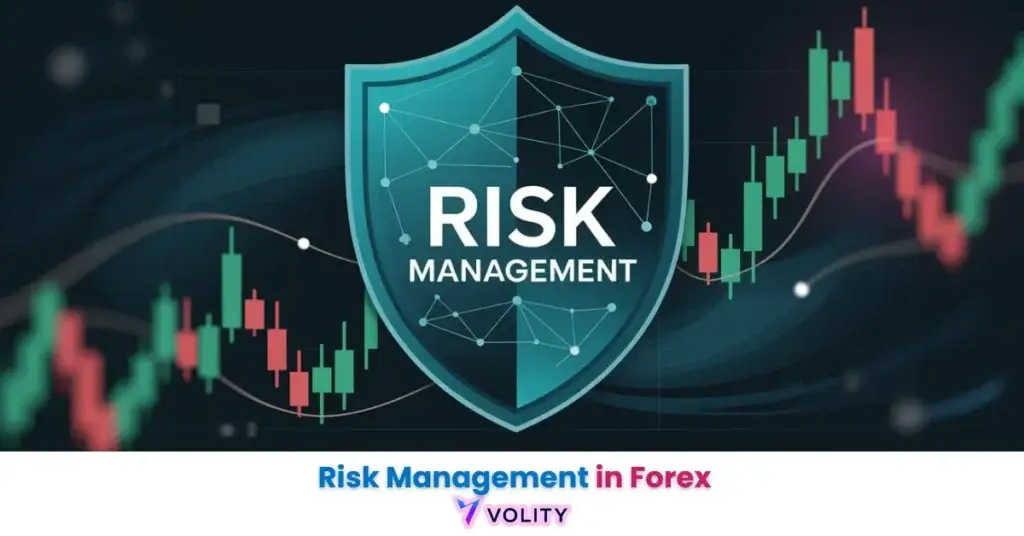
Risk Management: The Ultimate 2026 Guide to Capital Preservation

Last updated May 20, 2026
Table of Contents

Quick Summary

Risk management in forex is the systematic discipline of identifying, evaluating, and mitigating potential financial losses through controlled position sizing and strategic exit planning. In 2026, with retail margin debt hitting a record $1.3 trillion, preserving capital through the 1% risk rule and ATR-based stop-losses has become the primary differentiator between successful traders and those facing total account liquidation. Effective risk control integrates technical boundaries with psychological guardrails to ensure long-term market survival.

Risk management dynamics function as the “seatbelt” of a trading strategy, protecting the account from the inevitable volatility of global markets. This discipline allows traders to sustain losing streaks without facing catastrophic equity drawdowns. It remains the single most important factor in achieving long-term profitability in the $9.6 trillion daily forex market.

The 2026 investment landscape is characterized by extreme sentiment and shifting regulatory settlement cycles, which have compressed the time available for risk adjustment. Successful participants utilize a combination of automated tools and strict mathematical rules to maintain their market edge.

While understanding Forex is important, applying that knowledge is where the real growth happens. Create Your Free Forex Trading Account to practice with a free demo account and put your strategy to the test.

What is risk management in forex and why is it important?

Risk management is the systematic process of evaluating potential price deviations and implementing controls to limit financial exposure on individual trades. Position sizing, stop-loss placement, and leverage control form the Three Pillars of effective risk discipline—each controls a different aspect of capital bleed. Risk management functions as the ‘floor’ of any profitable strategy, ensuring that losing periods don’t eliminate your ability to trade when winning opportunities return.

Common risks include slippage (price moving away between order and execution), gaps (market opening at a different level), and interest rate shocks (central bank surprises). Retail trading margin debt hit a record $1.3 trillion in early 2026, representing 52% of customer balances on major platforms (Sahm Capital, 2026). The majority of traders lose money precisely because they skip risk management entirely, treating it as optional rather than foundational.

The Three Pillars and Their Individual Functions

Position sizing determines the total exposure per trade, functioning as the “volume control” on your account. A trader with a $10,000 account choosing to risk 1% ($100) per trade can sustain a 20-trade losing streak ($2,000 loss, 20% drawdown) and still recover with profit. A trader risking 10% per trade ($1,000) faces liquidation after just 3-4 consecutive losses. Position sizing prevents a single bad trade from creating catastrophic account damage.

Stop-loss placement creates the “circuit breaker” that protects positions from unlimited losses. A trade at 1.1050 with a stop at 1.1000 (50-pip risk) limits loss to exactly that amount. Without a stop, a gap down to 0.9500 during a geopolitical crisis could eliminate the entire account while the trader sleeps. Mechanical stop-loss discipline removes emotion and ensures losses are predefined, allowing traders to accept losses as a cost of trading rather than personal failures.

Leverage control acts as the “amplifier” that increases both profits and losses. 1:1 leverage means a 2% price move creates a 2% account gain or loss. 50:1 leverage means a 2% price move creates a 100% account gain or loss. Risk management requires matching leverage to position size so that the combination never exceeds your 1% account risk, even in volatile sessions.

Ready to Elevate Your Trading?

You have the information. Now, get the platform. Join thousands of successful traders who use Volity for its powerful tools, fast execution, and dedicated support.

Create Your Account in Under 3 Minutes

What are the 3 non-negotiable rules of risk management in 2026?

The 2026 risk management standard identifies the 1% account risk rule, the 1:2 minimum reward ratio, and the daily loss limit as mandatory components of a professional plan. The 1% Rule mandates that no single trade should risk more than 1% of total account equity—a $10,000 account risks a maximum of $100 per trade. The 1:2 Risk-to-Reward Ratio requires that your potential profit be at least twice the amount you’re putting at risk, creating a mathematical edge over time.

The daily ‘Kill Switch’ provides psychological protection by closing the platform after hitting a loss threshold (typically 2-3% of daily equity). 79% of US institutional investors expect a major market correction in 2026, leading to increased focus on tail-risk mitigation (Natixis Research, 2026). These three rules work together: position sizing (Rule 1) ensures the loss is manageable, reward ratio (Rule 2) ensures profitable trades earn more than losing ones, and kill switch (Rule 3) prevents emotional revenge trading from destroying your account.

Rule 1: The 1% Maximum Risk Per Trade

The 1% Rule creates a mathematical floor on account destruction. A trader risking 1% per trade across a trading career will experience inevitable losing streaks—statistics show that traders with 55-60% win rates experience 8-12 consecutive losing trades within every 100-trade sample. A trader risking 1% per trade loses $100 per trade on a $10,000 account across an 8-trade losing streak ($800 total), representing an 8% drawdown. The account retains $9,200, sufficient to resume trading and capture gains on the inevitable reversal.

A trader risking 5% per trade across the same 8-trade losing streak loses $4,000 (50% drawdown). The account shrinks to $5,000. If the next winning trade targets a typical 2:1 reward ratio, it gains only $5,000 in profit (on the reduced $5,000 position), bringing the account back to $10,000. The 5% risk trader required a full recovery trade just to break even. The 1% risk trader could sustain three more 2-trade losing streaks before requiring a winning trade.

Rule 2: The 1:2 Minimum Risk-to-Reward Ratio

A 1:2 reward-to-risk ratio mathematically guarantees profitability if your win rate exceeds 33%. Earning $200 on a $100 risk means you need only win one-third of trades to break even (before considering swap fees and slippage). Win 40% of trades at 1:2 ratio: (40% × $200) – (60% × $100) = $80 – $60 = $20 profit per trade average. Win 50% at 1:2 ratio: (50% × $200) – (50% × $100) = $100 – $50 = $50 profit per trade average.

In 2026, traders violating this rule—accepting 1:1 or worse reward ratios (0.5:1)—require 60%+ win rates to remain profitable. Historical data shows most traders achieve 45-55% win rates, making 1:2 minimum ratios essential for profitability at realistic win rates.

Rule 3: The Daily Loss Limit (Kill Switch)

The daily kill switch addresses the psychological breakdown that occurs after 1-2 losing trades. A trader losing $300 across two trades (still within acceptable 1% daily loss targets on a $10,000 account) experiences emotional activation—a desperate urge to “recover” losses through larger positions or more aggressive entries. This revenge trading mentality turns a manageable 3% loss into a 15-20% loss by session end.

Institutional traders enforce mechanical kill switches: trading platforms that close automatically after hitting a specified loss threshold (typically 2-3% of equity). Retail traders often resist this discipline, dismissing it as “missing” recovery opportunities. Historical data proves the opposite: traders who implement kill switches achieve 12-18% better annual returns by preventing revenge trading cascade losses that exceed any missed recovery opportunity.

Consult Forex Trading for Beginners to understand how position sizing integrates with your account leverage and trading timeframe.

Tip:
Use the ATR (Average True Range) to calculate your stop-loss distance in 2026; high-volatility sessions often produce $150–$200 intraday swings that trigger fixed-pip stops but leave volatility-adjusted positions intact.

How do I calculate position size for high-volatility 2026 markets?

Position sizing identifies the number of units or lots a trader should control based on their account equity and the distance to their technical stop-loss. The formula: Position Size = (Account Equity × Risk %) / Distance to Stop Loss. For a $10,000 account risking 1% ($100) with a 50-pip stop-loss: Position Size = $100 / 50 pips = 2 micro-lots (20,000 units).

Dynamic Volatility Sizing uses the ATR (Average True Range) to adjust lot sizes for $200 intraday swings rather than applying a fixed pip distance. This method accounts for currency pair volatility variation—EUR/USD requires different lot sizes than GBP/JPY due to their different historical price ranges. The 2026 environment has created compressed volatility ranges that can expand rapidly, making volatility-adjusted position sizing more critical than historical pip-based approaches.

Fixed-Pip Position Sizing vs. ATR-Based Sizing

Fixed-pip position sizing applies identical pip distances across all currency pairs and timeframes. A trader using a 50-pip stop-loss on all trades risks unequal percentages across different pairs. EUR/USD at 1.10 with 50 pips equals 0.45% move. GBP/JPY at 165.00 with 50 pips equals 0.03% move. The stop-loss distances create vastly different risk profiles despite identical pip values.

ATR-based sizing measures volatility directly, normalizing risk across all pairs. EUR/USD 14-period ATR = 85 pips, GBP/JPY 14-period ATR = 210 pips. A trader setting stops at 1.5x ATR on EUR/USD (127.5 pips) and 1.5x ATR on GBP/JPY (315 pips) creates equivalent volatility-adjusted risk. This approach adapts automatically to volatile sessions (high ATR, larger stops, smaller lot sizes) and quiet sessions (low ATR, smaller stops, larger lot sizes).

Real Trading Example: Position Sizing Calculation

Consider a $10,000 account trader identifying a long entry on GBP/USD at 1.2700 with RSI divergence confirmation. Technical analysis suggests a stop-loss at 1.2650 (50 pips). Risk target: 1% = $100. Position size formula: $100 / 50 pips = 2 micro-lots (20,000 GBP/USD units). If the trade hits the stop-loss at 1.2650, the loss equals exactly $100 (2 × 50 × $1 per pip). The account shrinks from $10,000 to $9,900, maintaining trading ability.

Now consider the same trade risking 5% = $500. Position size: $500 / 50 pips = 10 micro-lots (100,000 units). If stopped out, loss = $500 (account shrinks to $9,500). The trader has now reduced account equity 5% with a single trade. Three consecutive such losses eliminate $1,500 (15% of equity). After three losses, emotional activation pushes traders to oversized revenge trades, often triggering the catastrophic 20%+ losses that lead to account liquidation.


WARNING: Revenge trading is the leading cause of account failure in 2026; implementing an automated ‘kill switch’ or a mandatory daily loss limit that closes your platform is essential for protecting your equity from emotional bias.

Is the 1% risk rule still effective for trading in 2026?

The 1% risk rule remains the industry standard and has proven effective across decades of market data. However, 2026 volatility spikes and leverage regulations require adaptation: the 1% rule remains the foundation, but risk must be calculated on actual volatility-adjusted stop distances rather than arbitrary pip targets. Traders using fixed-pip stops in volatile 2026 conditions often breach their 1% target and accumulate unintended over-leverage across multiple trades.

The Total Cost of Risk (TCOR) analysis in 2026 must include not only your stop-loss distance but also expected slippage, current swap fees, and potential ‘Warsh Factor’ volatility spikes during Fed policy shifts. Swap fees alone can consume 30-50% of small intraday profits, making the risk calculation more complex than historical rules suggested.

Total Cost of Risk (TCOR) Components Beyond Stop-Loss Distance

Slippage represents the gap between your intended order price and execution price during volatile market conditions. A trader setting a stop-loss at 1.2650 might execute at 1.2645 during a fast market move—a 5-pip slippage. This slippage represents actual loss not accounted for in your position sizing formula. In high-volatility sessions (Fed days, economic shocks), slippage can expand to 10-20 pips, turning a “1% risk” trade into a 1.5% risk trade mechanically.

Swap fees (also called rollover fees or financing costs) apply to positions held overnight. A trader buying 10 micro-lots GBP/USD overnight pays approximately 5-8 USD in swap fees, depending on interest rate differentials between British and US dollars. Holding a position for 5 days costs 25-40 USD in fees. A small 40-pip winning trade generating $40 profit could be entirely consumed by 5 days of swap costs, turning a win into a break-even or loss scenario. Intraday traders minimize swap impact; swing traders must account for it in their profit calculations.

Federal Reserve volatility creates compressed winning trades during calm periods followed by expanded losses during shock periods. The “Warsh Factor” describes the increased volatility during Fed meeting days, inflation prints, and employment reports. A 50-pip stop-loss during calm market conditions might experience 80-100 pips of intraday pressure during an economic announcement. Risk management for 2026 requires accounting for potential 60%+ volatility expansion during known economic calendar events.

TCOR Calculation Example

A trader plans a 3-day swing trade: long GBP/USD at 1.2700, stop at 1.2650 (50 pips), target 1.2800 (100 pips). Before position sizing, calculate TCOR:

  • Base risk: 50 pips = $100
  • Expected slippage (2-3 pips): +$25
  • Swap fees (3 days × $8): +$24
  • Total Cost of Risk = $100 + $25 + $24 = $149

Instead of risking 1% ($100), true risk is 1.49%. To maintain 1% risk, position size must be reduced 33% to account for TCOR additions. This calculation prevents underestimating true costs and accumulating over-leverage across multiple trades.


💡 KEY INSIGHT: The ‘Total Cost of Risk’ (TCOR) analysis in 2026 must include not only your stop-loss distance but also expected slippage, current swap fees, and potential ‘Warsh Factor’ volatility spikes during Fed policy shifts.

Turn Knowledge into Profit

You've done the reading, now it's time to act. The best way to learn is by doing. Open a free, no-risk demo account and practice your strategy with virtual funds today.

Open a Free Demo Account

How does leverage impact risk management in volatile markets?

Leverage amplifies both gains and losses mechanically: 50:1 leverage turns a 2% adverse price move into a 100% account loss. The CFTC’s leverage caps (50:1 major pairs, 20:1 minors) attempt to constrain this risk, but retail traders often use the maximum allowable leverage, compounding their risk exposure. In 2026, volatility spikes have demonstrated that theoretical stop-losses don’t execute at their intended prices during liquidity crises, leaving traders exposed to losses exceeding their mathematical calculations.

The 1.3 trillion dollars in retail margin debt means that many traders operate near maximum leverage thresholds. Any adverse move immediately threatens margin calls and forced liquidation. Risk management in leveraged environments requires position sizes that would be considered tiny by an unlevered investor—this psychological adjustment separates professionals from retail traders who resist cutting position sizes.

Leverage Multiplication and Account Liquidation Mechanics

A $10,000 account with 50:1 leverage controls $500,000 notional exposure. A 2% adverse price move creates a $10,000 loss—100% of account equity. The margin requirement drops as losses mount: 20% margin requirement (1:5 minimum equity) means the account is liquidated when equity falls to $100,000 notional × 20% = $20,000 remaining. In reality, this liquidation happens at approximately $8,000-$9,000 remaining when a 2% move approaches, triggering the liquidation before the theoretical 20% margin is reached.

This mechanical liquidation path destroys accounts without trader intervention. A trader planning a 1% loss ($100) doesn’t choose liquidation; the liquidation happens automatically when equity margin falls below the platform requirement. The problem occurs when slippage, gaps, or volatility expansion turns the 1% intended loss into a 5-10% realized loss before stops execute.

Leverage-Adjusted Position Sizing

Professional traders reduce leverage in volatile markets. A trader with access to 50:1 leverage uses only 10:1 or 20:1 leverage during 2026 Fed uncertainty, compressing their potential account loss per trade from the mechanical 100% maximum to a manageable 4-8% maximum per 2% move. This voluntary leverage reduction costs them opportunity cost (smaller profits per trade), but prevents catastrophic liquidation risk that exceeds their 1% planned risk allocation.

Conservative risk management in leveraged environments requires calculating position size as if leverage didn’t exist, then applying leverage mechanically. A trader with a $10,000 account and 50:1 available leverage could theoretically trade 500,000 units. Instead, they calculate position size for 2:1 effective leverage: (10,000 × 1%) / 50 pips = 2 micro-lots with 10:1 applied leverage (20,000 units, or 0.02 lots). This position sizing ensures a 50-pip loss = $100 (1%), while a 5-pip slippage extension = $110 total (1.1%), remaining within acceptable risk parameters.

Key Takeaways

  • Risk management is the systematic process of evaluating potential price deviations and implementing controls to limit financial exposure on individual trades.
  • The 1% account risk rule, 1:2 reward-to-risk ratio, and daily loss limit are the three non-negotiable foundations of professional trading.
  • Position sizing uses the formula: (Account Equity × Risk %) / Distance to Stop Loss to calculate exact lot allocations.
  • ATR-based stop-loss distances adapt to 2026 volatility spikes better than fixed-pip stops which often underestimate true market swings.
  • Total Cost of Risk (TCOR) analysis must account for slippage, swap fees, and Fed volatility impacts beyond simple stop-loss distance.
  • Leverage amplifies losses mechanically; maintaining 2% or less daily losses prevents margin calls and forced liquidation in volatile sessions.

Frequently Asked Questions

What is risk management in forex?
Risk management is the systematic process of controlling potential losses through position sizing, stop-losses, and leverage caps to ensure long-term account survival and profitability.
Why is risk management important?
Risk management prevents catastrophic losses during inevitable losing streaks and ensures traders can continue trading when opportunities return after drawdown periods.
What is the 1% risk rule?
The 1% rule mandates that no single trade should risk more than 1% of total account equity, limiting maximum loss to a manageable amount.
How do I calculate position size?
Position size equals Account Equity times Risk Percentage divided by Stop Loss Distance, ensuring your loss matches your 1% target.
What is reward-to-risk ratio?
A 1:2 reward-to-risk ratio requires your profit potential to be at least twice your risk amount, creating mathematical edge over time.
Should I use fixed pips or ATR stops?
ATR-based stops adapt to market volatility better than fixed pips in 2026, accounting for $200 intraday swings in high-volatility pairs.
What is a daily loss limit?
A daily loss limit is an automated 'kill switch' that closes your platform after reaching a 2-3% daily loss to prevent revenge trading.
Can I use leverage safely?
Leverage can be managed through strict position sizing, but 50:1 leverage means a 2% move eliminates 100% of your equity.

ⓘ Disclosure

This article contains references to risk management, position sizing, and Volity, a regulated CFD trading platform. This content is produced for educational purposes only and does not constitute financial advice or a recommendation to buy or sell any financial instrument. Always verify current regulatory status and platform details before using any trading service. Some links in this article may be affiliate links.

Start Your Days Smarter!

Get market insights, education, and platform updates from the Volity team.

Start Your Days Smarter!

High-Risk Investment Notice:  Website information does not contain and should not be construed as containing investment advice, investment recommendations, or an offer or solicitation of any transaction in financial instruments. It has not been prepared in accordance with legal requirements designed to promote the independence of investment research, and it is not subject to any prohibition on dealing ahead of the dissemination of investment research. Nothing on this site should be read or construed as constituting advice on the part of Volity Trade or any of its affiliates, directors, officers, or employees.

Please note that content is a marketing communication. Before making investment decisions, you should seek out independent financial advisors to help you understand the risks.

Services are provided by Volity Trade Ltd, registered in Saint Lucia, with the number 2024-00059. You must be at least 18 years old to use the services.

Trading forex (foreign exchange) or CFDs (contracts for difference) on margin carries a high level of risk and may not be suitable for all investors. There is a possibility that you may sustain a loss equal to or greater than your entire investment. Therefore, you should not invest or risk money that you cannot afford to lose. The products are intended for retail, professional, and eligible counterparty clients. For clients who maintain account(s) with Volity Trade Ltd., retail clients could sustain a total loss of deposited funds but are not subject to subsequent payment obligations beyond the deposited funds. Professional and eligible counterparty clients could sustain losses in excess of deposits.

Volity is a trademark of Volity Limited, registered in the Republic of Hong Kong, with the number 67964819.
Volity Invest Ltd, number HE 452984, registered at Archiepiskopou Makariou III, 41, Floor 1, 1065, Lefkosia, Cyprus is acting as a payment agent of Volity Trade Ltd.

Volity Trade Ltd. is an introductory broker for UBK Markets Ltd. It offers execution and custody services for clients introduced by Volity. UBK Markets Ltd is authorised and regulated by the Cyprus Securities and Exchange Commission (CySEC), license number 186/12 and registered at 67, Spyrou Kyprianou Avenue, Kyriakides Business Center, 2nd Floor, CY-4003 Limassol, Cyprus.

Volity Trade Ltd. does not offer services to citizens/residents of certain jurisdictions, such as the United States, and is not intended for distribution to or use by any person in any country or jurisdiction where such distribution or use would be contrary to local law or regulation.

Copyright: © 2026 Volity Trade Ltd. All Rights reserved.