...

CPI vs. PPI: How Inflation Data Impacts Interest Rates & Forex

Table of Contents

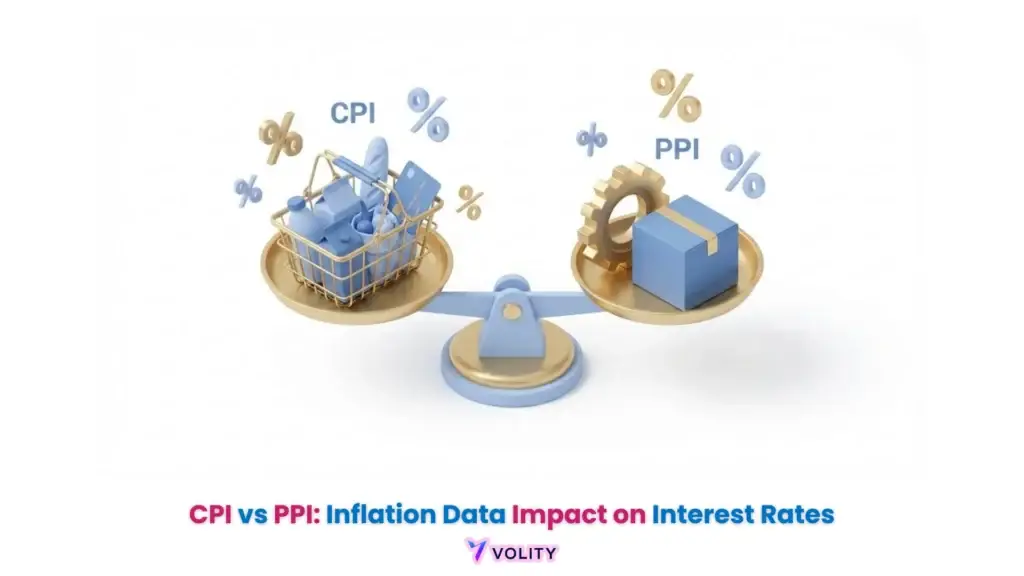
The Consumer Price Index (CPI) and Producer Price Index (PPI) are vital economic indicators that measure inflation by tracking price changes at consumer and producer levels, respectively.

These inflation data points are crucial for central banks like the Federal Reserve to formulate monetary policy, influencing interest rates and subsequently impacting global forex markets and currency valuations. Understanding these indices allows for a deeper comprehension of economic health and future market movements.

While understanding CPI and PPI is important, applying that knowledge is where the real growth happens. Create Your Free Forex Trading Account to practice with a free demo account and put your strategy to the test.

Why are CPI and PPI important economic indicators?

Inflation data, encompassing indices like CPI and PPI, provides a critical pulse on the economy’s health by revealing price changes over time. These metrics are fundamental for policymakers, businesses, and investors to gauge the cost of living, production expenses, and overall economic stability. Monitoring these indicators helps anticipate shifts in monetary policy and market dynamics.

The Significance of Price Stability in a Dynamic Economy

Stable prices are crucial for sustained economic growth and consumer confidence. High or volatile inflation erodes purchasing power, creates uncertainty for businesses, and can destabilize financial markets.

Central banks, such as the Federal Reserve, often target a 2% annual inflation rate (measured by indices like PCE or CPI) to maintain price stability and build maximum sustainable employment, as stated by the Federal Reserve.

This target guides their monetary policy decisions, aiming to balance economic expansion with controlled price levels.

What is inflation data?

Inflation data refers to statistical measures that track the rate at which the general level of prices for goods and services is rising, and consequently, the purchasing power of currency is falling.

The Consumer Price Index (CPI) and Producer Price Index (PPI) are two primary forms of inflation data. These indices provide insights into price changes at different stages of the economic pipeline, from raw materials to finished consumer goods.

Understanding the Consumer Price Index (CPI): What You Pay

The Consumer Price Index (CPI) is a key economic indicator that reflects the average change over time in the prices paid by urban consumers for a market basket of consumer goods and services. This index provides a comprehensive measure of retail inflation, directly affecting the cost of living for millions of individuals. Its widespread use makes it a crucial metric for evaluating economic policy and personal finance.

What is the Consumer Price Index (CPI)?

The Consumer Price Index (CPI) measures the average change over time in the prices paid by urban consumers for a market basket of consumer goods and services, according to the U.S. Bureau of Labor Statistics (BLS).

This index serves as a primary gauge of inflation data at the consumer level. It tracks a broad range of everyday expenses, providing a snapshot of changes in the cost of living for urban households.

Components and Calculation: The Market Basket

The CPI calculation relies on a market basket of goods and services, which represents what urban consumers typically buy. This basket includes major categories such as food and beverages, housing, apparel, transportation, medical care, recreation, education, and communication.

Data collectors from the BLS regularly survey prices for thousands of items in these categories across various cities. The index is calculated by comparing the current cost of this basket to its cost in a base period, expressing the result as a percentage.

To maintain accuracy and reflect changing consumer habits and product quality, the BLS employs hedonic adjustments, which account for improvements in goods and services over time.

The Role of Core CPI in Policy Decisions

Core CPI is a variant of the Consumer Price Index that excludes the highly volatile food and energy components. Central banks and policymakers often focus on core inflation because it provides a clearer signal of underlying, long-term price trends.

These core measures are often preferred by policymakers for assessing underlying inflation trends due to their reduced short-term fluctuations, as noted by CME Group. This stability helps the Federal Reserve and other central banks make more informed monetary policy decisions, as temporary price shocks in food or energy do not distort the overall inflation picture.

Ready to Elevate Your Trading?

You have the information. Now, get the platform. Join thousands of successful traders who use Volity for its powerful tools, fast execution, and dedicated support.

Create Your Account in Under 3 Minutes

Understanding the Producer Price Index (PPI): What Businesses Pay?

The Producer Price Index (PPI) offers a critical perspective on inflation from the vantage point of domestic producers. This indicator measures the average change over time in the selling prices received by businesses for their output. Analyzing PPI helps forecast future consumer prices and understand cost pressures within the supply chain.

What is the Producer Price Index (PPI)?

The Producer Price Index (PPI) measures the average change over time in the selling prices received by domestic producers for their output, as defined by the U.S. Bureau of Labor Statistics (BLS). This index captures changes in prices at various stages of production, from raw materials to finished goods.

It serves as an essential piece of inflation data, indicating potential future shifts in consumer prices as production costs often pass through to consumers.

Stages of Production and Price Transmission

The PPI tracks prices across three main stages of production: crude materials, intermediate materials, and finished goods. Changes in the prices of crude materials (like oil or agricultural products) can ripple through the entire supply chain, affecting intermediate materials (components, parts) before ultimately impacting finished goods prices.

This progression illustrates how rising supply chain costs can lead to cost-push inflation. For example, an increase in the price of raw steel will eventually raise the cost of manufacturing cars, which could then be passed on to the consumer. This price transmission mechanism highlights PPI’s role in signaling future inflationary pressures.

Why Core PPI Matters for Future Inflation

Core PPI, similar to Core CPI, excludes volatile food and energy components to provide a more stable measure of underlying producer price trends. Policymakers often pay close attention to core PPI because it can offer insights into future inflation expectations.

These core measures are often preferred by policymakers for assessing underlying inflation trends due to their reduced short-term fluctuations, as noted by CME Group. Sustained increases in core PPI suggest that businesses face persistent cost pressures, which are likely to be passed on to consumers in the form of higher retail prices, impacting future CPI readings.

CPI vs. PPI: Key Differences, Relationship, and Predictive Power

While both the Consumer Price Index (CPI) and Producer Price Index (PPI) measure inflation, they do so from distinct perspectives, offering different insights into economic trends. Understanding their unique characteristics and the relationship between them is crucial for comprehensive economic analysis.

PPI often serves as a leading indicator for CPI, providing an early glimpse into potential future consumer price movements.

What are the key differences between CPI and PPI?

The core differences between CPI and PPI lie in their scope, the basket of goods and services they track, and their primary focus. CPI measures prices from the consumer’s perspective, reflecting retail price changes, while PPI measures prices from the producer’s perspective, reflecting wholesale price changes. These distinctions make them complementary economic indicators, each offering unique insights into inflationary pressures.

Comparison Table: CPI vs. PPI at a Glance

FeatureConsumer Price Index (CPI)Producer Price Index (PPI)
ScopeRetail prices for consumersWholesale prices for producers
Data SourceHousehold spendingDomestic producers’ selling prices
BasketGoods & services bought by urban consumersOutput of domestic industries
FocusCost of living, consumer inflationProduction costs, business inflation
TimingOften lagging indicatorOften leading indicator for CPI

Which is a better indicator for forecasting inflation, CPI or PPI?

PPI is generally considered a leading indicator for CPI, as changes in producer costs often precede changes in consumer prices, though the lag can vary, according to WT Wealth Management White Paper. When producer prices rise, businesses eventually pass these increased costs onto consumers through higher retail prices.

This makes PPI an early warning signal for future consumer inflation. The lag between PPI rising and CPI rising is not fixed but typically ranges from several weeks to a few months, depending on factors like market competition, inventory levels, and the overall economic climate.

💡 KEY INSIGHT: A significant increase in PPI often signals upcoming pressure on CPI, giving economists and traders a window to anticipate future inflationary trends.

Interpreting Divergences: When CPI and PPI Tell Different Stories

Occasionally, CPI and PPI may diverge, telling different stories about the economy. For instance, PPI might rise while CPI remains stable, indicating that producers are absorbing higher costs without passing them onto consumers.

This could be due to intense competition, reduced consumer demand, or businesses accepting lower profit margins. Conversely, CPI could rise faster than PPI if strong consumer demand allows retailers to increase prices beyond their own cost increases.

Analyzing these divergences provides insights into market power, economic growth, and the overall health of the supply chain. Divergences can also signal periods of disinflation (slowing inflation) or even deflation (falling prices).

How Inflation Data Impacts Interest Rates & Central Bank Policy

Inflation data, derived from indices like CPI and PPI, plays a pivotal role in shaping interest rates and influencing central bank policy. These figures directly inform decisions made by institutions such as the Federal Reserve, which uses monetary policy tools to manage economic stability. Understanding this relationship is fundamental for anyone tracking financial markets.

How do central banks use CPI and PPI data?

Central banks use CPI and PPI data as primary inputs to assess inflationary pressures within the economy. Their mandate often includes maintaining price stability and building maximum sustainable employment.

The Federal Reserve, for example, often targets a 2% annual inflation rate (measured by indices like PCE or CPI) to maintain price stability and build maximum sustainable employment, as stated by the Federal Reserve.

If inflation data indicates prices are rising too quickly, central banks may tighten monetary policy to cool the economy. Conversely, if inflation is too low, they might implement stimulative policies.

How does CPI affect interest rates? How does PPI affect interest rates?

Higher-than-expected inflation data from both CPI and PPI typically leads to an increased likelihood of interest rate hikes by central banks. When prices are rising rapidly, central banks raise rates to make borrowing more expensive, thereby reducing spending and slowing inflation.

Conversely, weak inflation data can signal potential rate cuts or sustained low rates to stimulate economic activity. Unexpected inflation data can significantly influence the market’s perception of future interest rate hikes or cuts, directly impacting bond yields and currency valuations, as noted by FXCM. This direct link makes each CPI and PPI release a highly anticipated event for financial markets.

Beyond Rate Hikes: Quantitative Easing and Tightening

While interest rate adjustments are the primary tool, central banks also employ other monetary policy instruments in response to inflation data. Quantitative Easing (QE) involves purchasing government bonds and other securities to inject liquidity into the financial system, lowering long-term interest rates and stimulating investment.

Conversely, Quantitative Tightening (QT) involves reducing the central bank’s balance sheet, effectively removing liquidity and potentially raising long-term rates. These tools are often deployed when traditional interest rate adjustments alone are insufficient to achieve the central bank’s inflation and employment mandates.

The Ripple Effect: CPI & PPI on Forex Markets and Exchange Rates

Inflation data, particularly from CPI and PPI, creates significant ripple effects across forex markets and influences exchange rates. Traders and investors closely monitor these releases because they provide crucial insights into a country’s economic health and the likely trajectory of its central bank’s monetary policy. This can lead to rapid price movements in currency pairs.

How does inflation data impact forex markets?

Inflation data impacts forex markets by altering the perceived value of a country’s currency. Higher inflation, relative to other countries, can lead a central bank to raise interest rates, making that country’s currency more attractive to foreign investors seeking higher returns. This increased demand can strengthen the exchange rate.

A significant portion of forex market volatility often occurs within minutes of major economic data releases like CPI or PPI, as traders react to new information, according to FX Replay. The Fisher Effect postulates that the nominal interest rate is the sum of the real interest rate and expected inflation. Therefore, changes in inflation expectations directly influence nominal interest rates and, consequently, currency valuations.

How do different currency pairs react to inflation data?

Currency pairs react to inflation data based on the relative economic outlook of the two currencies involved. For example, if U.S. CPI comes in higher than expected, it could signal a more hawkish stance from the Federal Reserve, leading to a stronger U.S. dollar against other currencies (e.g., USD/JPY strengthens).

Conversely, if Eurozone PPI is unexpectedly low, it might prompt the European Central Bank to consider looser monetary policy, potentially weakening the Euro (e.g., EUR/USD weakens). Trading the news around these releases requires understanding the specific economic context and typical reactions of various currency pairs.

Advanced Insights for Traders & Investors

While standard CPI and PPI reports provide fundamental insights, advanced traders and investors seek deeper analyses and alternative indicators to gain a competitive edge. Understanding the psychological underpinnings of inflation expectations and exploring nuanced measures like Trimmed Mean CPI can offer a more complete picture of inflationary trends. This approach moves beyond basic data interpretation to provide a sophisticated understanding of market dynamics.

The Psychology of Inflation: Unpacking Inflation Expectations

Unlike most analyses, we delve into the often-overlooked psychological aspect of inflation. Inflation expectations are crucial because they influence consumer spending, wage demands, and business investment decisions. If consumers expect prices to rise significantly in the future, they may accelerate purchases, contributing to actual inflation. Similarly, workers may demand higher wages, leading to a potential wage-price spiral. This phenomenon is particularly relevant for prices that are considered sticky prices, meaning they adjust slowly over time. Central banks closely monitor these expectations as they can become self-fulfilling prophecies, making them a critical factor in policy formulation.

Are there other inflation indicators I should watch besides CPI/PPI?

Yes, there are several other valuable economic indicators for assessing inflation beyond just CPI and PPI. For a more refined view of core inflation, analysts often consider the Trimmed Mean CPI, which removes the most extreme price changes from the CPI basket, providing a more stable and less volatile measure of underlying inflation.

Other important measures include the Personal Consumption Expenditures (PCE) price index, favored by the Federal Reserve, and the Employment Cost Index (ECI), which tracks wage inflation. These alternative metrics offer a broader and more nuanced understanding of price pressures.

Advanced Strategies: Analyzing CPI/PPI in Context

Sophisticated market analysis integrates CPI/PPI data with other economic indicators and market sentiment. Traders should not rely on a single data point but rather consider the broader economic context, including unemployment rates, GDP growth, and manufacturing surveys.

Understanding the market’s consensus expectations for CPI/PPI is also vital, as deviations from these expectations often drive the strongest market reactions. This holistic approach helps identify scenarios where data might be misleading or where underlying trends are more significant than headline figures, providing a comprehensive view of economic growth.

Turn Knowledge into Profit

You've done the reading, now it's time to act. The best way to learn is by doing. Open a free, no-risk demo account and practice your strategy with virtual funds today.

Open a Free Demo Account

Common User Challenges & Misconceptions in Interpreting Inflation Data

Interpreting inflation data can be complex, and traders often encounter challenges and misconceptions that lead to counter-intuitive market reactions. Understanding these nuances is crucial for developing robust trading and investment strategies. Addressing common pain points helps to demystify the relationship between economic reports and financial market movements.

Why does the market sometimes react opposite to what CPI/PPI suggests?

The market sometimes reacts opposite to what CPI/PPI suggests because financial markets price in expectations. If inflation data comes in exactly as analysts expect, the market reaction might be minimal, even if the numbers are high. However, if the data significantly beats or misses those expectations, the forex market and interest rates can react sharply, often in unexpected ways.

This means that a seemingly “bad” inflation report (e.g., lower than previous but still inflationary) could lead to a positive market reaction if it was better than the expected outcome. Central bank forward guidance also plays a role, as markets anticipate future policy moves based on official communications.

Does the base effect always matter with inflation data?

The “base effect” matters significantly with inflation data, especially when looking at year-over-year figures for CPI and PPI. The base effect occurs when a dramatic increase or decrease in prices from 12 months prior distorts the current year-over-year inflation rate.

For example, if prices dropped sharply in the same month a year ago, the current year-over-year inflation rate will appear artificially high, even if current month-over-month inflation is modest. This phenomenon can make current figures seem higher or lower than underlying trends suggest, requiring careful consideration to avoid misinterpreting the true inflationary environment.

Key Takeaways

  • Consumer vs. Producer Inflation: CPI measures inflation at the consumer level, while PPI tracks inflation at the producer level.
  • Leading Indicator: PPI often serves as a leading indicator for CPI, signaling potential future changes in consumer prices.
  • Monetary Policy Influence: Both CPI and PPI are crucial for central banks when making interest rate and monetary policy decisions.
  • Market Volatility: Unexpected inflation data can trigger significant Forex market volatility and impact exchange rates.
  • Advanced Insights: Understanding inflation expectations and alternative measures like Trimmed Mean CPI offers deeper analytical perspectives.

FAQ

How often is CPI/PPI released, and where can I check the calendar?
Both the Consumer Price Index (CPI) and Producer Price Index (PPI) are typically released monthly by the U.S. Bureau of Labor Statistics (BLS). You can check official release dates on the BLS website, financial news sites, or economic calendars provided by brokers and data providers, which often include expected impact and previous figures.
How to trade based on CPI data releases?
Trading based on CPI involves anticipating market reactions to deviations from expected inflation. A higher-than-expected CPI may signal potential interest rate hikes and strengthen the currency, while a lower-than-expected CPI might suggest dovish policy and potential currency weakness. Traders enter positions based on expected central bank responses.
How to trade based on PPI data releases?
PPI trading is similar to CPI, but PPI can act as a leading indicator for consumer inflation. Unexpectedly high PPI may indicate future inflation, prompting anticipation of hawkish central bank action and a stronger currency. Traders can also analyze sector-specific PPI data for potential cost pressures.
Where to find reliable CPI/PPI data releases?
The most reliable sources are official government agencies. For the U.S., the Bureau of Labor Statistics (BLS) website is the primary authoritative source. Financial news outlets and economic data providers also share this information, but cross-referencing with official releases is recommended for accuracy.

References

Start Your Days Smarter!

Get market insights, education, and platform updates from the Volity team.

Start Your Days Smarter!

High-Risk Investment Notice:  Website information does not contain and should not be construed as containing investment advice, investment recommendations, or an offer or solicitation of any transaction in financial instruments. It has not been prepared in accordance with legal requirements designed to promote the independence of investment research, and it is not subject to any prohibition on dealing ahead of the dissemination of investment research. Nothing on this site should be read or construed as constituting advice on the part of Volity Trade or any of its affiliates, directors, officers, or employees.

Please note that content is a marketing communication. Before making investment decisions, you should seek out independent financial advisors to help you understand the risks.

Services are provided by Volity Trade Ltd, registered in Saint Lucia, with the number 2024-00059. You must be at least 18 years old to use the services.

Trading forex (foreign exchange) or CFDs (contracts for difference) on margin carries a high level of risk and may not be suitable for all investors. There is a possibility that you may sustain a loss equal to or greater than your entire investment. Therefore, you should not invest or risk money that you cannot afford to lose. The products are intended for retail, professional, and eligible counterparty clients. For clients who maintain account(s) with Volity Trade Ltd., retail clients could sustain a total loss of deposited funds but are not subject to subsequent payment obligations beyond the deposited funds. Professional and eligible counterparty clients could sustain losses in excess of deposits.

Volity is a trademark of Volity Limited, registered in the Republic of Hong Kong, with the number 67964819.
Volity Invest Ltd, number HE 452984, registered at Archiepiskopou Makariou III, 41, Floor 1, 1065, Lefkosia, Cyprus is acting as a payment agent of Volity Trade Ltd.

Volity Trade Ltd. is an introductory broker for UBK Markets Ltd. It offers execution and custody services for clients introduced by Volity. UBK Markets Ltd is authorised and regulated by the Cyprus Securities and Exchange Commission (CySEC), license number 186/12 and registered at 67, Spyrou Kyprianou Avenue, Kyriakides Business Center, 2nd Floor, CY-4003 Limassol, Cyprus.

Volity Trade Ltd. does not offer services to citizens/residents of certain jurisdictions, such as the United States, and is not intended for distribution to or use by any person in any country or jurisdiction where such distribution or use would be contrary to local law or regulation.

Copyright: © 2025 Volity Trade Ltd. All Rights reserved.