Technical analysis based on the Fibonacci sequence provides historical probabilities and does not guarantee future results. Trading involves high risk and potential loss of capital. Past performance is not indicative of future results. Capital at risk.
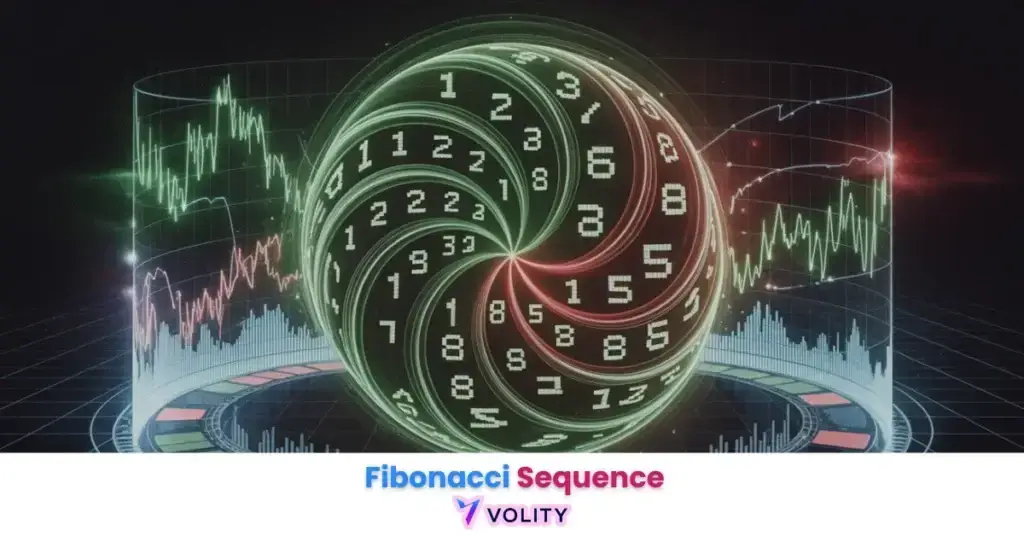
The Fibonacci sequence is an infinite series where each number is the sum of the two preceding ones. It identifies the mathematical basis for the 61.8% “Golden Ratio” used to plot retracements and extensions on trading charts. In 2026, the sequence remains the foundation for identifying high-probability reversal zones and trend exhaustion targets.
The Fibonacci sequence identifies a unique growth pattern where each new value represents the sum of the two integers immediately preceding it. It reveals a proportional rhythm that settles close to 1.618, a value known as the Golden Ratio, which turns up in geometry and in the growth patterns of many plants. As of 2026, understanding this numerical progression is essential for any trader utilizing technical projection tools.
While the sequence appears as a simple list of numbers, 0, 1, 1, 2, 3, 5, 8, 13, and beyond, its ratios guide the majority of modern chart analysis. This guide explores the mathematical derivation of these levels and their critical application in predicting price reactions.
While understanding Fibonacci Sequence is important, applying that knowledge is where the real growth happens. Create Your Free Forex Trading Account to practice with a free demo account and put your strategy to the test.
What is the Fibonacci sequence and how is it calculated?
The Fibonacci sequence is an infinite series of integers beginning with 0 and 1, calculated by adding the two most recent numbers to generate the next term. The recursive formula F(n) = F(n-1) + F(n-2) defines the sequence mathematically: starting with F0=0 and F1=1, each subsequent number equals the sum of its two predecessors. This creates the sequence: 0, 1, 1, 2, 3, 5, 8, 13, 21, 34, 55, 89, 144, 233 and onward. For traders calculating specific ratios, Binet’s Formula provides a shortcut to compute the nth Fibonacci number without calculating all preceding terms, useful when identifying exact retracement levels on high-value price ranges.
The clearest natural example is phyllotaxis, the spiral arrangement of seeds, leaves and florets in many plants. Markets are a different case entirely: Fibonacci levels matter there because a very large number of traders draw the same lines on the same charts, not because price obeys the sequence.
The Fibonacci retracements guide explains how the sequence mathematically generates the 23.6%, 38.2%, 50%, 61.8%, and 78.6% retracement levels used daily by institutional traders.
OEIS sequence A000045 gives the formal definition F(n) = F(n-1) + F(n-2) with F(0) = 0 and F(1) = 1, together with the reference list behind it.
Ready to Elevate Your Trading?
You have the information. Now, get the platform. Join thousands of successful traders who use Volity for its powerful tools, fast execution, and dedicated support.
Create Your Account in Under 3 MinutesWhat is the relationship between the Fibonacci sequence and the Golden Ratio?
The Fibonacci sequence reveals a convergence toward the Golden Ratio of approximately 1.618 as the integers in the series increase in magnitude. This convergence appears mathematically: dividing consecutive Fibonacci numbers (e.g., 233 ÷ 144 = 1.618) produces progressively more accurate approximations of Phi (φ), the Golden Ratio constant. The ratio does appear in some plant growth: the spiral arrangement of leaves and petals on many plants, pine cones, and the seed heads of sunflowers follow it. The popular version overshoots, and it is worth being precise about the limits. The Live Science article cited below, quoting Stanford mathematician Keith Devlin, records that the nautilus shell does not in fact grow its chambers to the Fibonacci sequence, that plenty of plants ignore the rule entirely, and that claimed links to the human body, art and architecture run from tenuous to fictional. The trading case for Fibonacci levels rests on shared convention among traders, not on a law of nature.
Deriving core trading levels from the Golden Ratio proves straightforward: the retracement level of 0.618 emerges as the inverse of 1.618, while the extension level of 1.618 projects price targets beyond the original swing. This mathematical relationship ensures that Fibonacci retracements and extensions work together as complementary tools within a unified framework.
Live Science: What is the Fibonacci sequence? separates what the sequence genuinely explains in plant growth from the much larger body of golden-ratio folklore, and traces the sequence back to Sanskrit prosody centuries before Leonardo of Pisa.
How do Fibonacci retracements identify market support and resistance?
Fibonacci retracements identify hidden support and resistance zones by applying ratios such as 38.2% and 61.8% to a significant price swing. The mathematics prove elegant: if a ratio appears in the Fibonacci sequence (e.g., 21 ÷ 55 = 0.382 or 21 ÷ 34 = 0.618), then the inverse ratio should theoretically act as a “sticky” level where prices pause before continuing. The “Golden Pocket” is the narrow band between the 61.8% and 65% retracement levels, watched closely because a lot of resting orders sit there. Price clustering in that band follows from where traders place orders, and it does not guarantee a reversal.
These levels act as self-fulfilling prophecies: millions of traders independently place orders at the exact same ratios because they learned Fibonacci analysis, creating genuine support/resistance that didn’t exist before the pattern became popular. This psychological phenomenon proves more powerful than mathematical magic, the Fibonacci ratios matter because consensus believes they matter.
support and resistance zones documents how Fibonacci-derived levels integrate with traditional price action support and resistance for creating high-conviction trading zones.
Fibonacci Sequence History and Evolution
The Fibonacci sequence reveals a rich history originating in Indian mathematics before being introduced to the Western world by Leonardo of Pisa in 1202. Indian mathematicians Pingala (approximately 200 BCE) and Virahanka (6th Century CE) first documented the pattern while analyzing Sanskrit prosody, counting syllables in poetic meters, producing the mathematical sequence centuries before European mathematicians recognized its significance.
| Entity | Historical Era | Key Contribution |
| Pingala | ~200 BCE | Earliest known description, in Sanskrit prosody |
| Virahanka | 6th Century CE | Explicit rule for the syllable counts |
| Leonardo of Pisa | 1202 CE | Introduced the sequence to Europe in “Liber Abaci” |
| Kepler | 17th Century | Linked consecutive ratios to the Golden Ratio |
| Elliott | 1930s | Applied the ratios to market structure |
History in this table follows the MacTutor biography of Fibonacci and OEIS A000045, both of which credit the earlier South Asian work. The final row is Elliott, The Wave Principle (1938).
Leonardo of Pisa (known as Fibonacci) popularized the sequence in his 1202 book “Liber Abaci” through the famous rabbit breeding problem: if you start with one pair of rabbits and each pair breeds one new pair monthly, how many pairs exist after 12 months? The answer follows the Fibonacci sequence. Johannes Kepler later recognised the relationship between Fibonacci ratios and the Golden Ratio, connecting the sequence to seventeenth-century work on natural growth.
The MacTutor biography of Fibonacci records how Liber Abaci carried Hindu-Arabic numerals into Europe, and OEIS A000045 credits the earlier South Asian work of Pingala and Virahanka.
Why is the 50% retracement level used in trading?
The 50% retracement level identifies a psychological midpoint in price action but is not mathematically derived from the Fibonacci sequence rules. Traders include the 50% level in Fibonacci tools despite its non-Fibonacci origin because price psychology treats it as significant, when price has fallen exactly halfway from a swing high to low, traders psychologically perceive this as “balanced” and expect reversals. This perception creates reality: enough traders place orders at 50% that price genuinely bounces there, validating the level despite its mathematical illegitimacy.
The 50% level connects to Gann Theory and Dow Theory, which both emphasize halfway corrections as natural retracement points. Risk emerges from over-reliance on the 50% level without secondary confluence: a bounce at 50% without RSI or EMA confirmation often fails, wasting capital on false signals.
Relative Strength Index (RSI) and Exponential Moving Average (EMA) provide the secondary confirmation indicators that validate Fibonacci levels and reduce false signals from psychological price zones.
Beyond Price: Fibonacci Time Zones and Spirals
Fibonacci applications extend beyond vertical price levels to identify potential reversal timing through horizontal time zones and curved spirals. Fibonacci Time Zones use vertical lines spaced at Fibonacci intervals (1, 2, 3, 5, 8, 13… bars or candles) to predict where trend reversals might occur in time dimension rather than price. This approach acknowledges that volatility clusters at specific intervals, if a trend began at bar 1, reversals often occur near bars 5, 8, or 13, following the Fibonacci sequence.
Fibonacci Spirals map time and price simultaneously on logarithmic scales, creating curved lines that show where price-time confluence might trigger reversals. These spirals work when anchor points are selected correctly but suffer from high subjectivity: different traders choose different “correct” starting points, producing different spiral projections.
A worked illustration rather than a recorded trade. Take an impulse leg from 1.0800 to 1.1000, a 200-pip move. The 61.8% retracement of that leg sits at 1.0876, because 1.1000 minus 0.618 of 0.0200 is 1.08764. If price turns there and the turn happens to land on a Fibonacci time interval counted from the start of the move, a trader has two independent reasons to look for a long rather than one. Past performance is not indicative of future results.
fibonacci-extensions explains how Fibonacci extensions project price targets beyond 100% using the same ratios that create retracement levels, completing the Fibonacci methodology for complete trade planning.
Fibonacci spirals documents the mathematical construction and advanced use cases for combining time-based and price-based Fibonacci analysis in professional trading systems.
Turn Knowledge into Profit
You have done the reading, now it is time to act. The best way to learn is by doing. Open a free, no-risk demo account and practice your strategy with virtual funds today.
Open a Free Demo AccountKey Takeaways
- Fibonacci sequence identifies an infinite series where each integer is the sum of the two preceding numbers.
- Fibonacci ratios including 61.8% and 38.2% reveal the proportional balance found in both nature and markets.
- Fibonacci history reveals that Indian mathematicians Pingala and Virahanka documented the pattern centuries before Leonardo of Pisa.
- Fibonacci 50% levels act as psychological midpoints for traders, despite not being true ratios of the sequence.
- Fibonacci sequence applications in 2026 include identifying “Golden Pockets” where reversal probability is highest.
- Fibonacci time zones and spirals reveal potential market volatility windows based on sequence-derived intervals.
Frequently Asked Questions
This article contains references to Fibonacci sequence analysis, technical analysis, and Volity, a regulated CFD trading platform. This content is produced for educational purposes only and does not constitute financial advice or a recommendation to trade based on Fibonacci analysis. Always test Fibonacci strategies on demo accounts and conduct independent research before deploying live capital. Some links may be affiliate links.
What our analysts watch: Fibonacci levels concentrate trader attention rather than predict the future. Three desk principles for using them well. Anchor only on swings that are visible to other participants (clear impulse legs and obvious pivots, not noisy intra-bar wicks). Treat the cluster of levels as a zone, not a line, so price reactions inside one or two ATR of a level still count as confirmation. And weight the 61.8% and 161.8% levels higher than 38.2% and 50% because the deeper retracement and the first major extension carry more institutional flow on the books we track. When retracement plus extension plus structure all align at a single price, the level is doing real work.
Volity operates a trading platform and also publishes educational and analytical content about trading. The content on this page is for educational purposes only and should not be considered financial advice. Volity may benefit commercially when readers open trading accounts through links on this site.
Our content is produced and reviewed under documented editorial standards; see our comparison and review methodology.