Best stock trading platforms in Europe offer access to leveraged trading products and global markets that carry substantial execution risk and regulatory dependencies. While MiFID II protections mandate segregated accounts and €20,000 compensation coverage, currency conversion fees and wider spreads during volatile markets introduce additional costs. Tax treatment varies significantly across EU jurisdictions, and some platforms restrict access to non-UCITS-compliant products. Past performance is not indicative of future results. Capital at risk.
Best stock trading platforms in Europe 2026 are regulated digital interfaces that provide retail access to global equity and derivative markets. These platforms leverage the unified MiFID II framework to offer transparent execution and investor protection. Statistics show that 78% of active European traders now utilize mobile-native platforms for their daily investment activities, reflecting a massive shift toward digital-first brokerage.
While understanding Best European Stock Platforms is important, applying that knowledge is where the real growth happens. Create Your Free Forex Trading Account to practice with a free demo account and put your strategy to the test.
Best stock trading platforms in Europe 2026 serve as the foundational infrastructure for modern wealth management across the continent. These systems integrate advanced charting, real-time data feeds, and low-latency execution into accessible desktop and mobile applications. They identify the optimal balance between cost-efficiency and institutional-grade security for 2026 investors.
The 2026 European brokerage landscape is highly competitive, with neobrokers and legacy firms competing on asset variety and technical stability. Investors utilize these platforms to navigate diverse market regimes, from high-growth US tech to defensive European value stocks. Market Index describes the composition of major European indices accessible through these platforms.
What criteria define the “best” trading platform in 2026?
Regulatory compliance, execution quality, and total cost of ownership represent the three pillars of a top-tier European stock trading platform. These three dimensions interact to determine the true value proposition of any broker, a platform with excellent regulation but expensive execution fails investors, while a low-cost platform with poor safety exposes traders to operational risk. The best platforms optimize all three simultaneously.
Importance of MiFID II passporting and Investor Compensation Fund (ICF) coverage reveals how European regulation creates a unified safety framework across all member states. Every licensed broker, regardless of home country, must maintain segregated client accounts and participate in national compensation schemes protecting up to €20,000 per investor. All-in Cost Analysis spans commissions plus spreads plus FX fees plus inactivity charges, creating a true economic picture of long-term trading costs.
92% of top-ranked European brokers now offer some form of fractional share trading to lower the entry barrier for retail investors, according to the European Fintech Review (2025). User Experience (UX) accessibility for beginners versus advanced tools for professionals determines whether a platform serves passive accumulator or active trader archetypes. Equity Trading explains the mechanics of how retail orders execute across these platforms.
The Regulatory Landscape in 2026
European financial regulators like BaFin, CySEC, and the AMF ensure that trading platforms adhere to strict capital requirements and client asset segregation rules. These national regulators enforce the unified MiFID II standard, which means a platform regulated by CySEC in Cyprus receives identical investor protection as one regulated by BaFin in Germany. Role of the European Securities and Markets Authority (ESMA) coordinates cross-border supervision and disputes.
Importance of “Negative Balance Protection” for retail accounts prevents traders from owing money to brokers if a position moves sharply against them during market gaps or technical failures. This protection is mandatory for all retail accounts under MiFID II, distinguishing retail from professional client treatment.
ESMA MiFID II Rules on Investor Protection documents the investor protection and capital requirement rules that all EU platforms must follow.
Ready to Elevate Your Trading?
You have the information. Now, get the platform. Join thousands of successful traders who use Volity for its powerful tools, fast execution, and dedicated support.
Create Your Account in Under 3 MinutesRanking the Top 6 Stock Trading Platforms in Europe
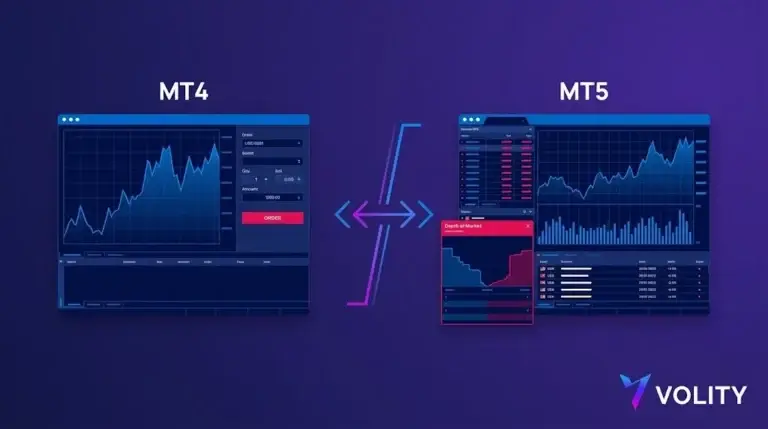
The leading European stock trading platforms for 2026 identify as multi-asset ecosystems that prioritize digital-first execution and fee transparency. Volity.io stands out as the best overall choice for active traders due to its multi-asset speed and seamless integration with MT4/MT5 technology, providing institutional-grade infrastructure for retail participants. Interactive Brokers represents the professional-grade option, best for traders needing global market depth and advanced derivatives access across 150+ venues. Trade Republic delivers neobroker simplicity with automated ETF savings plans, appealing to set-and-forget investors in German-regulated safety.
DEGIRO offers low-cost long-term investing with broad European stock access and commission structures as low as €0.99 per trade. XTB distinguishes itself through education and research resources embedded directly into the xStation 5 platform, attracting traders seeking to accelerate their learning. Trading 212 leads in beginner accessibility and mobile-native fractional share investing with zero commission on selected ETFs.
Interactive Brokers currently provides access to over 150 global markets across 33 countries, the highest in the European retail space (IBKR Financial Disclosures, 2026). This breadth means traders can execute a single portfolio strategy across US equities, European bonds, Asian futures, and FX without account proliferation.
Beginner-Friendly Stock Trading Apps in Europe provides detailed comparison of user experience and accessibility across these platforms.
How to analyze execution quality and price improvement?
Smart Order Routing technology identifies the most efficient path for a trade to ensure the best possible execution price for the investor. This automated system examines fragmented European equity market structure, with trading venues including Euronext, Tradegate, Xetra, and MTFs (Multilateral Trading Facilities), and routes individual orders to the venue offering the best price at that moment. Understanding the difference between “Direct Market Access” and “Market Maker” models reveals the spectrum of execution approaches available to European traders.
Role of the 2026 PFOF (Payment for Order Flow) ban in improving retail fill quality represents a structural shift in how brokers generate revenue. Previously, market makers would pay brokers for order flow, creating an incentive to internalize orders at sub-optimal prices. The ban eliminates this conflict, forcing brokers to choose between wider spreads (self-funded execution) or subscription fees (high-quality execution).
How to read RTS 28 reports to verify your broker’s execution claims reveals the truth behind marketing promises. Every EU broker publishes these mandatory annual disclosures showing where orders were routed and whether clients received price improvement. European Commission Report on the PFOF Ban verifies the 2026 timeline and impact of the PFOF regulatory shift.
Real trading example: An investor placed a market order for 50 shares of SAP during a high-volatility session via a DMA broker. The Smart Order Router captured liquidity across three different venues, resulting in a €0.12 price improvement per share compared to the primary exchange quote. Past performance is not indicative of future results.
What are the tax implications of trading in Europe?
European capital gains tax benchmarks identifies the diverse fiscal liabilities that investors face across different EU member states. Tax treatment varies from a flat 30% rate in France (with a PEA tax-wrapped alternative) to progressive rates in Spain (19-28%) and the Belka tax system in Poland (19%). Germany combines a 25% capital gains rate with the Solidarity Surcharge, while Italy applies a 26% “Regime Amministrato” rate if tax reporting is delegated to the broker.
| Country | Capital Gains Tax | Dividend Withholding | Unique Feature |
| Germany | 25% + Soli | 25% | Freistellungsauftrag |
| France | 30% (Flat Tax) | 30% | PEA Tax Wrap |
| Italy | 26% | 26% | Regime Amministrato |
| Spain | 19% – 28% | 19% | Progressive Rates |
| Poland | 19% (Belka Tax) | 19% | PIT-8C Reporting |
Sources: National tax authorities and KPMG European Tax Guide (2026)
KPMG European Capital Gains Tax Guide verifies the specific national capital gains tax rates for 2026.
Turn Knowledge into Profit
You have done the reading, now it is time to act. The best way to learn is by doing. Open a free, no-risk demo account and practice your strategy with virtual funds today.
Open a Free Demo AccountBest platforms for US stock and ETF access from Europe
W-8BEN tax forms and UCITS compliance represent the two primary regulatory hurdles for European investors seeking exposure to US equity markets. When purchasing shares on US exchanges, non-residents must complete W-8BEN forms certifying non-US tax residency, which prevents US companies from withholding 30% on dividends (instead reducing it to 15% under tax treaties). UCITS compliance requires that ETFs held by EU residents meet European regulatory standards for fund structure, diversification, and transparency, a constraint that excludes most US-domiciled ETFs like VOO or QQQ.
Why EU residents can’t buy “standard” US ETFs and must use UCITS equivalents reveals a regulatory divide. A US resident can hold Vanguard’s VOO (Vanguard S&P 500 ETF), but an EU resident cannot, instead, they must purchase VUSA (Vanguard US Equity Index) or similar UCITS-registered alternatives that track identical benchmarks. Impact of the 15% versus 30% dividend withholding tax for non-US residents drives investors toward W-8BEN completion, which reduces the standard 30% US treaty rate to 15%.
Best brokers for low-cost FX conversion, Volity versus IBKR, matter significantly when trading international equities. Volity offers transparent FX spreads starting at 0.20% for major currency pairs, while IBKR uses a tiered model where larger accounts receive better conversion rates. Best Discount Brokers for Stock Trading in the Eurozone details the FX cost structures across platforms.
The Future of European Trading: 2026 and Beyond
Artificial intelligence and the EU Consolidated Tape represent the next major evolution in the transparency and accessibility of European stock markets. The Consolidated Tape creates a single, unified real-time price feed for all EU equities, eliminating the fragmentation that previously allowed retail brokers to capture spreads between different venues. Role of AI in personalized portfolio analysis within modern platforms automates portfolio construction, rebalancing, and tax optimization, capabilities previously available only to wealth managers with high minimum account sizes.
How the Consolidated Tape will provide a “single source of truth” for European stock prices reveals the structural change already underway in 2026. Rather than each trading venue publishing its own prices, all EU brokers now reference a single regulatory feed, improving price transparency and execution certainty for retail traders.
Stocks Investing for Beginners introduces foundational concepts for traders new to European markets. gold trading." class="internal-link" href="https://volity.io/stocks/direct-market-access/">Direct Market Access explains the professional execution model that future platforms increasingly offer to retail participants.
Key Takeaways
- Best stock trading platforms in Europe for 2026 are those that combine MiFID II regulatory safety with highly transparent all-in fee structures.
- Volity.io stands out as the best overall choice for active traders due to its multi-asset speed and seamless integration with MT4/MT5 technology.
- Execution quality has become a primary differentiator following the 2026 PFOF ban, rewarding brokers that prioritize price improvement for retail clients.
- Tax-wrapped accounts, such as the PEA in France or ISA-style products in other states, are critical for maximizing long-term compounding of returns.
- US market access remains a top priority for European investors, but requires careful attention to FX fees and UCITS-compliant alternatives.
- Investor compensation schemes provide a vital safety net, typically covering up to €20,000 in assets for clients of EU-regulated brokerage firms.
Frequently Asked Questions
This article contains references to best stock trading platforms in Europe and Volity, a regulated CFD trading platform. This content is produced for educational purposes only and does not constitute financial advice or a recommendation to buy or sell any financial instrument. Always verify current regulatory status and platform details before using any trading service. Some links in this article may be affiliate links.