Investing in financial products involves risk. Losses may exceed the value of your original investment.
Quick answer
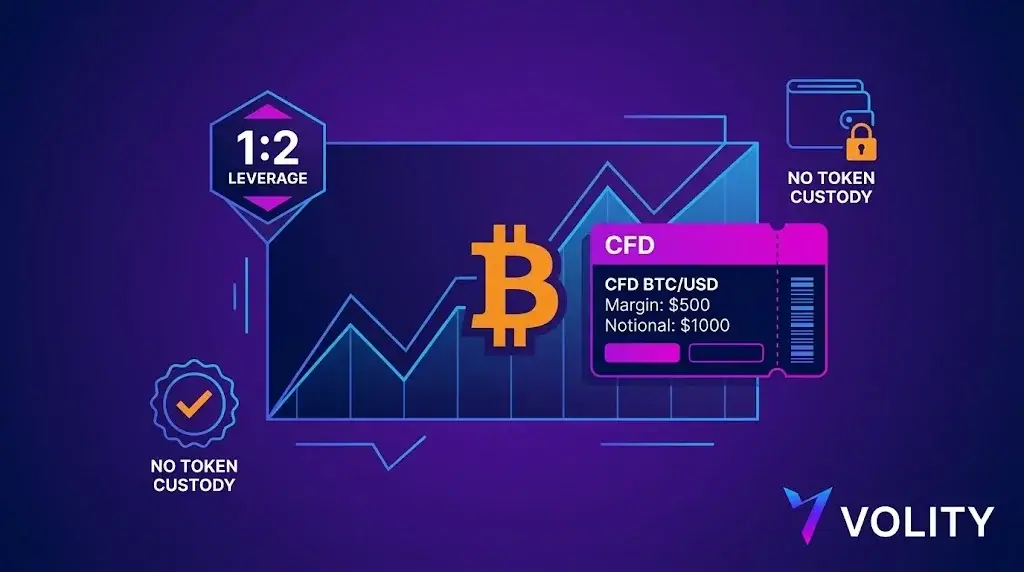
CFD bitcoin trading is leveraged speculation on the BTC/USD price without holding actual bitcoin or its custody risk. Retail leverage is capped at 1:2 in the EU under MiCA-aligned rules, with mandatory negative balance protection. Typical spreads run 30 to 100 USD on retail accounts. Overnight financing applies on positions held past broker rollover.
A bitcoin CFD is a contract on the price of BTC settled against the broker. You never hold the coin, never run a wallet, never manage a seed phrase. You post margin, the broker tracks the BTC reference price, and your profit or loss is the price move multiplied by your contract size. The structure removes the operational risk of self-custody and adds the financial risk of leverage. Under ESMA rules, retail leverage on cryptoasset CFDs is capped at 1:2.
How a bitcoin CFD trade actually works
You open a long contract at BTC USD 60,000 with a notional of USD 10,000 (about 0.167 BTC). At 1:2 retail leverage, the initial margin is 50% of notional: USD 5,000. The broker tracks the BTC reference price minute by minute. If BTC moves to USD 63,000, your position is up USD 500 (5% on notional, 10% on margin). At USD 57,000, your position is down USD 500.
You close the contract when you choose. There is no expiry on a perpetual CFD. Overnight financing applies on positions held past the daily cut-off, typically a small percentage of notional per day, charged on long positions and either credited or charged on short positions depending on the rate.
Leverage and margin under ESMA
Retail leverage on cryptoasset CFDs is capped at 1:2. That means initial margin is 50% of notional. To take USD 10,000 of BTC exposure, you post USD 5,000. To take USD 100,000 of exposure, you post USD 50,000.
The cap is deliberate. Crypto routinely moves 5-10% in a session and 30-50% in a month. Higher leverage on these moves is a fast path to ruin, which is exactly why the ESMA product-intervention measure put crypto at the lowest leverage tier.
Negative balance protection applies. You cannot lose more than the equity in your account. If a sudden gap takes the position below zero equity, the broker absorbs the deficit.
CFD vs spot bitcoin: the practical comparison
| Feature | Spot BTC | BTC CFD |
|---|---|---|
| Custody | You hold the coin | Broker holds the contract |
| Wallet management | Yes, your responsibility | None |
| Self-custody risk | Lost keys, phishing | None |
| Counterparty risk | Exchange-level | Broker-level (ICF EUR 20k for eligible retail at UBK) |
| Leverage | 1:1 | Up to 1:2 retail (ESMA) |
| Short selling | Difficult for retail | One-click short |
| Withdrawal mechanics | On-chain, network fees | Cash to bank |
| Tax treatment | Capital gains in most jurisdictions | Varies; often treated separately |
What goes wrong
- Weekend gaps. Bitcoin trades 24/7 but CFD venue liquidity dips on weekends. A Saturday news event can move BTC 10% before the broker spread widens to absorb the volatility. Stop-losses may fill at meaningful slippage.
- Funding bleed on long-held positions. Overnight financing on a long BTC CFD held for two months can equal 1-2% of notional per month. On a flat market that is pure cost.
- Leverage creep. Retail caps prevent the worst case (1:50 BTC was a route to ruin pre-ESMA), but 1:2 is still leverage. A 30% drawdown on a 1:2 position is 60% of margin gone.
- Mistaking price feed for spot. The CFD reference price tracks a basket of major spot venues but is not identical to any single venue. Small dislocations are normal.
When a BTC CFD is the right tool
- Active trading. Day and swing traders who want precise sizing, two-way exposure, and no wallet operations.
- Hedging spot holdings. A long-term holder can short a BTC CFD to neutralise short-term downside without disposing of the underlying coin (and triggering capital gains).
- Multi-asset accounts. Traders who run FX, indices, commodities, and crypto on one account benefit from the unified margin and reporting.
When spot BTC is the right tool
- Long-term ownership. Holding bitcoin as a savings instrument over years.
- On-chain use cases. Lightning payments, self-sovereign custody, integration with DeFi or DePIN.
- Donations and gifts. Direct on-chain transfers to a recipient address.
BTC CFD trading at Volity
Volity offers CFD exposure to bitcoin and 20+ other cryptoassets. Retail leverage is capped at 1:2 under ESMA. Negative balance protection applies. Execution is by UBK Markets Ltd, a Cyprus Investment Firm authorised by CySEC under licence 186/12. Eligible retail clients of UBK Markets are covered by the Cyprus Investor Compensation Fund up to EUR 20,000 per client per firm. Trading is available on MT4, MT5, and the Volity web platform.
Volity operates a trading platform and also publishes educational and analytical content about trading. The content on this page is for educational purposes only and should not be considered financial advice. Volity may benefit commercially when readers open trading accounts through links on this site.
Our content is produced and reviewed under documented editorial standards; see our comparison and review methodology.