Investing in financial products involves risk. Losses may exceed the value of your original investment.
Quick answer
Forex risk management is the discipline of sizing positions so a single losing trade can’t damage an account. The standard framework: cap risk per trade at 1% of account equity, set stops based on Average True Range or structural levels (not arbitrary pip distances), enforce a daily max-loss circuit breaker (typically 3%), and journal every trade. Without this, leverage compounds losses faster than skill compounds gains.
Forex risk management is not a stop-loss. It is a system that decides how much you risk on every trade, how much you risk in any given week, and how much of your account you are willing to draw down before you stop trading and review. Stops are the last layer. Position sizing is the first. Most retail forex accounts that blow up do so for one reason: they sized correctly on a winning streak, then doubled up on a losing one. The framework that follows fixes that.
The five-layer framework
Run these in order. Skipping a layer is how accounts die.
- Risk-per-trade. The percentage of account equity you are willing to lose on a single trade if the stop is hit.
- Position size. Derived from risk-per-trade, stop distance, and pip value.
- Leverage cap. Regulatory and self-imposed. Never the same number.
- Weekly risk budget. Total risk across all open positions in a rolling 5-day window.
- Drawdown circuit-breaker. The account-level threshold that forces you offline.
Layer 1: risk-per-trade
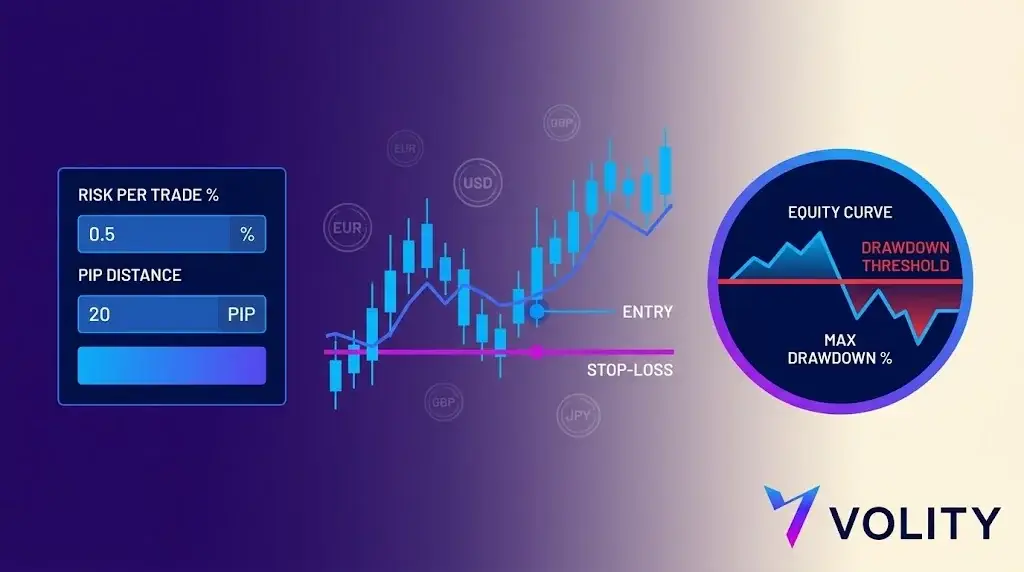
The rule we run on the desk is 1% of account equity per trade. Some traders go to 2% on high-conviction setups. Almost nobody who survives long-term goes above 2%.
Why 1%? Math. A 10-trade losing streak at 1% leaves you with 90.4% of your starting equity. The same streak at 5% leaves you with 59%. At 10%, you are at 35% and need a 186% gain to recover. Risk-per-trade compounds against you on losing streaks just as it compounds for you on winning ones.
Layer 2: position sizing math
Three inputs:
- Account equity in your base currency.
- Stop distance in pips.
- Pip value per standard lot for the pair you are trading.
Worked example. Account: EUR 10,000. Risk-per-trade: 1% = EUR 100. Trade: long EUR/USD with a 25-pip stop. Pip value on EUR/USD per standard lot is $10, roughly EUR 9.20 at a 1.0870 rate. Position size = EUR 100 / (25 pips x EUR 9.20) = 0.43 standard lots, or 43,000 units of EUR/USD.
Notional exposure on that trade is roughly EUR 43,000. On a EUR 10,000 account, that is 4.3x leverage. Well inside the maximum leverage available on major pairs.
Layer 3: leverage caps
Two numbers run here: the maximum the account allows and your personal cap.
Volity offers leverage of up to 1:500 on forex pairs. That is a maximum, not a target. Even at 1:30 on every position, a 3.3% adverse move on a major wipes a fully-margined account.
The personal cap is the leverage you actually use, derived from layer 2. If your position-sizing math produces a leverage figure above 5-7x on a major pair, your stop is too wide for your account size, or your account is too small for the strategy. Adjust position size, not leverage. A lot size calculator makes that adjustment exact.
Layer 4: weekly risk budget
One trade at 1% risk is fine. Five trades at 1% risk, all correlated long-USD positions, is a 5% trade. Correlation is the silent killer in forex risk management.
The rule: cap total open risk at 3-5% of account equity. If you have three open positions risking 1% each, you have 3% of your account on the line. If two of them are EUR/USD long and GBP/USD long, the effective correlated risk is closer to 1.7-1.8%, but a dollar-strength shock takes both stops in one move.
Track open risk daily. Spreadsheet, journal, broker P&L tab; all work.
Layer 5: drawdown circuit-breaker
Set the threshold before you need it. Two levels:
- Soft circuit at -8% from peak equity. Cut position size in half. Review the last 20 trades. Look for a regime shift, a setup that has stopped paying, or process slippage.
- Hard circuit at -15% from peak equity. Stop trading for two weeks. Paper-trade only. Resume at half size. Restore full size only after 10 consecutive trades with no rule violations.
This is the rule that saves accounts. Discretionary traders override it under stress; that is exactly when the rule has to be mechanical.
What goes wrong
- Sizing on entry quality, not stop distance. A high-conviction setup with a 60-pip stop is not a bigger position; it is a smaller position with the same risk.
- Ignoring spread and slippage in stop placement. A 10-pip stop on a pair with a 1.5-pip spread and a 1-pip news slippage is effectively a 7.5-pip stop. Build the buffer in.
- Revenge sizing after a loss. Doubling on the next trade to recover is the textbook path to ruin. Sticking to the rule, especially after a loss, is the entire game.
- Curve-fitting the rules to the last trade. The framework is not the place to innovate. Innovate on entry signals; keep risk rules boring.
Forex risk management at Volity
Volity gives you MT4 and MT5 with full position-sizing tooling, leverage of up to 1:500 on major and non-major currency pairs, negative balance protection, and one-click pip value calculators. Leverage magnifies gains and losses alike, so size each position from your stop, not from the leverage available. Eligible retail clients of UBK Markets are covered by the Cyprus Investor Compensation Fund up to EUR 20,000 per client per firm. Execution is by UBK Markets Ltd (CySEC 186/12).
Common questions
How much should I risk per forex trade?
The fixed-fractional rule: never risk more than one to two percent of account equity on a single trade. Position size is then a function of stop distance, account currency, and pip value, not of conviction. A confident setup that violates the sizing rule is still a violation. Equity grows compound when you survive long enough.
What is the difference between margin and risk?
Margin is the deposit the broker holds to open and maintain the position. Risk is the amount of equity at stake if the stop loss triggers. They are not the same number. A 30:1 leveraged forex position uses about 3.3% of capital as margin, but the risk on that trade is determined by stop distance, often 1% of equity or less.
Why do most retail traders blow up their accounts?
Three repeated patterns: over-sizing positions relative to stop distance, removing or widening stops after they are placed, and revenge-trading after a loss. Each of those individually is recoverable; combined they compound into account terminal velocity. The fixed-fractional rule plus journal discipline protects against all three. Edge is preserved by survival, not predicted by setups.
Volity operates a trading platform and also publishes educational and analytical content about trading. The content on this page is for educational purposes only and should not be considered financial advice. Volity may benefit commercially when readers open trading accounts through links on this site.
Our content is produced and reviewed under documented editorial standards; see our comparison and review methodology.