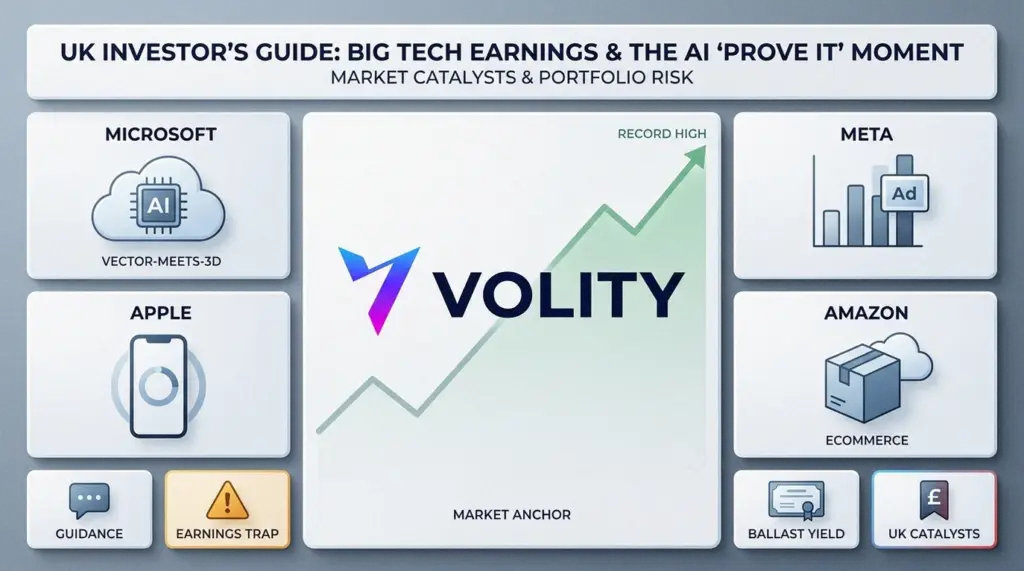
The Great Tech Earnings Sprint Could Reset the Market’s Mood
The most important week of the May trading calendar has arrived, and it belongs to Big Tech.
Microsoft (MSFT) and Meta Platforms (META) report after Wednesday’s close. Apple (AAPL) and Amazon (AMZN) follow on Thursday. For portfolios leaning on the megacap complex, this is not background noise. It is the main event.
The market enters the week in a bold mood. The S&P 500, Nasdaq 100 and Dow Jones Industrial Average sit at or near record territory. Meanwhile, hopes for Bank of England monetary policy continue to support risk assets. Yet record highs come with a rather unpleasant side effect: investors become jumpy.
At this altitude, every guidance line matters. A cloud margin can move a sector. An iPhone comment can chill a whole index. A casual remark about artificial intelligence spending can add, or erase, tens of billions in market value before breakfast.
That is the tension now. The market has spent 18 months paying generously for the AI story. This week, four of the biggest companies in the world must show whether the story still deserves that price.
Why This Week Matters
Artificial intelligence has changed what investors expect from technology companies. Nvidia (NVDA) became the clearest expression of that trade, as demand for chips, servers and data-centre capacity outpaced even bullish forecasts.
However, the trade has spread far beyond Nvidia. Semiconductor ETFs such as SMH have become shorthand for AI infrastructure. Broadcom (AVGO) has pulled in patient capital. Super Micro Computer (SMCI) turned from a specialist server maker into a market obsession. ServiceNow (NOW), meanwhile, has shown that software companies can earn premium valuations when they sell efficiency in an AI wrapper.
The market is not inventing the demand. Companies are spending heavily on compute, storage, networking and software tools. Still, price matters. Many AI-linked shares now carry valuations that leave little room for soft language.
This earnings sprint is not only about last quarter. It is about whether investors can keep expanding the multiple on future growth.
Microsoft and Meta will be judged on cloud demand, AI capital spending and advertising strength. Apple must answer a more awkward question: can it reignite iPhone growth while proving that services still deserve a rich multiple? Amazon, meanwhile, has two exams at once. Traders want to see steady AWS growth and credible momentum in advertising.
By the Numbers
- 4 megacaps: Microsoft, Meta, Apple and Amazon report within two trading sessions.
- 3 major indexes: The S&P 500, Nasdaq 100 and Dow trade near record levels.
- 18 months: The broad AI rally has reshaped software, chips and server valuations.
- 7% plus: Some defensive income names now offer yields above that level.
- Friday: By then, traders should have fresh guidance across cloud, ads, phones and AI spending.
What Traders Should Watch
Nvidia remains the marquee chart. Its march to new highs keeps the AI trade alive and, more importantly, keeps animal spirits alive. However, momentum has stretched across the group.
Alphabet (GOOGL) and Advanced Micro Devices (AMD) show elevated relative strength readings. That does not make them automatic shorts. In a strong tape, overbought can stay overbought. Still, it does argue for tighter stops and smaller position sizes.
Meanwhile, the semiconductor complex shows a familiar pattern. The leaders, including Nvidia and Broadcom, sit well above short-term moving averages. Laggards are attracting catch-up bids. That split often comes before consolidation, not necessarily collapse.
For longer-term investors, the AI infrastructure story remains intact. The past five years have rewarded companies that sat close to cloud spending, chip demand and enterprise automation. Super Micro’s long run illustrates how violently infrastructure picks can re-rate during a new capital cycle.
Even recent appetite for new AI listings shows that capital still wants exposure. The demand tells its own story: investors still believe another winner sits somewhere in the hardware, networking or compute stack. Whether that belief proves sensible is another matter.
The Earnings Traps
Results will not trade in a straight line. Roblox (RBLX) recently offered a useful reminder. The stock rose after earnings, even though the headline numbers looked modest. Engagement metrics and guidance mattered more than the surface print.
By contrast, Quantum Business Technologies beat estimates and still fell. That was the market saying good news had already been rented in advance. When valuations run hot, strong bookings can become an exit ramp.
There are quieter warnings too. MicroVision (MVIS) has issued cautionary signals. Microchip Technology (MCHP) faces lower expectations into its own results. These are not market-moving stories on their own. Yet they show cracks beneath the shiny megacap surface.
That matters because investors often discover risk from the bottom up. The index can look calm while smaller suppliers begin to complain.
Defensives Are Not Offering Much Comfort
The usual hiding places look less inviting this time. Consumer staples have been dealing with margin pressure, weak volumes and cautious shoppers. Campbell Soup (CPB), General Mills (GIS) and Nomad Foods (NOMD) have all had to wrestle with that squeeze.
Normally, that sector gives portfolios a softer place to land when technology stumbles. However, if staples are also under pressure, the next sell-off may lack a clean defensive rotation.
That pushes some investors towards higher-yield defensive shares, including pharmaceutical and infrastructure names. Yields above 7% may not excite momentum traders. Still, they can act as ballast when the growth trade gets rough.
What the Megacaps Need to Prove
Microsoft must show that Azure growth remains strong enough to justify enormous AI spending. Investors will listen closely for commentary on Copilot demand and enterprise adoption.
Meta needs to defend two stories at once. First, advertising must stay healthy. Second, spending on AI and the metaverse cannot look reckless. Traders will forgive heavy investment, but only if revenue keeps moving.
Apple faces the cleanest sentiment test. The market wants clarity on iPhone demand, China trends and services growth. Because Apple carries huge index weight, its guidance can affect far more than its own shares.
Amazon must prove AWS can keep reaccelerating while its advertising unit keeps gaining scale. If both pieces work, the stock can support a broader rally. If either wobbles, investors may question the premium.
The week continued with Bitcoin holding $80,000 as Fed cut fears returned and UK small caps outpacing Big Tech via IWM.
Key Takeaways
- Cloud commentary matters most: Strong language from Microsoft and Amazon could extend the AI trade.
- Margins are the pressure point: Heavy AI spending needs visible revenue traction.
- Apple guidance is psychological: A cautious outlook could weigh on the entire megacap basket.
- Semis look stretched: Traders should respect momentum, yet avoid oversized exposure after sharp moves.
- Defensive rotation looks messy: Staples weakness reduces the market’s usual cushion.
The Contrarian Corner
Some smaller stories deserve attention. Analyst expectations for Onto Innovation (ONTO) and Oklo (OKLO) have been moving higher, which shows that investors remain receptive to niche growth themes.
However, lower expectations can be just as useful. Companies such as Nextlink enter results with more disappointment already priced in. A merely decent update can produce a sharper reaction than a strong update from a crowded favourite.
Alibaba (BABA) also sits in the background as a rotation candidate. Recent enthusiasm around Chinese technology reflects a simple idea: investors may want AI and cloud exposure at cheaper valuations. That trade is not yet mainstream in US portfolios. Still, portfolio whispers often arrive before flows.
The question for the week is direct. Have investors already paid full price for AI’s impact, or can earnings support another leg higher?
By Friday, the market should have its answer. Until then, the right stance is not panic or bravado. It is disciplined attention: know the levels, watch the guidance, and do not let a record high do your thinking for you.
This UK-focused week sits inside a wider crypto storyline that traders are already tracking: the Senate Crypto Clarity Act vote with Bitcoin holding $80k, and the days that built up to it including Bitcoin holding $82k as Clarity Act odds jumped and spot ETF inflows pushing Bitcoin near $81k. For traders trying to fit a playbook to this volatility, our eight trading strategies for the 2026 market matches each setup to time, account size and risk tolerance.
UK-specific context for the week
UK investors face an extra translation step every earnings week. Reported results come in dollars, the portfolio reads in pounds, and the GBP/USD cross is rarely still on the day of a big print. A 1.5% move in cable can wipe out a chunky beat or turn a small miss into a comfortable loss. Hedging that exposure is usually easier than ignoring it. Investors holding the megacaps through a sterling-denominated ISA or general investment account should look at whether their broker offers a built-in FX layer, or whether each rebalance is leaking another conversion fee.
Tax treatment is the other UK lever. Capital gains realised inside a stocks and shares ISA are sheltered; gains outside the wrapper count against the annual CGT allowance. For active traders rotating positions around earnings, that line matters: a series of small wins outside the wrapper can drag the marginal tax rate up faster than the underlying returns justify. The Bank of England rate path also feeds back into UK retail demand for tech via consumer spending and growth expectations, so the policy backdrop is not just a US story.
Earnings-week playbook for retail accounts
Active traders preparing for the megacap prints can compress the week into three windows. Pre-print: tighten stops on any open megacap position, sit out the last ninety minutes if the cost of a surprise is more than the value of the next move. During-print: avoid placing fresh orders in the after-hours bid-ask vacuum where spreads widen to three or four times their daytime norm. Post-print: wait for the second-day reaction. The price action that survives the next morning is usually the one worth trading.
Position sizing matters more than usual around earnings. A 1 to 2 percent of equity risk budget keeps a single bad print from breaking the account. Correlated megacap longs (MSFT, GOOG, META, AMZN held simultaneously) count as one position for risk purposes, not four, because they move together on macro surprises. Investors who want exposure to the sector without single-name risk can use a Nasdaq 100 tracker as the simpler vehicle.
Frequently asked questions
How do US tech earnings affect a UK portfolio?
Two channels: the direct hit (megacaps make up a meaningful slice of any global tracker) and the FX channel (results report in dollars, portfolio reads in pounds). A strong USD on a beat can amplify the gain for UK holders; a weaker USD on a miss can soften it. Investors holding Big Tech through a UK broker should know whether their account hedges FX automatically or leaves it open.
Which megacaps report this week and what should I track?
Microsoft (MSFT) and Meta (META) report after Wednesday’s close; Apple (AAPL) and Amazon (AMZN) follow on Thursday. The numbers that move the tape are AI capital-spending guidance for Microsoft and Meta, services revenue and China for Apple, and AWS growth plus retail margins for Amazon. Forward guidance usually matters more than the headline EPS line.
How does the Bank of England rate path affect tech stocks?
Tech valuations are sensitive to the discount rate applied to future cash flows. When the Bank of England signals slower rate cuts, growth-style valuations come down. The transmission is usually weaker than the equivalent Fed signal because US tech sells globally, but UK investor sentiment and retail flows still respond to local policy.
Should UK investors hold crypto alongside tech this week?
Crypto and Big Tech are correlated on risk-on days but decouple on event days. The Senate Crypto Clarity Act vote is one such event for crypto. Holding both as separate sleeves is reasonable; sizing them so a bad day in one does not force selling in the other is the harder discipline.
What is the cheapest way to trade megacap earnings from the UK?
For direct equity exposure, real share ownership in a UK ISA or general investment account is the cleanest tax wrapper. For active trading around earnings, CFDs offer leverage and short flexibility but no underlying ownership. Volity offers both real fractional shares from $0 and stock CFDs in the same account, plus a multi-currency wallet that holds USD and EUR alongside GBP-bridge balances so FX conversion happens once at the platform rate.