Crypto Clarity Act Faces Bank Backlash Before Thursday Vote
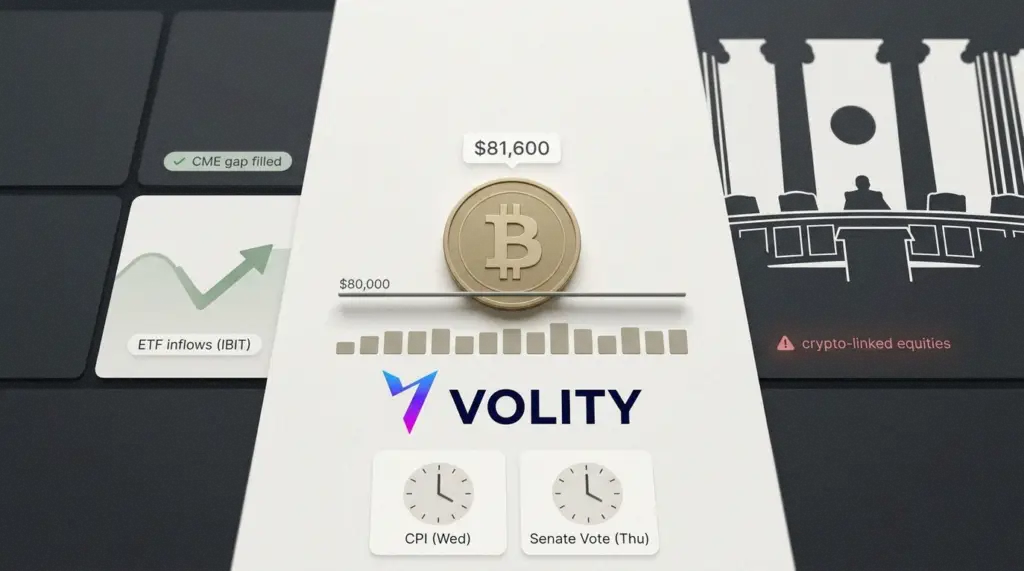
Bitcoin spent the week doing something useful for traders: almost nothing. It hovered near $81,600, held the $80,000 line and refused to unravel. That matters, because quiet tapes often carry more information than noisy ones.
Volume has stayed firm, while a CME gap has been filled. Meanwhile, sellers have not managed to force a clean break lower. However, Thursday now carries the heavier risk. The Senate Banking Committee marks up the revised Crypto Clarity Act, and banks are pushing hard against it.
Before that, inflation gets the first swing. The consumer price index lands Wednesday at 8:30 a.m. Eastern time. Forecasts have moved towards 3.6%, from 3.3%. Rates traders may set the mood before senators even sit down.
Banks Turn Up the Heat
The banking lobby has moved from grumbling to mobilisation. The American Bankers Association’s chief executive sent an urgent alert to members, urging them to press senators against the bill. The message was plain: call now, not later.
Crypto firms see the same moment through a different lens. The bill promises the first broad federal rulebook for digital assets. After years of enforcement-led uncertainty, that would mark a sharp change. It would also put clearer boundaries around exchanges, custody, tokens and market oversight.
Prediction markets now price full passage near 73%. The House has already approved its version. If the Senate committee advances the text on Thursday, the path runs through a floor vote, reconciliation and then the White House.
That is still a crowded route. However, investors do not need certainty to reprice risk. They only need improving odds, especially after a long period of Washington fog.
- Revised text: released ahead of the May 14 debate window.
- Next step: Senate Banking Committee markup on Thursday.
- Market pricing: passage odds near 73% in prediction markets.
- Bitcoin level: spot price near $81,600, with $80,000 acting as support.
- Macro trigger: CPI due Wednesday at 8:30 a.m. Eastern.
Bitcoin Stays Calm, but the Tape Is Not Sleepy
Bitcoin’s calm looks deliberate rather than dull. The market absorbed negative Coinbase premium readings, which often hint at softer United States spot demand. Even so, buyers defended the big round number below.
That does not remove downside risk. A CPI surprise could hit liquidity immediately. A weak markup result could also drain the regulatory premium. Still, the market has not shown the panic usually seen before deeper breaks.
BlackRock’s spot Bitcoin ETF, IBIT, remains the institutional tell. It has led a six-week streak of ETF inflows, keeping a steady bid under the asset. Meanwhile, spot XRP ETFs in the United States recorded their strongest inflows in four months.
Those flows matter because they change the buyer base. Fast money still moves the intraday tape. However, ETF inflows help explain why bad news has not snowballed.
Strategy Loss Sharpens the Bear Case
Michael Saylor is again defending Bitcoin’s safe-haven credentials. Ray Dalio questioned the claim, and Saylor pushed back. Yet the louder market story sits inside Strategy’s own numbers.
Strategy, ticker MSTR, reported a $12.5 billion net loss. The figure has fed fresh pressure on its Bitcoin-linked equity profile. It has also pulled some May 2026 price expectations lower, as traders price more downside risk.
The company’s dividend debate adds another wrinkle. Saylor’s camp argues Strategy can manage its Bitcoin sales plan without weakening the broader thesis. However, critics now have cleaner ammunition. They can point to losses, dilution worries and a stock that trades like leveraged Bitcoin.
For crypto traders, the read-through is simple. If Bitcoin loses $80,000, Strategy’s equity could exaggerate the move. If Bitcoin clears $83,000, short covering in related names may move quickly.
Altcoins Move From Noise to Rotation
The rotation below Bitcoin has become more selective. Sui rose roughly 30% over the week, with traders watching a reclaim of $1.50. That level now acts as a simple temperature check.
TRON gained 26% over three months. Bulls want it to hold $0.35, despite persistent doubts about the quality of the move. Meanwhile, Zcash broke above $600, then stalled as momentum faded.
Zcash now carries two competing stories. Grayscale has filed for a ZEC ETF, helped by renewed privacy demand. However, a bearish crossover has traders eyeing a possible pullback towards $400.
Ethereum also looks untidy. The Ethereum Foundation unstaked 21,270 ETH, raising fresh questions about treasury management. ETH trades near $2,300, while a weak RSI points towards a possible $2,200 support test.
Network upgrades add to the week’s clutter. Ronin’s Ethereum Layer 2 migration went live with roughly 10 hours of downtime. Bittensor’s “Conviction” upgrade arrives next week, with subnet governance and investor protections in focus.
- Sui: up about 30% in a week, with $1.50 in view.
- TRON: up 26% in three months, testing confidence near $0.35.
- Zcash: above $600, but momentum points back towards $400 risk.
- Ethereum: near $2,300, with $2,200 the next watched support.
- Bittensor: major governance upgrade scheduled for next week.
Miners Feel the Squeeze
Crypto miners are not enjoying this tape. CleanSpark, MARA and Keel shares fell after punishing first-quarter losses. MARA reported a $1.3 billion loss. CleanSpark’s loss was roughly twice that. Keel reported a $145 million loss.
The sector’s AI pivot now faces a harder test. Investors liked the story when power assets looked scarce and Bitcoin looked one-way. However, earnings have forced a sharper question: who can actually convert megawatts into margin?
Bhutan also sold another $8.2 million of Bitcoin, reducing reserves further. The sale was not large enough to shake the global market. Still, sovereign selling always catches attention, especially near an obvious support line.
Elsewhere, institutional crypto kept building. Augustus, backed by Peter Thiel, received an OCC nod for an AI stablecoin bank. Bernstein placed a $190 target on Circle. In Korea, Upbit listed the privacy AI token VVV.
Security Risks Keep Circling
The market’s legal and technical risks did not take the day off. Three men were charged over a $6.5 million “wrench attack” crypto robbery. Separately, Goliath Ventures’ chief executive admitted he had “failed” investors tied to an alleged $328 million scheme.
Bitcoin node flooding also stirred surveillance and Sybil attack fears. Those concerns remain technical, but traders should not ignore them. Network confidence often looks solid until liquidity dries up.
Google flagged the first AI-assisted zero-day hitting two-factor authentication. Meanwhile, Solana’s Alpenglow upgrade is in live testing. Aptos is also pushing an encrypted mempool designed to reduce frontrunning.
The week continued with Bitcoin holding $80,000 as Fed cut fears returned and UK small caps outpacing Big Tech via IWM.
Key Takeaways
- $80,000 remains the line: Bitcoin needs to hold it through CPI and the Senate markup.
- $83,000 is the trigger: a clean break could force short covering across crypto equities.
- Policy risk is now tradable: Thursday’s vote may matter more than another exchange listing.
- ETF flows still support dips: IBIT inflows help explain the market’s resilience.
- Altcoin risk is uneven: Sui has momentum, while Zcash and ETH face clearer pullback levels.
The week now turns on two clocks: CPI at 8:30 a.m. Wednesday, then the Senate markup on Thursday. Bitcoin has earned patience so far. Next, it needs a catalyst.
This vote is the next chapter in a storyline that began earlier in the week, when Bitcoin held $82,000 as US Clarity Act odds jumped, and built on the price action from spot ETF inflows pushing Bitcoin near $81,000. UK readers tracking the cross-asset picture can pair this with the UK investors guide to crypto, tech earnings and AI forecasts. For traders trying to fit a playbook to the Clarity Act swings, our eight trading strategies for the 2026 market covers the setups that survive a regulatory week.