Investing in financial products involves risk. Losses may exceed the value of your original investment.
Blackrock ethb staked is a core topic for traders in 2026. The complete guide follows.
Crypto steadies as investors pivot from war headlines to yield
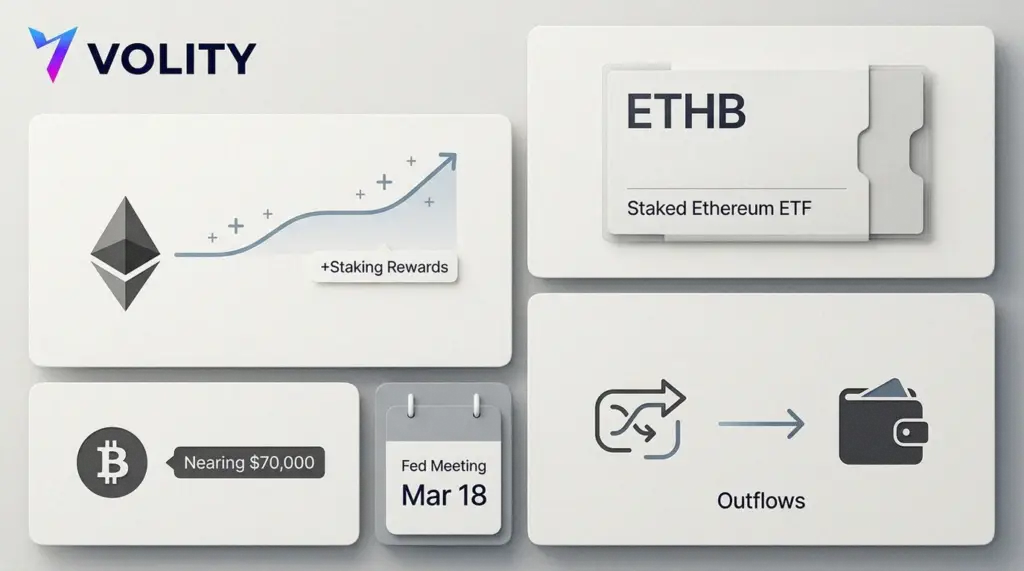
Bitcoin pushed back towards $70,000 on Tuesday, while Ethereum fought to hold the $2,000 line. The price action looked less like panic buying and more like a market exhaling. Overnight, traders had fretted about further escalation in the Iran-US confrontation. By the morning, however, risk appetite returned in patches, helped by calmer rhetoric and a familiar crypto reflex: chase the new product.
That product came from BlackRock. The asset manager launched the iShares Staked Ethereum Trust ETF, ticker ETHB, on Nasdaq. The market’s attention snapped from geopolitics to something more concrete: a yield-bearing Ether wrapper inside a regulated fund. If Bitcoin simply stores scarcity, then Ethereum now pitches income, at least on paper, and that distinction mattered on a day when investors craved a reason to lean in.
ETHB offers spot Ether exposure while staking part of the fund’s holdings on-chain. It then passes through 82% of staking rewards after costs. Meanwhile, the fee schedule reads like a land grab: a stated 0.25% that falls to 0.12% for the first $2.5bn of assets or the first year, whichever comes first.
BlackRock has form here. Its spot bitcoin ETF, IBIT, sits at roughly $55bn in assets. Its existing Ethereum vehicle, ETHA, stands near $6.5bn. This third product completes a neat ladder: bitcoin for the allocators, ether for the builders, and now ether plus yield for the spreadsheet crowd. However, the trade comes with a question that never really leaves staking: what happens to distributions if on-chain yields fall, or if operational frictions rise?
Ethereum’s price dipped about 0.3% around the launch, then steadied. That looked like restraint rather than rejection. Traders also watched for supply signals, as large holders reportedly pulled around $155m of Ether off exchanges. Any sharp break below $2,000 would now have to contend with a cohort that seems comfortable holding inventory elsewhere.
Bitcoin’s bounce, but with levels in mind
Bitcoin’s rebound carried the familiar undertone of a tightening float. Exchange balances have trended lower for months, while long-dormant coins barely budge during sell-offs. Meanwhile, daily crypto trading volumes were cited around $52.6bn, a reminder that liquidity remains deep enough for large funds to express views without turning the market into a wrecking yard.
Still, the chartists have their own map. A push above the recent range highs near $70,000 would keep the path open towards $80,000. However, a slide towards $65,000 stays plausible if macro data bites, or if the geopolitical story regains heat. That tension has kept leverage in check, which is often when the next move arrives.
Altcoins catch a bid, cautiously
With the headline risk fading, some altcoins perked up. Avalanche chatter revived after Grayscale’s Avalanche ETF rolled out, and traders began eyeing a technical break around $10. Meanwhile, XRP holders fixated on talk of a $750m buyback plan, which would tighten supply optics even if execution remains the real test.
Elsewhere, the market stayed true to its nature: always half-fundamental, half-theatre. Pi Coin drew attention on rumours of a Kraken listing and the approach of Pi Day. Solana, meanwhile, flirted with a familiar bull-trap zone around $90. The riskiest names moved first, even as the main narrative sat with BlackRock and staking yield.
By the numbers
- ETHB fee: 0.25%, discounted to 0.12% for first $2.5bn or one year
- Staking pass-through: 82% of rewards after fees
- IBIT assets: about $55bn
- ETHA assets: about $6.5bn
- Reported ETH exchange outflows: about $155m
TradFi steps closer as regulators keep the pressure on
Traditional finance kept edging into crypto’s plumbing. Wells Fargo filed a trademark for WFUSD, signalling interest in a bank-branded stablecoin. Mastercard said it had onboarded more than 85 crypto firms to expand stablecoin settlement rails. Revolut notched a UK banking licence, while various jurisdictions pushed sandbox approvals and MiCA-linked milestones.
However, enforcement and operational risk stayed in the background like a low hum. Binance.US named compliance veteran Stephen Gregory as chief executive amid scrutiny tied to sanctions and Iran-related issues. Meanwhile, hacks and glitches continued to provide the market with its most reliable bear case, from wallet-draining domain hijacks to liquidation bugs.
What traders are watching next
Macro stands ready to interrupt the party. The Federal Reserve meeting on March 18 looms, and rate-cut expectations still whip across risk assets. Token unlocks also sit on the calendar, including a $43m unlock for ZRO on March 20. The next week could test whether this rally rests on genuine demand, or merely on relief.
Key takeaways
- ETHB changes the pitch: ether now has an ETF wrapper that explicitly targets yield.
- $2,000 matters for ETH: it is both a psychological line and a liquidity magnet.
- BTC levels remain binary: above $70,000 invites $80,000 talk, below invites $65,000.
- Altcoin strength looks fragile: it depends on liquidity staying easy and headlines staying quiet.
- Watch the calendar: FOMC and unlocks can reset positioning faster than any chart pattern.
For more on this topic see our deep-dives on Bitcoin, DeFi Exploits and XRP: Reading Crypto Risk Signals, Crypto Market Turmoil and the XRP ETF: Investment Insights, and Crypto Market Watch: Bithumb Penalties, Bitcoin ETFs and Solana Flows.
What our analysts watch: Three lenses dominate our reading of the equity tape. Sector rotation tells us where capital is moving (defensives versus cyclicals, value versus growth). Earnings revisions show whether analyst expectations are catching up to or trailing reality. Real yields and the dollar set the discount rate that valuation multiples respond to. When earnings estimates rise faster than the index price and real yields stabilise, the setup tends to favour patient longs.
Frequently asked questions
How much money do I need to start trading stocks?
Many regulated brokers now allow account opening with no minimum deposit and offer fractional shares for as little as $1. A practical starting balance for a long-only beginner is $500 to $2,000, enough to diversify across a handful of positions without paying meaningful percentage spreads. The FCA publishes investor education resources worth reading before opening an account.
What is the difference between stocks, ETFs, and CFDs?
A stock is direct ownership in a company. An ETF is a basket of stocks (or other assets) traded as a single security. A CFD (contract for difference) is a leveraged derivative that tracks the underlying price without conferring ownership. Each has different cost, tax, and risk profiles. ESMA imposes leverage caps on retail CFDs in the EU and UK.
How do I choose a trustworthy broker?
Verify regulation with a tier-one authority (FCA in the UK, CySEC in Cyprus, BaFin in Germany, ASIC in Australia, or your local regulator). Check segregated client funds, negative-balance protection, transparent fees, and a clean disciplinary record. Avoid any platform offering guaranteed returns or pressuring deposits. The FCA Financial Services Register is free to search.
Should I day-trade or invest long-term?
Most retail accounts that day-trade lose money over time. Long-term passive investing in diversified index ETFs has historically delivered competitive returns with far less effort and lower stress. Active day-trading can work, but it requires capital, an edge proven over hundreds of trades, and the time to monitor positions intraday. Start passive; layer active only after the basics are durable.
Related guides
- Ethereum explained
- Bitcoin explained
- Cryptocurrency trading
- Best crypto investments
- Crypto trading platforms
Volity Editorial, Volity research: The Volity desk reads ETHB through three lenses. First, structure: spot Ether exposure with on-chain staking, with eighty-two percent of staking rewards passed through net of costs. That is a meaningful yield pickup over plain spot ETH. Second, distribution: BlackRock platform reach concentrates flow into a single product, which compounds liquidity and tightens the market. Third, regulatory framing: SEC tolerance for staked-ETF structures unlocks similar products across other proof-of-stake assets. The signal worth tracking is whether the pattern extends to Solana, Cardano, and beyond.
Volity analyst FAQ
What is a staked Ethereum ETF?
A staked ETH ETF holds spot Ether and stakes a portion of the underlying assets through validators, then passes a defined share of staking rewards through to investors net of fees. The structure combines price exposure with native yield inside a regulated wrapper. The Investopedia proof-of-stake primer covers the underlying yield mechanics.
How safe is staked ETH versus self-custodial staking?
The ETF wrapper transfers operational and slashing risk to the issuer and its validator partners, which removes the technical complexity for the investor at the cost of accepting issuer-level credit and operational risk. Self-custodial staking eliminates issuer risk but adds key-management, slashing-monitoring, and validator-selection burdens. Neither is universally safer; the choice maps to operational preference. The SEC EDGAR 19b-4 filings are the canonical record for product approvals.
Does ETHB make Ethereum a better trade than Bitcoin?
Both can be true at the same time. ETH offers price exposure plus native yield through ETHB, which appeals to income-mandate allocators. BTC offers cleaner scarcity narrative and a deeper institutional comp set through spot ETF products. Most diversified crypto allocations hold measured weights to both, with the ratio adjusted by macro regime and conviction rather than treating the choice as binary. The CoinDesk Ethereum reference tracks the live price action.
What does BlackRock entry signal for crypto yield products?
BlackRock product launches function as institutional validation events: they widen the addressable buyer pool, tighten product economics through fee competition, and accelerate regulatory tolerance for adjacent structures. The signal worth tracking is the pipeline of follow-on staked-ETF filings across other proof-of-stake assets, because each new approval extends the same playbook to a new chain.
External references
- Investopedia proof-of-stake primer
- SEC EDGAR ETF filings
- CoinDesk Ethereum price
Volity operates a trading platform and also publishes educational and analytical content about trading. The content on this page is for educational purposes only and should not be considered financial advice. Volity may benefit commercially when readers open trading accounts through links on this site.
Our content is produced and reviewed under documented editorial standards; see our comparison and review methodology.