Investing in financial products involves risk. Losses may exceed the value of your original investment.
Us 401k crypto is a core topic for traders in 2026. The complete guide follows.
Crypto news digest: Memecoins roar back, retirement doors open, and quantum unease creeps in
Memecoins have started strutting again. Yet the grown-up money news sat elsewhere, with Washington nudging retirement plans towards crypto exposure and markets chewing on security risks that feel distant, until they don’t. Meanwhile, traders watched Bitcoin whales keep their hands in their pockets as options rolled off and alt narratives fought for oxygen.
Memecoin heat returns as Memecore rips higher
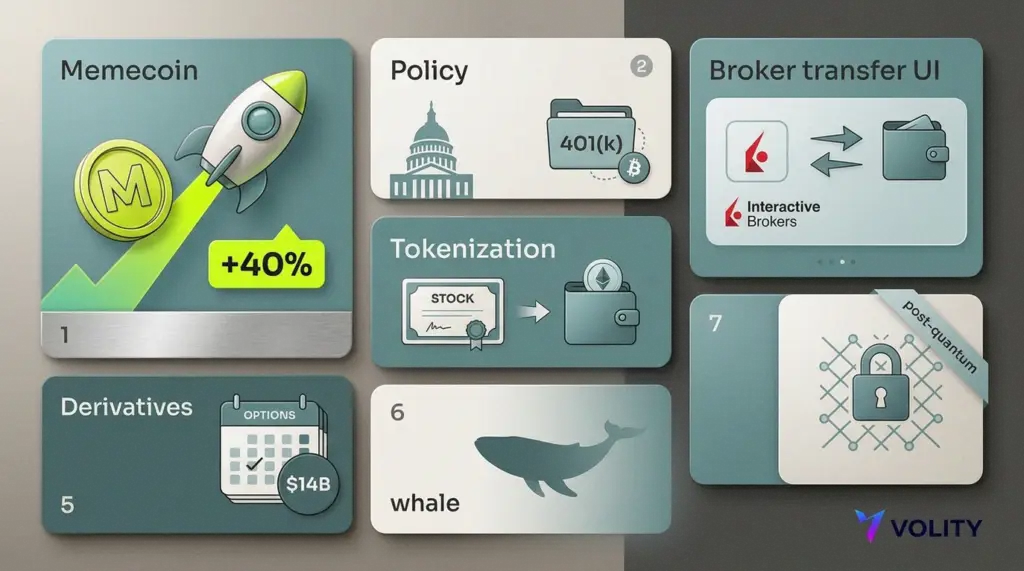
At the frothier end of the tape, MemeCore (M) jumped as much as 40% in a day, lifting from about $1.47 to roughly $1.72. As a result, the token’s market value pushed above $3bn and it briefly sat around #34 by size, only eight months after launch.
However, the move looked less like steady accumulation and more like leverage and whales swapping matches in a fireworks factory. Binance futures activity spiked after a March 25 hardfork, which cut gas fees by about 100x and added account abstraction features. The meme trade gained a “real upgrade” story, even if most buyers cared more about momentum than architecture.
Technicians pointed to an attempted push towards resistance near $1.85, with price flirting around the $1.71 to $1.75 band. Meanwhile, forecasts ranged from the punchy to the unhelpful: some models pitched $2.44 almost immediately and as high as $4.62 by year-end, while others mapped a broad $0.96 to $3.81 range. In other words, everyone agreed on volatility.
Policy and plumbing: crypto edges closer to the mainstream saver
More interesting for the long arc, the White House cleared a rule change that opens 401(k) plans to crypto exposure. That shift matters because it drags crypto from trading screens into the slow, regular drip of wages and auto-enrolment. However, it also invites a new round of arguments about suitability, fees and who gets sued in the next drawdown.
Meanwhile, Coinbase and Better have been preparing crypto-backed mortgage concepts tied to Fannie Mae style underwriting, a sign that the industry still wants collateral to do more than sit there. Interactive Brokers also moved to let clients transfer crypto in from external wallets without forcing a sale first, which smooths friction for active users.
Regulators sent mixed signals too. The CFTC issued its first self-custody no-action letter for XRP derivatives, which traders took as a nod to more pragmatic oversight. However, politicians also pushed to curb insider bets around government-linked events, while the UK moved to freeze crypto political donations.
Bitcoin whales stay quiet as options and sentiment jostle the tape
While memecoins screamed, Bitcoin’s biggest holders whispering mattered more. Whale activity reportedly sank to lows last seen in 2023, even as about $14bn in BTC options expired, a combination that can leave price more sensitive to gamma flows than “conviction”.
Sentiment improved from extreme fear as Bitcoin clawed back towards $71,000. However, some researchers warned chunks of the Bitcoin supply sat underwater after the pullback, which can change behaviour if holders tire of waiting.
Tokenisation keeps advancing, quietly and persistently
Beyond the daily candle-watching, tokenised assets continued to inch from concept to product. Australia’s conversation centred on potential productivity gains, with figures around $16.7bn in benefits floated and a central bank push for more experimentation. Meanwhile, Franklin Templeton and Ondo marketed tokenised ETF access with 24/7 wallet-based trading, a pitch designed to make traditional wrappers feel old.
Funding also followed the infrastructure rather than the jokes. Circle, Coinbase and Ripple backed payments firm Tazapay’s $36m raise, while Payy raised $6m to build private stablecoins on zero-knowledge rails. Even during meme bursts, the pipes keep getting thicker.
Security: cloud-mining hype and the longer shadow of quantum
Hype merchants kept pushing “free” Bitcoin cloud-mining lists promising effortless yields. However, traders have learned the hard way that “verified” is often just a marketing adjective.
On the higher-stakes end, quantum anxiety crept back into the narrative. Google’s timeline talk pulled “quantum-safe” encryption into a 2029 frame, while fully homomorphic encryption and other techniques got another round of attention as possible mitigations. It is not tomorrow’s trade, but it is an uncomfortable reminder that crypto’s security assumptions sit on mathematics, not vibes.
Alt watch: familiar names jolt, but leadership stays fragile
Across majors and large alts, traders tracked Ondo trying to reclaim $0.50, Solana back above $90 on upgrade chatter, and LINK holding $9-plus with tokenisation messaging. XLM rose about 7% amid payments-coin rotation, while Zcash surged above $235 on privacy buzz and fresh funding headlines. Meanwhile, XRP churned around $1.40 with ETF flow chatter and regulatory tea-leaf reading.
By the numbers
- MemeCore (M): up to +40% on the day; roughly $1.47 to $1.72
- M market cap: above $3bn; around #34 by size at the peak
- Hardfork date: March 25; gas fees claimed down about 100x
- BTC options: about $14bn notional expiring
- Tazapay raise: $36m; Payy raise $6m
Key takeaways
- Memecoin rallies built on leverage can gap both ways, so size positions as if liquidity disappears.
- 401(k) access broadens the buyer base over time, yet it may also raise headline and legal risk during drawdowns.
- Quiet Bitcoin whales can mean boredom or caution, therefore watch options flows and dealer positioning closely.
- Tokenisation stories are turning into products, which may favour “picks and shovels” chains and issuers.
- Quantum safety is not a catalyst today, but security narratives can reprice quickly when big tech sets timelines.
For more on this topic see our deep-dives on Dogecoin Price Prediction: Will DOGE Hit $1 or Crash?, XRP-Powered Cloud Mining Meets ETF Buzz: Crypto Cross-Currents, and Bitcoin, DeFi Exploits and XRP: Reading Crypto Risk Signals.
For more on this topic see our deep-dives on Crypto Whales Pivot to PayFi: Pepe vs Remittix and the Memecoin Shift, Crypto Bounce Explained: ETF Rails Meet Whale Demand, and Crypto Investment News: Grayscale Staking ETFs, XRP Surge and BTC Inflows.
Volity Editorial notes: Three frames convert the digest into a defensible positioning read. Auto-enrolment savings flow trajectory (the U.S. 401(k) channel adds roughly 350 billion dollars of annual contributions, of which a 1 to 3 percent allocation to digital assets would represent a multi-year structural bid that does not appear in the daily ETF flow data because the participant-level allocation reaches the spot market through a different transmission path).
Stablecoin and on-chain plumbing maturation (the Coinbase-Better mortgage product, the Interactive Brokers wallet-transfer feature, and the CFTC self-custody letter together signal that the regulated rails for retail crypto interaction are graduating from prototype into production, which compresses the operational counterparty risk that priced into prior-cycle valuations). Memecoin behaviour as a sentiment thermometer (the 40 percent MemeCore session signals that the speculative-dollar pool inside crypto has reactivated, but the structural-thesis weight on the move is approximately zero because memecoin rallies historically resolve through one to three week mean-reversion).
When the three frames align, the digest reads as constructive on the structural channel and neutral on the speculative one.
Frequently asked questions
How quickly will the 401(k) crypto rule change translate into measurable spot flow?
The translation timeline runs over multiple quarters rather than weeks, because the operational chain (recordkeeper menu approval, plan sponsor fiduciary review, ERISA documentation update, participant communication, target-date fund glide-path revision) compresses to roughly 18 to 24 months for the median large plan. The structural read is that the policy change is the upstream signal; the downstream spot-flow expression appears gradually through 2026 and 2027 as the implementation chain works through the recordkeeper platforms. Traders who position for the policy signal capture the structural-bid expectation; traders who wait for the flow data to confirm the signal will enter at materially higher prices because the marginal allocator decision is set by policy review rather than by daily flow tracking. The SEC market regulation pages document the broader policy framework.
What does the Coinbase and Better mortgage concept mean for stablecoin demand?
The crypto-backed mortgage concept tied to Fannie Mae underwriting establishes a structural collateral use case that converts stablecoin balances from idle treasury into productive collateral inside the U.S. mortgage system, which is the deepest and most regulated retail-debt market in the world. The transmission channel is direct: borrowers post stablecoin collateral, the lender originates a conforming or non-conforming mortgage against the collateral, and the secondary-market sale to the GSE channel translates the structure into a fixed-income product that absorbs into pension-and-insurance allocator demand. The structural consequence is that stablecoin demand acquires a permanent collateral-use basis, which compresses the redemption-risk premium that priced into stablecoin valuations through the prior cycle. The FATF virtual-asset guidance documents the international policy backdrop.
How should traders treat the MemeCore 40 percent session as a market signal?
The right treatment is as a high-beta sentiment indicator rather than a fundamental signal. Memecoin sessions of 30 percent or more historically lead recovery legs in the broader speculative pool by 24 to 72 hours when accompanied by AI-token and layer-one alternative confirmation; in isolation, the same session typically resolves through mean-reversion within one to three weeks without leading the broader tape. The structural value of the signal is informational rather than directional, and the correct positioning response is to monitor whether the AI-token, privacy-coin, and layer-one alternative segments produce confirming sessions over the following 48 to 96 hours rather than to chase the leading move. The Investopedia retirement-planning reference covers the broader retirement-account framework that drives the structural-flow expansion.
Why does the CFTC self-custody no-action letter for XRP derivatives matter beyond XRP?
The self-custody no-action letter establishes that the CFTC will not pursue enforcement against participants who use self-custody arrangements for the specific derivatives use case described in the letter, which sets a regulatory reference point that adjacent cases can cite when designing similar self-custody integrations across other digital assets. The structural consequence is that the operational architecture for institutional self-custody integration with regulated derivatives venues acquires a defensible regulatory basis, which removes one of the principal operational objections that fiduciary allocators have raised against direct digital-asset exposure. The XRP-specific scope is narrow; the structural precedent is broad, and the broad implication is the part that matters for the multi-year positioning view across the asset class.
Related guides
- Bitcoin explained
- Cryptocurrency trading
- Crypto trading platforms
- Best crypto investments
- Risk management
Volity operates a trading platform and also publishes educational and analytical content about trading. The content on this page is for educational purposes only and should not be considered financial advice. Volity may benefit commercially when readers open trading accounts through links on this site.
Our content is produced and reviewed under documented editorial standards; see our comparison and review methodology.