Investing in financial products involves risk. Losses may exceed the value of your original investment.
Cryptocurrency market news is a core topic for traders in 2026. The complete guide follows.
The crypto market is buzzing-but also jittery. Prices are swinging, regulators are circling, and a few bold moves hint at where adoption goes next. Here’s the quick read, with clear takeaways and smooth transitions for easy scanning.Major market moves
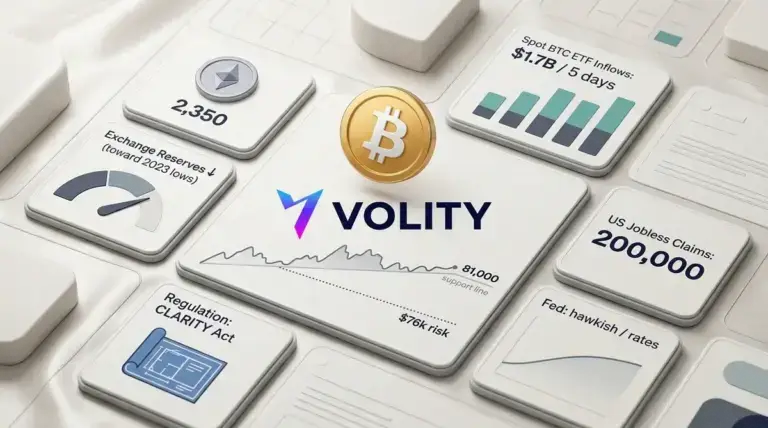
Bitcoin (BTC): below $110,000BTC slipped under the $110K mark as spot BTC ETF outflows picked up. Meanwhile, gold hit all-time highs, challenging Bitcoin’s “digital gold” narrative and pulling some haven demand away.Ethereum (ETH): near $3,500ETH trades around $3,500. Although ETF inflows are rising, price action remains muted-therefore some analysts expect a near-term pullback if momentum doesn’t improve.Solana (SOL): around $180SOL is holding near $180 amid wider uncertainty. Notably, first options trades have appeared, which typically implies higher interest and potentially more volatility ahead.Regulation and strategy
Newsmax & Trump-linked tokensNewsmax became the first major organization to add Trump-associated cryptocurrencies to its treasury, signaling a deeper, more public corporate step into digital assets.Japan’s yen stablecoinTop Japanese banks are collaborating on a yen-pegged stablecoin, a move that should speed up domestic digital-currency adoption and streamline payments.France scrutinizes BinanceFrench authorities urged Binance to tighten compliance, underscoring how global oversight of large exchanges continues to intensify.Sector updates
Stablecoin supply hits a recordEthereum-based stablecoins now exceed $162B in supply-evidence of strong demand for dollar-like liquidity on chain.Ripple’s $1B dealRipple announced a $1B acquisition of a treasury management firm, expanding its reach into traditional finance infrastructure.Market outlook
Fear is elevatedThe Fear & Greed Index has dropped to extreme fear, highlighting broad anxiety. However, select small caps-for example ZORA-are rallying ahead of listings, suggesting niche opportunities still exist.Ghana readies rulesGhana plans to introduce crypto regulations by end-2025, opening new, regulated channels for investors in emerging markets.Bottom line
Volatility remains high, yet structural growth continues-especially in stablecoins, ETF access, and real-world integrations. For traders and investors, the playbook is simple:- Respect risk during drawdowns,
- Track inflows/outflows and options activity, and
- Look for selective strength in regulated markets and upcoming listings.
For more on this topic see our deep-dives on Interactive Brokers USDC Deposits: Stablecoin Rails Meet Brokerage, XRP, Bitcoin and Blockchain in Healthcare: Crypto Investment Trends, and Crypto Investment Snapshot: Ethereum Prices, Bitcoin News, DeFi Updates.
For more on this topic see our deep-dives on Crypto Market: Bitcoin, Ethereum and Top Investments at New Highs, Crypto Market Trends: ETF Flows, Ethereum Breakouts & Top Plays, and Crypto Bounce Explained: ETF Rails Meet Whale Demand.
By Volity Editorial, Volity research desk.
What our analysts watch: Three cross-asset reads anchor a serious view of the BTC-gold-stablecoin triangle. Rolling 30-day correlation between BTC and gold, watched across regimes, exposes when the digital-gold narrative is actually working in the data versus when BTC is trading on the Nasdaq beta; the two regimes are distinguishable but neither is durable across full cycles. Stablecoin-supply growth on Ethereum, decomposed by issuer, is a leading indicator of risk-asset funding capacity; flat or rising supply during price drawdowns typically precedes constructive moves, while declining supply tends to coincide with extended distribution. And spot-ETF net flow on the major BTC products, watched daily, separates structural institutional re-allocation from short-term tactical positioning that reverses on the next negative print.
Related coverage on Volity
- How to Avoid Crypto Scams: A Beginner Safety Checklist
- How to Choose a Trading Platform: A 10-Point Checklist
- Demo vs Live Trading Account: A 7-Step Checklist Before You Go Live
- How to Size a Trade: Position Sizing and Risk Per Trade for Beginners
- Risk-Reward Ratio Explained: How to Set It and Why It Matters
- ETF vs Index Fund: The Difference and Which to Pick
Frequently asked questions
How does the IMF describe the digital-asset and gold relationship in 2025?
The IMF publishes ongoing financial-stability analysis covering crypto-asset developments, gold flows, and cross-asset risk transmission, with detailed coverage in the Global Financial Stability Report. The IMF Global Financial Stability Report archive is the standard institutional reference. The structural read: the IMF framework treats crypto as a risk asset with structural and cyclical drivers separable from gold, which aligns with the empirical observation that gold rallies on fiscal and geopolitical risk while crypto rallies primarily on liquidity and risk-appetite cycles, and that the two move in opposing directions during specific macro regimes.
What does the BIS publish about stablecoin-supply dynamics and crypto liquidity?
The BIS publishes regular analysis of stablecoin supply, settlement architecture, and the implications for monetary transmission. The BIS working paper series on tokenised finance covers the underlying mechanics. The structural read: stablecoin supply functions as the funding base for the broader crypto market, with growth typically preceding constructive risk-asset moves and decline typically coinciding with extended distribution; the relationship is not deterministic but is structurally one of the cleanest forward indicators in the asset class.
How does the European framework handle stablecoin issuance and access?
The MiCA framework provides the dedicated EU regime for asset-referenced tokens and e-money tokens, with reserve, disclosure, and authorisation requirements that align with the trajectory of US stablecoin regulation. The ESMA MiCA framework page publishes the consolidated rules. Volity, accessed via UBK Markets and supervised by CySEC under licence 186/12, lists major listed crypto CFDs with segregated client funds, negative-balance protection, and the standardised retail disclosure that the EU framework requires.
Related guides
- Bitcoin explained
- Ethereum explained
- Cryptocurrency trading
- Crypto trading platforms
- Best crypto investments
Volity operates a trading platform and also publishes educational and analytical content about trading. The content on this page is for educational purposes only and should not be considered financial advice. Volity may benefit commercially when readers open trading accounts through links on this site.
Our content is produced and reviewed under documented editorial standards; see our comparison and review methodology.