Investing in financial products involves risk. Losses may exceed the value of your original investment.
Crypto investments xrp is a core topic for traders in 2026. The complete guide follows.
Main stories of the crypto day
As the world of digital assets continues to evolve, the intersection of finance, technology, and health offers intriguing prospects. Today, the spotlight is on XRP’s resilient stance, Samsung’s venture into decentralised healthcare, and bullish forecasts for Bitcoin and stablecoins. Here’s the lowdown from the crypto sphere.XRP: resilience, risk, and the institutional spotlight
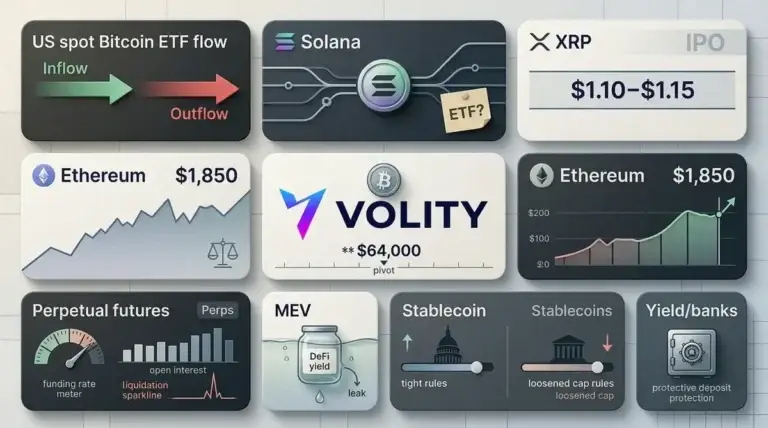
- XRP price steady at $2.70: XRP holds firmly above the $2.70 support, showing resilience despite recent market pressures. Traders remain poised for impending volatility following a liquidation wave.
- Price outlook for September-December 2025: Analysts suggest XRP could peak at $2.84 this month, averaging close to $2.80. If momentum builds, $3 becomes a feasible psychological target, with October possibly seeing highs of $3.17 and a year-end average around $2.93.
- Speculation vs. opportunity: Institutional adoption is a significant price driver. Following a 2025 rate cut by the US Federal Reserve, XRP surged 1.5% to $3.08, mirroring a wider cryptoeconomic rally.
- Boldest predictions: Some analysts foresee XRP soaring as high as $4 by late September, contingent on favourable legal and institutional movements.
The big macro headline: central banks and Bitcoin
- Deutsche Bank’s big call: Within the next five years, a prominent central bank could add Bitcoin to its reserves. This shift would redefine crypto’s role within the global financial system, signalling burgeoning legitimacy.
Samsung and Galeon: medicine, meet the blockchain
- Pioneering partnership: Samsung has partnered with Galeon to integrate AI-driven ultrasound technology with blockchain-based electronic health records (EHR). This innovative alliance blends cutting-edge tech, offering exciting prospects in medical applications.
- Decentralised healthcare, live in Europe: Galeon’s EHR now operates in 18 French hospitals, handling over five million patient files daily. Samsung’s equipment aims to stream anonymised scan data directly to this system, enhancing AI training without compromising patient privacy.
- Focus on women’s health: The initial rollout prioritises women’s health, with AI designed to detect congenital conditions early and optimise diagnostics. Benjamin Tarter from Samsung France stated that the goal is to disrupt the healthcare market collaboratively.
- Web3 community-governed research: The Atlantis platform, powered by the GALEON token, invites over 100,000 stakeholders to engage in governance. Token holders can vote on data utilisation and support future research, nurturing a transparent, decentralised scientific economy.
- Why it matters: This innovative model transforms traditional data management, enabling equitable collaboration among patients, clinicians, and researchers. The priority remains providing streamlined workflows, data-driven medicine, and secure patient information management.
Other market movers and newsmakers
- Little Pepe storms the memecoin charts: This quirky token is enjoying a wild rally, spurred on by a growing online community and speculative trading.
- Solana dips below $220: Recent highs have given way to increased selling pressure. Analysts speculate on whether a deeper pullback is imminent, as both whales and institutional investors shape the market narrative.
- Bain & Co warns: AI revenue may fall short by $800B: Analysts believe this shortfall may impact AI-embedded crypto ventures, prompting reassessment of overly optimistic predictions for “crypto AIs.”
- Stablecoins & corporate crypto: Societe Generale-FORGE pairs with Bullish Europe to introduce a regulated USDCV stablecoin, reflecting ongoing regulatory trends. PayPal is also pushing its stablecoin agenda, while the Strive-Semler merger creates a $1.2B Bitcoin treasury.
- Noteworthy debut: Dogecoin ETF listed on DTCC: This listing serves as further evidence that meme tokens are garnering mainstream interest.
- Regulatory pilots and hacks: Vietnam initiates a five-year, government-regulated crypto pilot, and US-UK regulators collaborate on a major market alignment effort. Meanwhile, UXLINK scrambles in the aftermath of an $11.3M hack.
Trading desk tips and market themes
- Watch liquidity and open interest: Twists in open interest-especially surrounding XRP-could lead to notable price fluctuations in the coming days.
- Token governance on the rise: From Galeon’s decentralised funding model to the increasing clout of memecoin holders, the significance of decentralisation in practical governance is becoming more evident.
- Institutional flows matter: While retail movements still capture headlines, the activities of whales and central banks now significantly influence market direction-keep these players under close observation.
What to watch tomorrow
- Look out for updates on significant hacks and token swaps, particularly as institutional interest grapples with enduring cybersecurity threats.
- Will XRP maintain its ground or break out? Monitor volatility triggers in conjunction with upcoming Federal Reserve signals.
- Pay attention to macroeconomic policy shifts as analysts dissect hints for the next steps in crypto and digital asset regulation.
Final word
Each passing day pulls the crypto ecosystem further away from its speculative roots and deeper into the realms of global infrastructure and industry. Today’s developments reaffirm that the future of finance is increasingly intertwined with technology, governance, and tangible data streams.For more on this topic see our deep-dives on Crypto Market Rebound: Expert Bitcoin Forecasts After the Crash, Bitcoin Short Squeeze Explained: How ETF Inflows Trigger BTC Rallies, and Crypto News: $50M USDT Heist, UNI Burn Vote, Bitcoin and Token Unlocks.
For more on this topic see our deep-dives on Dogecoin Price Prediction: Will DOGE Hit $1 or Crash?, Stablecoins, DeFi Hacks and Bitcoin: Reading the Crypto Risk Map, and Cardano and Wirex Partnership: Crypto Cards and Web3 Super Apps.
For more on this topic see our deep-dives on Wall Street Meets Web3: How TradFi and Crypto Are Converging, Ethereum ETFs and the USDC Welfare Pilot Reshaping Finance, and Bitcoin and Crypto Crashes: How US Tariff Shocks Hit Markets.
What Volity Editorial watches: Three reads frame an enterprise-utility-aware crypto allocation. XRP institutional-flow signals: cross-border-payment volume on RippleNet, on-demand-liquidity corridor adoption, and the $2.84 to $2.80 price band that the recent forecast cycle has anchored. Samsung-class enterprise-blockchain announcements: pilot programmes that include named institutional partners, defined data-layer specifications, and timeline commitments are structurally different from announcements that lack those elements. And stablecoin sector capitalisation alongside the regulatory framework, since the segment now functions as the dollar-rail backbone for crypto and increasingly for cross-border commerce. When institutional flow is rising, enterprise pilots are graduating into production, and stablecoin issuance is regulator-aligned, the utility-driven thesis has all three legs underneath it.
Related coverage on Volity
- How to Avoid Crypto Scams: A Beginner Safety Checklist
- How to Choose a Trading Platform: A 10-Point Checklist
- Demo vs Live Trading Account: A 7-Step Checklist Before You Go Live
- How to Size a Trade: Position Sizing and Risk Per Trade for Beginners
- Risk-Reward Ratio Explained: How to Set It and Why It Matters
- ETF vs Index Fund: The Difference and Which to Pick
Frequently asked questions
How does XRP institutional-flow data differ from speculative-trading data?
XRP institutional flow tracks RippleNet corridor activity, on-demand-liquidity volumes, and qualified-institutional positioning, all of which are reported separately from the speculative-trading tape. The CoinDesk learning library tracks the XRP institutional-utility context. Reading institutional flow alongside the price tape is the cleaner framework than treating price as the only signal.
What is the realistic timeline for enterprise-blockchain deployments in healthcare?
Healthcare-data infrastructure carries regulatory complexity (HIPAA in the US, GDPR in the EU, sector-specific rules across other jurisdictions) that typically extends pilot-to-production timelines well beyond consumer-facing blockchain projects. The Investopedia blockchain reference covers the broader framework. Multi-year horizons are the realistic baseline.
How are stablecoins reshaping cross-border payment economics?
Stablecoin issuance now exceeds several hundred billion dollars across USDC, USDT, and the major regulated alternatives, with cross-border settlement use cases growing faster than the trading-pair use case. The BIS analysis on DeFi market structure contextualises the stablecoin payment-system framework. The economic impact is measurable on a 12 to 24 month horizon.
How does the FATF view enterprise-blockchain compliance?
The FATF virtual-asset framework now extends explicitly to enterprise-blockchain deployments that touch financial-system rails, requiring compliance with travel-rule data sharing, sanctions screening, and beneficial-ownership transparency. The FATF virtual-asset policy hub sets the international compliance baseline that serious enterprise projects now reference.
Related guides
- Bitcoin explained
- Ethereum explained
- Cryptocurrency trading
- Best crypto investments
- Crypto trading platforms
Volity operates a trading platform and also publishes educational and analytical content about trading. The content on this page is for educational purposes only and should not be considered financial advice. Volity may benefit commercially when readers open trading accounts through links on this site.
Our content is produced and reviewed under documented editorial standards; see our comparison and review methodology.