Investing in financial products involves risk. Losses may exceed the value of your original investment.
Bitcoin short squeeze is a core topic for traders in 2026. The complete guide follows.
Crypto news digest: Bitcoin eyes $80k amid ceasefire jitters and ETF frenzy
Bitcoin sat near $71,200 in late trading, a touch softer on the day. However, price action still looks like a market that wants to lift. Traders tied the recent bounce to easing ceasefire fears, a slide in crude, and the sort of forced buying that often follows crowded short positioning. Ethereum held around $2,182, while smaller tokens swung harder as leverage got rinsed.
Market snapshot: BTC bases, shorts face the squeeze
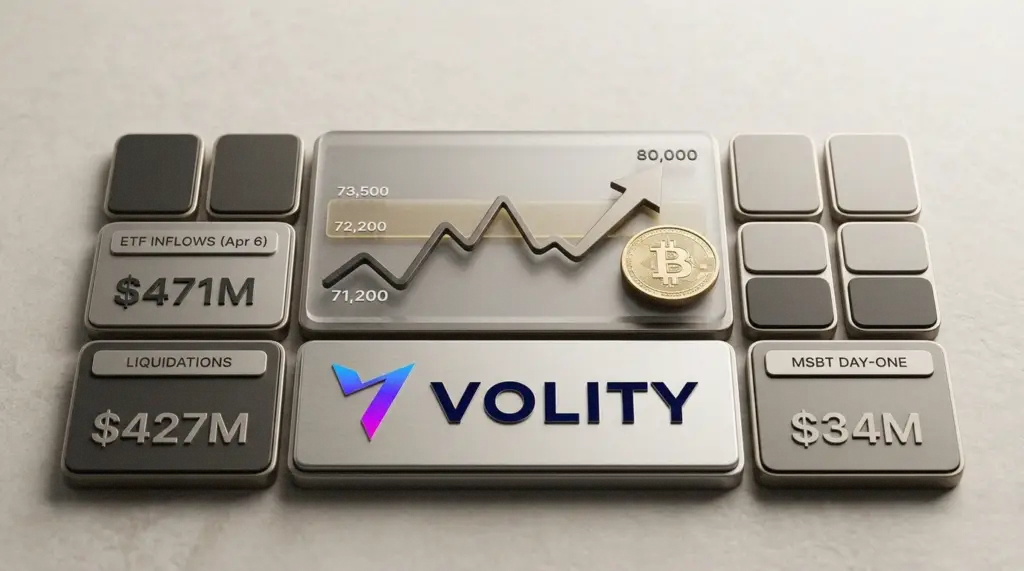
Bitcoin changed hands around $71,362 mid week after a sharp move higher that coincided with cooler geopolitics and weaker oil. Meanwhile, liquidations did the heavy lifting. Roughly $427m of shorts were wiped out in the burst, which helped explain the speed of the advance.
Positioning remains the story. Traders have flagged a dense band of leveraged shorts around $72,200 to $73,500.
A clean push through that range could trigger a second wave of forced buying, with the next psychological target near $80,000. On chain watchers also point to a thick demand zone, with about 850,000 BTC accumulated between $60,000 and $70,000.
That is the kind of base bulls like, even if it can break under stress.
Elsewhere, Ethereum traders watched the Ethereum Foundation’s plan to sell 5,000 ETH via CoWSwap, which added a whiff of supply to an already choppy tape. Cardano hovered near $0.25 as long liquidations built, while Bittensor flirted with technical damage near $297. Meanwhile, BNB held above a descending channel line, and Zcash jumped after $46m of buying linked to Grayscale flows.
ETF wars: Wall Street leans in
The ETF land grab widened after Morgan Stanley launched MSBT, pitching it as a low fee on ramp. The fund reportedly pulled about $34m on day one, with a headline fee of 0.14%. Meanwhile, a filing for a spot PEPE ETF underlined how quickly the product menu keeps stretching, from serious to silly, sometimes in the same breath.
Flows stayed supportive. Spot Bitcoin ETFs took in about $471m on April 6, with the biggest names doing most of the work. Large transfers of BTC and ETH into Coinbase Prime also kept traders alert for potential market making, hedging, or future distribution.
Regulation: stablecoins move into the spotlight
Washington is pushing harder on stablecoins, especially on anti money laundering expectations. Treasury’s Scott Bessent has pressed for quick movement on the CLARITY Act, while the GENIUS Act framework would lean on issuers to monitor transactions more aggressively. Meanwhile, FinCEN has drafted concepts that also point towards issuer level policing.
Dubai, through VARA, has clarified parts of its token issuance playbook. That matters because many stablecoin and exchange ventures still treat the Gulf as a bridge market for capital and licensing. Meanwhile, geopolitical risks flickered again with chatter about Iran and the Strait of Hormuz, a reminder that crypto trades 24 hours a day but still borrows its mood from oil and rates.
AI and big tech: more pipes, more bots
Crypto’s AI theme has not gone away. Bank of Montreal has talked up fresh work in AI and quantum, while CoreWeave’s expanding Meta relationship, now framed around roughly $21bn, keeps the AI infrastructure boom in focus. Meanwhile, Visa’s work on AI assisted commerce hints at a future where payments and automated trading tools blur further.
Retail traders, for their part, continue to chase automated “income” bots. However, the gap between glossy marketing and real risk stays wide. In fast markets, bots can amplify mistakes as quickly as they exploit micro moves.
Memecoins and presales: heat without brakes
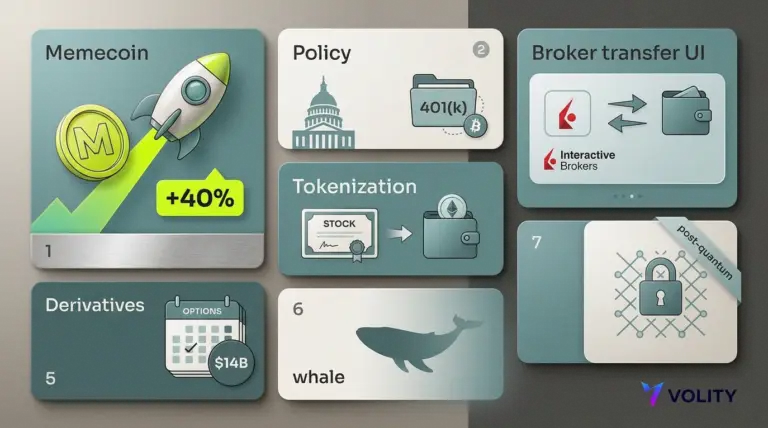
Solana’s memecoin factory kept running, while presales such as DOGEBALL and Little Pepe drew attention from momentum traders. Little Pepe’s tally was pitched around $28m as later stages approached. Binance Wallet’s push into prediction style tools added more frictionless gambling like behaviour, which tends to thrive when volatility rises.
Macro and geopolitics: calmer headlines, fragile calm
US equities rallied on truce talk, and smaller cap strength hinted at a risk on turn. However, the Federal Reserve remains split on cuts, and the Middle East remains one headline away from re pricing crude, the dollar, and everything levered to them. Crypto’s “safe haven” narrative may get tested in real time if tensions flare.
By the numbers
- BTC: ~$71,200, with shorts clustered at $72,200 to $73,500
- Short liquidations: about $427m in the latest squeeze
- ETF launch: Morgan Stanley’s MSBT, about $34m day one, 0.14% fee
- Spot ETF flows: about $471m on April 6
- On chain demand: ~850,000 BTC accumulated between $60k and $70k
Key takeaways
- If BTC clears $73,500 with volume, momentum traders will target $80,000, while stops could fuel the move.
- Watch ETFs for flow consistency, not one day spikes, because sticky inflows change dips into bids.
- Ethereum faces headline supply risk from planned sales, so rallies may meet quicker selling.
- Stablecoin AML rules could tighten short term liquidity, yet longer term they may widen institutional comfort.
- Memecoin and presale heat signals risk appetite, which often peaks near local tops, not bottoms.
For more on this topic see our deep-dives on Bitcoin Crash and Gold Record Highs: How Crypto and Safe Havens Diverge, Bitcoin and Geopolitical Risk: How BTC Reacts to Middle East Tension, and Bitcoin ETF Inflows vs DeFi Exploits: Two Sides of Crypto.
What our analysts watch: The Volity desk reads any squeeze setup through three lenses. Aggregated perpetual swap funding rates across the major venues (negative funding plus rising open interest signals shorts crowded).
Liquidation heatmap density above current price (the size and proximity of the next cluster sets the squeeze magnitude). Spot ETF flow over the prior five sessions (positive flow into rising open interest is the asymmetric setup).
When negative funding meets a thick liquidation cluster within three percent of spot and ETF flow stays positive, sizing into long exposure with predefined stops is the structurally favoured trade.
Frequently asked questions
What exactly triggers a bitcoin short squeeze?
A short squeeze begins when price breaks through a resistance level dense with leveraged short liquidations. Each forced close adds buying pressure, which pushes price higher, which forces more closes. The cascade ends when the cluster is exhausted or new shorts step in at the higher price. The Investopedia short squeeze reference covers the broader market mechanics.
Why do ETF inflows make squeezes more likely?
Sustained ETF inflows tighten spot supply at the same time as crowded shorts increase the available liquidation fuel. The combination means even modest spot demand can break the next resistance, which then ignites the leverage cascade. The U.S. SEC publishes the registered S-1 filings that detail each spot bitcoin ETF’s creation mechanism.
How do I read a liquidation heatmap correctly?
The heatmap visualises where leveraged positions would auto-close based on margin levels and venue rules. The cluster size matters more than the distance: a thick cluster at five percent away can squeeze harder than a thin cluster two percent away. Use it as positioning context, not as a price target. The CFTC publishes Commitments of Traders data that contextualises the broader speculative positioning.
Is fading a short squeeze a viable strategy?
Only with strict risk control and after the cascade exhausts. Short squeezes are momentum events, not value mispricings, and most retail attempts to fade them mid-cascade end in additional liquidation. The disciplined approach is to wait for the squeeze to print its high on declining volume, then look for a reversal pattern with a stop above the squeeze peak. The FINRA day-trading guidance covers the broader risk-management framework.
Related guides
- Bitcoin explained
- Cryptocurrency trading
- Crypto trading platforms
- Best crypto investments
- Risk management
Volity operates a trading platform and also publishes educational and analytical content about trading. The content on this page is for educational purposes only and should not be considered financial advice. Volity may benefit commercially when readers open trading accounts through links on this site.
Our content is produced and reviewed under documented editorial standards; see our comparison and review methodology.