Crypto market stumbles as Bitcoin slips below $80,000
Bitcoin’s return above $80,000 lasted just long enough to tempt late buyers.
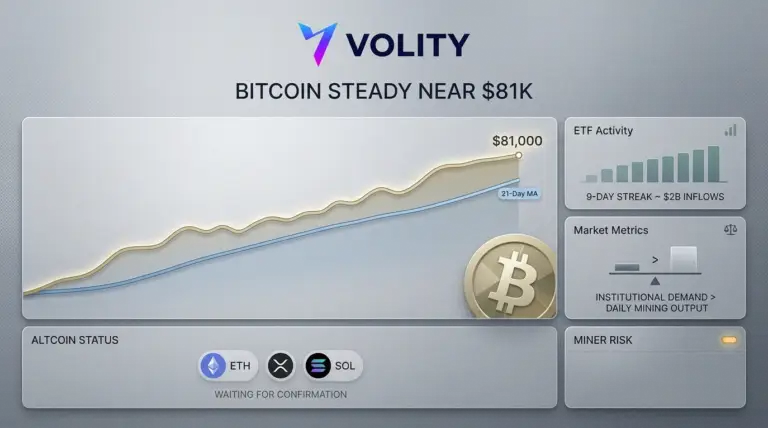
After clearing that mark on 4 May, BTC slipped back below it today as spot Bitcoin ETFs posted their first May outflows. The move broke a brisk run of demand after April drew $1.97 billion into the products, the strongest monthly total this year.
However, the retreat looks less like a collapse than a stress test. Futures positioning had become crowded, while spot demand looked thinner than the headline ETF numbers suggested. A modest flow reversal was enough to shake leveraged longs out of the trade.
Bitcoin traded near the high-$70,000s in morning dealing, leaving bulls defending a level that had only just turned symbolic. Meanwhile, the wider crypto market softened as traders took profits across large tokens and rotated into cash.
The timing matters. Consensus 2026 in Miami had helped revive the old conference-week bid. Yet the mood cooled quickly once ETF flows turned negative, Coinbase reported a near $400 million quarterly loss, and macro traders pared risk.
Political enthusiasm also faded at the margin. Donald Trump’s “Project Freedom” provided a brief tailwind for digital assets. However, traders have become more selective about campaign promises, especially where regulation and banking access remain unresolved.
Prediction markets now show the shift in tone. Bets on Bitcoin reaching $90,000 this month sit near 23 percent. That still leaves room for a squeeze, but it no longer prices a straight road higher.
By the numbers
- $80,000: Bitcoin’s freshly lost round-number support.
- $1.97 billion: April inflows into spot Bitcoin ETFs.
- 23 percent: Market odds of BTC touching $90,000 this month.
- Nearly $400 million: Coinbase’s reported first-quarter loss.
- $515 million: USDT frozen across blacklisted wallets in 30 days.
Altcoins split as traders hunt momentum
Altcoins did not fall in one neat line. Instead, traders chased specific charts, exchange listings and network upgrades.
Cardano (ADA) bounced after breaking a closely watched downward trendline. Bulls are now watching the $0.30 area, where previous selling pressure has appeared. However, the rebound needs stronger volume to look more than tactical.
BNB also outperformed after invalidating a bearish pattern. A push toward recent highs remains possible if Binance avoids fresh United States scrutiny. Still, any new compliance headline would probably hit the token first.
PROS delivered the loudest move. The token jumped 48 percent after listings on Upbit and Bithumb, two exchanges that can still wake Korea’s retail crowd before breakfast in London.
Yet the broader message was mixed. Traders bought stories, not the market. Tokens without fresh catalysts struggled to keep pace with the early-May Bitcoin surge.
Deals and infrastructure take centre stage
Corporate activity kept moving, even as token prices lost ground.
Kraken owner Payward agreed to buy Hong Kong payments firm Reap for $600 million. The deal strengthens Kraken’s stablecoin and payments reach in Asia, where dollar-linked tokens remain useful plumbing for trading, remittances and corporate transfers.
Meanwhile, 21Shares launched TCAN, an ETF offering United States investors exposure to Canton Network. The product gives traditional investors another route into tokenised finance without asking them to manage wallets or private keys.
Polygon cut block times as it tries to attract more stablecoin activity. Faster blocks can help payments and exchange settlement, though developers still need deep liquidity and reliable tooling.
Solv also moved its tokenised Bitcoin infrastructure from LayerZero to Chainlink. The switch points to a familiar theme: security now sells better than novelty, especially after a long list of bridge failures.
AI money keeps crossing into crypto
The AI trade remains crypto’s strangest side door. It brings capital, talent and, occasionally, frantic PowerPoint energy.
Aptos Foundation unveiled a $50 million fund for AI-linked projects. The effort places Aptos alongside chains trying to host agents, data markets and automated transaction systems.
Core Scientific, meanwhile, continues its pivot from Bitcoin mining toward AI data centres. The appeal is clear. AI clients may offer steadier revenue than mining, where margins swing with power prices and Bitcoin difficulty.
Still, the pivot carries execution risk. Data centres need different customers, contracts and capital spending. Miners cannot simply swap ASICs for GPUs and call it a strategy.
Cloudflare added another twist. The company beat earnings expectations but cut AI-related jobs, reminding investors that AI spending is not a one-way escalator for every business attached to the theme.
Regulators tighten the perimeter
Regulatory pressure intensified across several jurisdictions, and the list was unusually broad.
- Australian police seized $4.1 million in Bitcoin tied to a dark web case.
- South Korea moved to restrict overseas crypto transfers.
- European Central Bank president Christine Lagarde warned about euro stablecoin risks.
- Germany discussed ending Bitcoin’s tax-free holding benefit by 2027.
- Tether blacklisted 371 wallets and froze $515 million of USDT within 30 days.
- United States authorities continued to monitor Binance compliance.
- Taiwan indicted a television anchor over a USDT-funded Chinese influence case.
These actions share one thread. Governments are not trying to ban every crypto activity. Instead, they are targeting capital flight, sanctions evasion, political financing and consumer exposure.
That distinction matters for traders. Clean, regulated infrastructure may benefit. However, privacy tools, offshore ramps and lightly supervised stablecoin routes face a harder year.
Politics adds noise, not yet certainty
Crypto has become a campaign asset, but not a settled policy programme.
A HarrisX poll found that the CLARITY Act could influence some voters. Crypto political action committees also mapped midterm spending plans during Consensus. Meanwhile, Trump family ventures stayed in view, with Donald Trump Jr. defending World Liberty and Eric Trump playing down American Bitcoin’s $82 million loss.
Investors should separate access from outcomes. Political attention can lift valuations quickly. However, statutes, agency guidance and bank compliance departments still decide how products actually reach customers.
Exchanges and listed companies wobble
Coinbase had a rough session after its quarterly loss and an AWS outage that interrupted Coinbase Exchange for about two hours. The company also moved to delist perpetual contracts tied to KAITO, CAKE and VET.
For COIN holders, the issue is no longer just trading volume. Investors are now looking at custody revenue, subscription income, expenses and legal risk. A strong crypto tape may not automatically rescue the stock.
Block, Jack Dorsey’s payments company, moved higher despite posting its first loss in years. The reaction suggested investors cared more about forward spending discipline than the headline loss.
SoFi’s crypto relaunch brought in $121 million of activity but little profit. That underlines a common fintech problem: crypto can pull users through the door, while margins remain low once compliance and incentives are counted.
Key takeaways
- Bitcoin: Watch ETF flows first. A return to inflows could rebuild the $80,000 case quickly.
- Leverage: Crowded longs make dips sharper. Funding rates deserve more attention this week.
- Altcoins: ADA, BNB and PROS show traders still reward clear catalysts.
- Stablecoins: Kraken’s Reap deal and Tether freezes put payments infrastructure in focus.
- Equities: COIN, miners and AI-linked crypto stocks may trade differently from tokens.
The market has not lost its appetite for risk. It has merely become less forgiving.
Bitcoin below $80,000 turns a celebration into a negotiation. Bulls need fresh ETF demand, cooler leverage and cleaner macro conditions. Bears, however, still need to prove this is more than another fast shakeout in a market built for them.