Investing in financial products involves risk. Losses may exceed the value of your original investment.
China tech finds its old swagger as the AI tide pulls chips, clouds and Hong Kong higher
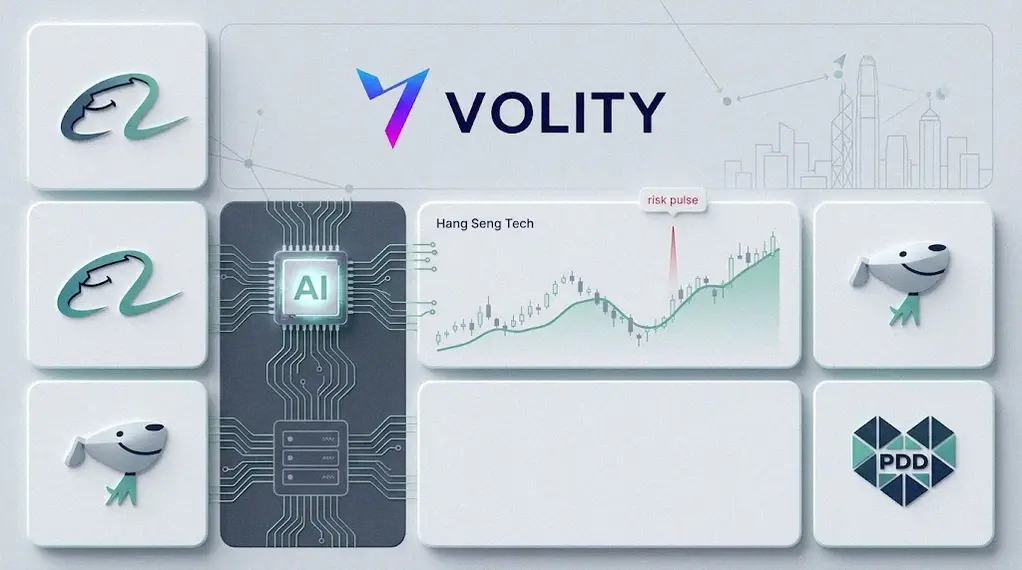
Chinese tech shares came back with a shove this week, not a shuffle. The Hang Seng Tech Index climbed about 4.3% and pushed towards levels last seen in late 2021.
Meanwhile, the mood music has changed. Beijing has eased off the megaphone.
Washington has lowered its voice. Money has started to creep back into names investors had written off as unlovable.
Alibaba’s U.S. line, BABA, has led the charge, with year to date gains that traders now quote in reckless ranges, depending on the start date. However you measure it, the stock has stopped behaving like a value trap. For the practical routes in, see our guide to how to buy Alibaba stock. JD and PDD have followed, helped by the simplest catalyst of all. Expectations were low enough to trip over.
Valuations still do much of the selling. Many of these stocks remain far below their 2021 peaks, even after the bounce.
Every incremental hint of regulatory calm turns into a levered move. Recent approvals around games and consumer internet products have mattered.
So has the sense that officials want functioning capital markets again, not merely obedient ones.
At the same time, China’s AI push has stopped sounding like a slogan and begun to look like budget lines. Baidu has leaned into models, tools and deployment.
Meanwhile, domestic chip and foundry names have benefited from the national mission to reduce reliance on U.S. technology. When local headlines talk about “self reliance”, traders hear “subsidies, orders, and friendlier rules”.
The tape responds.
Yet the rally is not purely a China story. It plugs straight into the global semiconductor cycle, where the centre of gravity still sits in Silicon Valley and Hsinchu. Nvidia remains the keystone, because the AI boom still runs on its software stack as much as its GPUs. Meanwhile, hyperscalers keep buying compute like it is oxygen, which keeps the market focused on 2025 and 2026 capacity rather than next quarter’s noise.
TSMC anchors the supply chain with leading edge manufacturing that few can match. Every strong AI capex comment from MSFT, META or AMZN tends to echo back into Taiwan. Networking and custom silicon themes have also stayed alive, with AVGO and AMD often acting as the “second derivative” trades when Nvidia looks crowded.
That global bid changes how to read the China bounce. If you believe AI infrastructure spending lasts, then China internet is not just a domestic re rating.
It is also a late entry point into an AI shaped world, via cloud, ads, commerce and devices. However, it is still China.
Policy risk has not vanished. It has merely stepped out for a cigarette.
Traders should also respect how quickly this market snaps back. A hot run can turn into a 20% air pocket on one tax rumour or one stern headline. Position sizing matters more than conviction. The better setups may be the ones that let you stay in the game without needing perfect timing.
By the numbers
- Hang Seng Tech Index: up about 4.3%, nearing late 2021 levels.
- BABA: sharply higher year to date, now trading like a re rating story again.
- JD, PDD: solid year to date gains, helped by sentiment and flows.
- NVDA, TSM: still treated as the AI cycle’s “must own” core by many desks.
- 2026: increasingly the horizon for AI capacity debates, not just 2025.
Key takeaways
- Buy dips, not breakouts: China internet has momentum, yet headlines can gap it down.
- Pair trades may work: long China tech, hedge with index puts or a weaker beta counter.
- Keep AI core exposure clean: NVDA and TSM still drive the complex’s direction.
- Watch flows: China internet ETFs can amplify both rallies and reversals.
- Respect crowding: when Nvidia stalls, second tier AI names often wobble first.
For now, the tape says investors want growth again, and they are willing to forgive old sins if the numbers start moving. Meanwhile, the AI buildout keeps paying the bills for semis, and it gives China’s platforms a fresh narrative that is not purely “policy roulette”. However, this is a trade that requires discipline. Ride it with stops and sizing, not speeches.
For more on this topic see our deep-dives on Nvidia Hits $5 Trillion: What the Record Means for Investors, Argan (AGX) Stock: Earnings, Power Demand and Buy Case, and Ironclad Stop-Loss Rules for Volatile Markets: A Trader Playbook.
What our analysts watch: Three readings filter narrative from substance on HK tech. Southbound Stock Connect daily flows tell us whether mainland capital is rotating into HK names (the structural bid for any sustained rally).
Cloud and AI capex disclosures from quarterly earnings reveal whether revenue is following infrastructure spend or only chasing it. Regulatory tone from the Cyberspace Administration of China and the Hong Kong SFC sets the discount rate that the index trades against.
When all three confirm, durable upside opens beyond short-term squeezes; when any of the three diverge, rallies fade quickly into supply.
Related coverage on Volity
- What Is a P/E Ratio and How to Use It
- Fundamental Analysis in Stock Trading: A Working Definition
- Growth Investing vs Value Investing: Which Style Fits You?
- Fractional Shares Explained: How to Start Investing With
- How to Start Stock Trading: A 2026 Beginner Guide
- Dividend Investing for Beginners: How to Start
Frequently asked questions
What drives the Hang Seng Tech Index most directly?
Three threads dominate. Earnings revisions for the top five constituents (Alibaba, Tencent, Meituan, Xiaomi, JD.com) drive index-weighted EPS.
Southbound flow through Stock Connect drives marginal demand. Beijing policy stance (anti-trust, data security, AI regulation) drives the multiple investors are willing to pay.
The IMF publishes the macro framework that shapes broader China equity flows.
How does China AI capex translate into Alibaba and Baidu earnings?
AI capex flows through cloud infrastructure (Alibaba Cloud, Tencent Cloud, Baidu AI Cloud) and into model and chip purchases (SMIC, NVIDIA China-tier). Revenue growth lags capex by two to four quarters. Investors paying for the AI thesis must distinguish between capex disclosed (visible) and capex monetised (lagging), which is why the spread between Cloud revenue growth and infrastructure spend is the cleanest single read. Investopedia covers the sector mechanics in detail.
What are the cleanest ETF entries for Hang Seng Tech?
KWEB (KraneShares CSI China Internet) and CQQQ (Invesco China Technology) are the two most liquid US-listed wrappers. The 3067.HK Hang Seng Tech ETF is the local Hong Kong vehicle. Each has slightly different sector tilts and currency exposures. The Nasdaq publishes the underlying constituent breakdowns and daily NAVs.
How should retail traders manage HK tech volatility?
Position-size for headline risk, use limit orders rather than market orders during low-liquidity overnight sessions, and avoid concentration in any single regulatory-exposed name. Volity research builds basket strategies for HK tech exposure, paired with currency hedges where appropriate.
Related guides
- Best AI stocks to invest in
- Indices trading platforms
- Stocks investing for beginners
- Best stock trading platforms in Europe
- Best trading platforms
Volity operates a trading platform and also publishes educational and analytical content about trading. The content on this page is for educational purposes only and should not be considered financial advice. Volity may benefit commercially when readers open trading accounts through links on this site.
Our content is produced and reviewed under documented editorial standards; see our comparison and review methodology.