Investing in financial products involves risk. Losses may exceed the value of your original investment.
Resolv defi exploit is a core topic for traders in 2026. The complete guide follows.
Crypto markets bleed as Resolv exploit rocks DeFi
A nasty DeFi exploit made the week’s opening feel like a bad hangover. Meanwhile, Bitcoin hovered near $70,000, yet confidence slipped as traders weighed sticky inflation, geopolitical noise and an ugly reminder that smart contracts still break. However, the real shock came from Resolv Labs, where attackers minted tens of millions of unbacked USR tokens and used thin liquidity as an exit.
As the selling spread, larger coins sagged and smaller tokens flickered with odd strength. The tape looked like a classic risk-off day with a few speculative pockets refusing to die. XRP sank towards $1.40, while traders rotated into whatever still had momentum.
Resolv’s USR exploit turns $100,000 into $80 million of counterfeit tokens
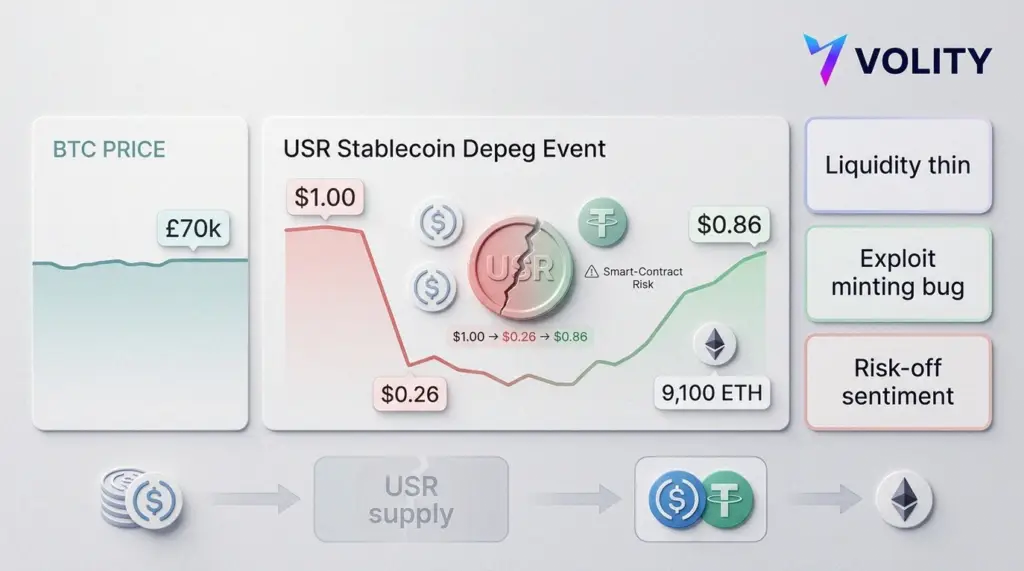
Resolv Labs’ USR stablecoin was hit by a minting exploit that, in effect, turned a relatively small sum of USDC into a huge print run of unbacked tokens. The attacker used roughly $100,000 to $200,000 in USDC to mint around 50 million USR, an outcome that pointed to a catastrophic weakness in the minting logic.
Prices did what they always do when a “stable” coin is revealed as optional. USR plunged as much as 74% to about $0.257 before rebounding to around $0.85 to $0.86. However, the bounce did little for liquidity providers who wore the worst of the dump. The exploiter sold across venues including KyberSwap and Velora, pulling out about $17 million in USDC and USDT, and then rotated proceeds into more than 9,100 ETH, roughly $23.8 million at the time.
Resolv said no underlying assets were lost, yet it paused operations while it investigated. Meanwhile, on-chain trackers followed the remaining stash, with around 36 million USR still sitting in the attacker’s orbit. Because the token price fell so sharply, that remainder was suddenly worth only a couple of million dollars.
The anger in DeFi circles is familiar. A protocol with roughly $500 million in total value locked can still ship a minting mechanism that behaves like a money printer. The episode will not just punish USR holders. It will also harden attitudes to stablecoin risk, especially for newer pegs that rely on complex contract plumbing.
Bitcoin holds $70,000 but macro fog thickens
Bitcoin traded in a rough $68,000 to $70,000 band as broader risk appetite faded. However, the macro list stayed unhelpful: rate-cut timing remained uncertain, inflation prints looked sticky, and Middle East tensions kept energy risk in the background. Crypto’s usual “uncorrelated” pitch sounded thin.
Miners also flashed mild stress signals. Hash rate eased, and traders began to price in a potential difficulty drop, with some estimates near 7.5%. Meanwhile, ETF flows turned choppier and options markets showed more defensive positioning, suggesting investors wanted protection rather than moonshots.
Still, signs of rotation appeared. BlackRock shifted about $140 million of BTC and ETH to Coinbase Prime, and an old “2012” era wallet moved roughly $147 million. However, those movements can mean custody, profit-taking or simply housekeeping. Traders treated it as texture, not a trend.
Altcoin tape: XRP sags, memes twitch, strength hides in corners
- XRP slid to about $1.40 as whale activity cooled, although retail interest stayed lively.
- SIREN pushed higher even as majors weakened, a reminder that thin markets can still squeeze.
- PI traded near $0.19 ahead of a v21-themed catalyst, while Kaspa attracted “rebound” chatter after a sharp drawdown.
Meanwhile, the meme corner kept its usual mixture of comedy and ugliness. One token collapse triggered threats and harassment online, while major projects again warned about Telegram impersonators and fake airdrops. The day’s worst behaviour came from humans, not code.
Regulatory and industry tremors add to the noise
On regulation, a few themes overlapped. US derivatives policy looked marginally more constructive, yet state-level fights continued, including a looming shutdown risk for a prediction-market operator in Nevada. Meanwhile, Brazil delayed parts of its crypto tax debate ahead of elections, leaving local firms in limbo.
Elsewhere, product marketers kept pushing the next wrapper. An ETF push tied to Hyperliquid drew attention, while tokenised gold standards moved forward as firms fought over what “store of value” should mean in a blockchain costume.
Layoffs and enforcement were also back in the headlines. Crypto job cuts continued , while cross-border police actions froze hundreds of millions tied to scams. The industry faced a two-front grind: damaged trust on-chain and tightening scrutiny off-chain.
By the numbers
- USR exploit: about 50 million allegedly unbacked tokens minted.
- Capital used: roughly $100,000 to $200,000 USDC quoted in early tracking.
- USR low: about $0.257, before recovering near $0.85 to $0.86.
- Proceeds: roughly $17 million in stablecoins, then 9,100+ ETH accumulated.
- Bitcoin battleground: $69,000 to $70,000 remains the near-term line traders watch.
Key takeaways
- Track the attacker wallet. Further USR selling could spill into correlated DeFi names via liquidity stress.
- Respect the $69,000 area in BTC. A clean break risks a faster move as hedges kick in.
- Fade “stable” narratives without proof. Minting controls and redemption mechanics matter more than APY.
- Watch ETH flows after the exploit. Conversions into ETH can distort short-term funding and perp positioning.
- Assume scams rise after chaos. Phishing spikes tend to follow every big exploit and headline panic.
The day’s message was blunt. DeFi still carries sudden, mechanical tail risk, while macro still decides the mood. Traders will keep one eye on the Fed calendar, and the other on the next contract that fails at the worst moment.
For more on this topic see our deep-dives on Bitcoin Slides Toward $85K: Wall Street Jitters and Institutional Buying, Bitcoin and Ethereum: Peace Talks and the Quantum Computing Trade, and Bitcoin Price Analysis: Forecast Frameworks, Trends and BTC vs ETH.
What our analysts watch: Three filters cut the smart-contract risk surface. First, the audit roster: at least two reputable firms, with public reports and a published bug-bounty programme.
Second, time-in-production with deep TVL; protocols with 18+ months and 500m+ USD locked have survived more attack vectors. Third, on-chain governance hygiene: timelocks on parameter changes, multi-sig admin keys, no upgradable contracts behind opaque proxies.
When BTC sells off on a DeFi exploit headline, the price action is usually reflexive and short-lived; the structural damage is to the affected protocol, not the asset class.
Frequently asked questions
How do DeFi exploits typically affect Bitcoin price?
The first-order effect is small: BTC has no smart-contract surface of its own. The second-order effect is risk-off rotation, where institutional capital that was earning DeFi yield exits to stablecoins or fiat, sometimes selling spot BTC to cover unrealised losses. The historical pattern is a 24- to 48-hour BTC drawdown of 1 to 4 percent that recovers when contagion is shown to be contained. The BIS tracks crypto contagion dynamics in its quarterly reviews.
Can I detect smart-contract risk before depositing?
Some of it. Public audit reports flag the obvious surface (re-entrancy, oracle manipulation, access control). What you cannot fully detect is novel attack composition across multiple protocols. Investopedia covers DeFi risk at a foundational level. Treat any DeFi position as venture-style allocation; never deposit money you need within 12 months.
What is FATF guidance on virtual-asset risk?
The FATF has issued repeated guidance on virtual-asset service providers, including DeFi platforms. The travel rule, KYC obligations, and sanctions screening are now standard regulator expectations. For retail users, the practical takeaway is to use protocols that operate within those frameworks where possible; that often correlates with better security practice.
How does Volity insulate me from DeFi smart-contract risk?
Volity provides custodied spot BTC, ETH and altcoin exposure through UBK Markets (CySEC licence 186/12) with our Saint Lucia and Cyprus entities. Your exposure is to the underlying asset, not to a yield protocol. If you want crypto without owning smart-contract risk, custodied spot is the simplest route.
Related guides
Volity operates a trading platform and also publishes educational and analytical content about trading. The content on this page is for educational purposes only and should not be considered financial advice. Volity may benefit commercially when readers open trading accounts through links on this site.
Our content is produced and reviewed under documented editorial standards; see our comparison and review methodology.