Eight Trading Strategies for a Jumpy 2026 Market
Markets in 2026 have not rewarded sleepy hands. AI stocks still lurch on capital-spending rumours. Rate-cut hopes keep shifting. Meanwhile, one hot inflation print can turn a tidy trade into a small kitchen fire.
That does not mean traders need more screens or louder alerts. They need a plan that fits their time, temperament and account size. Below are eight tested approaches, with the virtues and bruises of each.
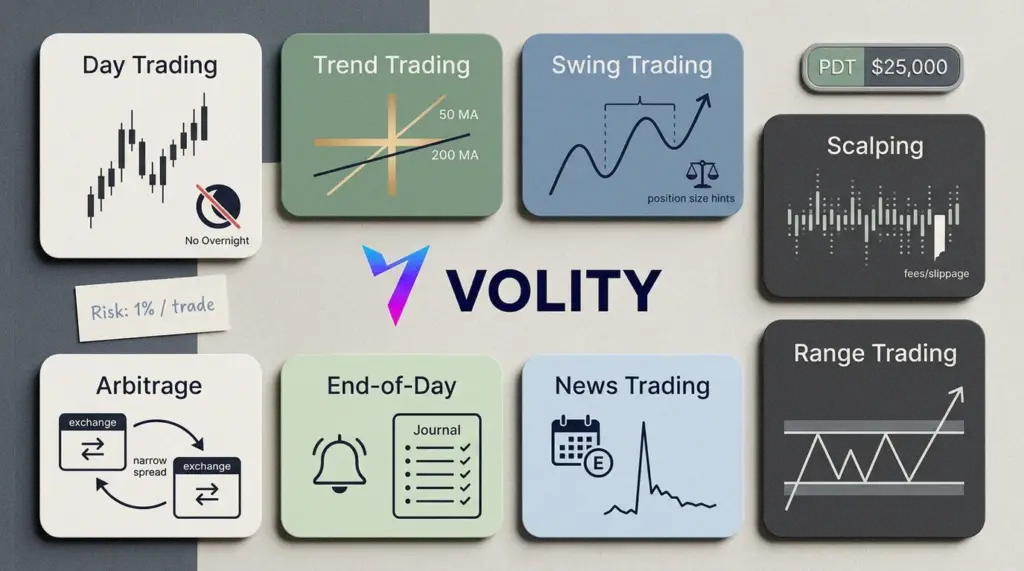
Day Trading
Day traders open and close positions before the bell. They hunt intraday breaks, reversals and bursts of volume. They avoid overnight shocks, but they inherit every minute of market noise.
The method works best in liquid names. Think SPY, QQQ, NVDA, TSLA and other tickers with tight spreads. A trader might buy a clean break above resistance, then sell when volume fades.
However, the costs are not only financial. Day trading demands fast execution, stable technology and strict sizing. Some markets apply a pattern day trader rule requiring a minimum equity balance for frequent margin day trading; the EEA and UK do not, capping retail leverage under ESMA and FCA rules instead.
The discipline matters more than the setup. Many skilled traders risk 1 percent or less on each trade. Meanwhile, uninformed traders often widen stops after entry, then call it conviction.
Trend Trading
Trend traders try to stay with the strongest current. They use moving averages, breakout levels and volume to confirm direction. A classic signal comes when the 50-day average climbs above the 200-day average.
This approach suits markets with persistent leadership. AI infrastructure, defence, chips and power-grid stocks have all produced powerful runs at points during the last cycle. However, trends rarely move in straight lines.
A practical trend trader buys pullbacks, not panic. Stops often sit below recent swing lows. Meanwhile, trailing stops protect gains when a leader finally loses sponsorship.
The main danger is late entry. By the time a ticker dominates chat rooms, much of the move may have gone. Traders should demand confirmation, but avoid chasing vertical candles.
Swing Trading
Swing traders hold positions for several days or a few weeks. They want the meat of a move, not every tick. This makes the approach attractive for people with jobs outside the market.
Setups often include flags, earnings breakouts, failed breakdowns and support bounces. A trade may risk $2 to target $5 or $6. That ratio gives room for wrong calls, provided losses stay small.
Still, swing trading carries overnight risk. A regulatory headline, drug trial result or chip-order rumour can gap a stock beyond a stop. Position size must reflect the calendar.
For many private traders, this is the most workable compromise. It requires preparation, but not minute-by-minute staring. However, it still punishes sloppy entries and emotional exits.
Scalping
Scalpers aim for tiny gains, often in seconds or minutes. They trade bid-ask spreads, one-minute patterns and order-book shifts. The method can look dull until the losses arrive quickly.
Speed matters. So do commissions, platform quality and deep liquidity. A scalper in TSLA or NVDA may take dozens of trades inside a tight range.
However, the margin for error is narrow. Fees can erase small wins. Slippage can turn a good setup into a flat trade. Meanwhile, one stubborn hold can wipe out hours of careful cutting.
This is not a gentle starting point. Professionals use rules, hotkeys and often automation. Retail traders should paper trade it first, then measure results honestly.
Arbitrage
Arbitrage seeks price differences between related assets. In theory, a trader buys the cheap version and sells the expensive one. In practice, the easy money usually disappeared before breakfast.
Examples include ETF pricing gaps, dual listings, futures against cash markets and crypto spreads. However, execution speed decides the outcome. So does access to multiple venues and enough capital.
The appeal is clear. Properly hedged arbitrage can reduce market direction risk. Yet the risks do not vanish. Borrow costs, failed fills, exchange outages and rule changes can all bite.
For most individual traders, this is a specialist lane. Still, understanding arbitrage helps explain why apparent mispricings collapse so fast.
End-of-Day Trading
End-of-day traders make decisions after the close. They review daily candles, support zones and volume. Then they set orders for the next session.
This style cuts the noise. It also prevents revenge trades after a bad morning. It suits investors who cannot monitor markets during regular hours.
The trade-off is obvious. End-of-day traders miss intraday reversals and fast catalysts. Overnight gaps can also make stops less precise.
Even so, the slower tempo can improve decision-making. A daily chart often shows what a five-minute chart hides. Meanwhile, written plans become easier when the market is closed.
News Trading
News traders focus on catalysts. Earnings, central-bank decisions, inflation data, clinical trial results and supply warnings can all move prices sharply.
The method rewards preparation. Traders need the calendar, recent price levels and expected figures. They also need to know what the market has already priced in.
However, the first move often lies. A stock may spike on an earnings beat, then fall on guidance. A bond rally may reverse after one sentence in a central bank press conference.
Stops should be tight, but not fanciful. Liquidity can vanish around data releases. Smaller size usually beats brave talk.
Range Trading
Range traders buy near support and sell near resistance. They rely on the market’s habit of chopping sideways between bigger moves. Indicators such as RSI and Bollinger Bands can help mark extremes.
This strategy works best when volume cools and headlines quieten. Traders define the box, then fade moves towards its edges. Meanwhile, they place stops just outside the range.
The problem arrives when the box breaks. A real breakout can run hard and punish repeated fading. Range traders must accept that some levels stop working.
Patience helps. Small wins can compound, but only if losses stay boring.
The storyline continued the next day with the Crypto Clarity Act vote as banks pushed back and Bitcoin held $80k, and crossed over to equities in our UK investors guide to crypto, tech earnings and AI forecasts for the same week.
By the Numbers
- 1 percent – a common maximum risk per trade for disciplined active traders.
- 1:30 / 1:2 – EEA/UK retail leverage caps (ESMA/FCA) on major FX and crypto CFDs, in place of a minimum-equity threshold.
- 50 and 200 days – moving averages many trend traders watch for direction.
- 2 to 3 times risk – a typical reward target for swing setups.
- Seconds to weeks – the holding-period spread across these eight styles.
Key Takeaways
- Match the strategy to your schedule before choosing tickers.
- Use smaller size around CPI, Fed decisions and earnings.
- Avoid scalping unless costs and execution are excellent.
- Trend and swing approaches suit many part-time traders better.
- Keep a trading journal, or repeat the same expensive lesson.
No strategy removes uncertainty. The market will still gap, fake out and punish impatience. Yet a defined method changes the game. It tells traders where to enter, where to leave and when to do nothing.
In a market this jumpy, doing nothing can be the cleanest trade of the day.
For a deeper walkthrough of how these strategies play out across asset classes, see the crypto trading guide and the forex trading guide.
Recent crypto coverage shows how these strategies play out in real markets: E*Trade cutting crypto fees while Bitcoin held $95,000, spot ETF inflows pushing Bitcoin toward $81,000, and Bitcoin holding $82,000 as US Clarity Act odds jumped all tested different playbooks in a single week.
Risk management is the strategy
Choosing a strategy is only half the work. The other half is sizing positions so a wrong call does not break the account. In a 2026 tape that whipsaws on rate-cut headlines and AI capex rumours, most blow-ups come from oversized single positions, not from picking the wrong setup. Three rules cover most cases.
- Fixed-fractional risk. Risk a fixed percentage of account equity per trade (commonly 1 to 2 percent). Position size flexes with stop distance so the dollar risk stays constant.
- Correlation awareness. Two long crypto trades, two short USD trades or two AI stock longs are not three independent bets. They behave as one position when the market moves. Cap total correlated exposure.
- Daily and weekly loss limits. A hard rule that stops trading for the day after a defined loss prevents revenge trading. A weekly limit catches the slower bleed.
Paper trading before live capital
Strategies look obvious on a chart in hindsight. Live execution exposes the gaps: missed entries, slippage on news, premature exits, the urge to add to losers. Paper trading on a demo account for a defined period (two to four weeks per new strategy) catches most beginner mistakes before they cost real money. The goal is not to prove the strategy works but to prove you can execute it consistently when no money is on the line. Once execution is clean on paper, sizing up to micro-lots of real capital is a smaller step than going from zero to full size.
Reviewing trades is part of the strategy
The trader who reviews every closed position weekly catches drift early: stops being moved, position sizes creeping up, the same setup being traded at the wrong time of day. A short trade journal (entry reason, exit reason, what was different from the plan) turns a string of trades into a feedback loop. After three months the journal often shows which of the eight strategies actually fits your temperament, and which one you should drop.
Frequently asked questions
Which trading strategy works best in a volatile market like 2026?
No single strategy dominates a volatile market. Range trading shines when price keeps reverting inside a known band, trend trading wins on extended directional moves, and news trading converts geopolitical shocks into setups for traders fast enough to act. The right pick depends on your time available, risk tolerance and capital. Most active retail traders combine two or three rather than relying on one.
How much capital do I need to start day trading in 2026?
The Volity wallet opens at $0, so the account barrier is not the constraint. Practical capital for day trading depends on the asset class: forex tolerates smaller accounts (a few hundred dollars) because of available leverage, stocks usually require more depending on jurisdictional pattern-day-trader rules, and crypto can be started small because most platforms allow fractional sizing. Risk per trade should still be a fixed percentage of account equity, not a fixed dollar amount.
Is swing trading better than day trading for beginners?
For most beginners, yes. Swing trading runs on daily or 4-hour charts, gives time to review setups before acting, and tolerates wider stops. Day trading demands faster decisions, more screen time and tighter risk control. The strategy that works is the one that fits your schedule and temperament without forcing trades during hours you are not present.
How do I manage risk across multiple strategies?
Set a single account-level risk budget (commonly 1 to 2 percent of equity per trade) and apply it uniformly across whichever strategies you run. Track open positions across strategies so correlated risks (two long crypto trades in different setups) do not silently double your exposure. Use a separate sub-account if a strategy needs a different risk regime.
Can I run multiple strategies on Volity at the same time?
Yes. The Volity platform supports the full retail asset range (forex, indices, commodities, stocks, crypto) on Volity MT, native web and native mobile, so a swing trader holding equity positions, a forex day trader and a crypto scalper can all operate from the same account. Position sizing and stop discipline are what keeps the parallel approach workable.