Quick answer
Crypto trading means buying and selling cryptocurrencies to profit from price changes, either by owning coins (spot) or trading their price with derivatives like CFDs and futures. It ranges from long-term holding to active day trading. Crypto markets run 24/7 and are highly volatile, so trading them requires risk management and discipline, not just market knowledge.
The Crypto Trading Starter Kit
A plain-English PDF: what to check before you trade, how orders and risk really work, and the mistakes to skip. Get it free.
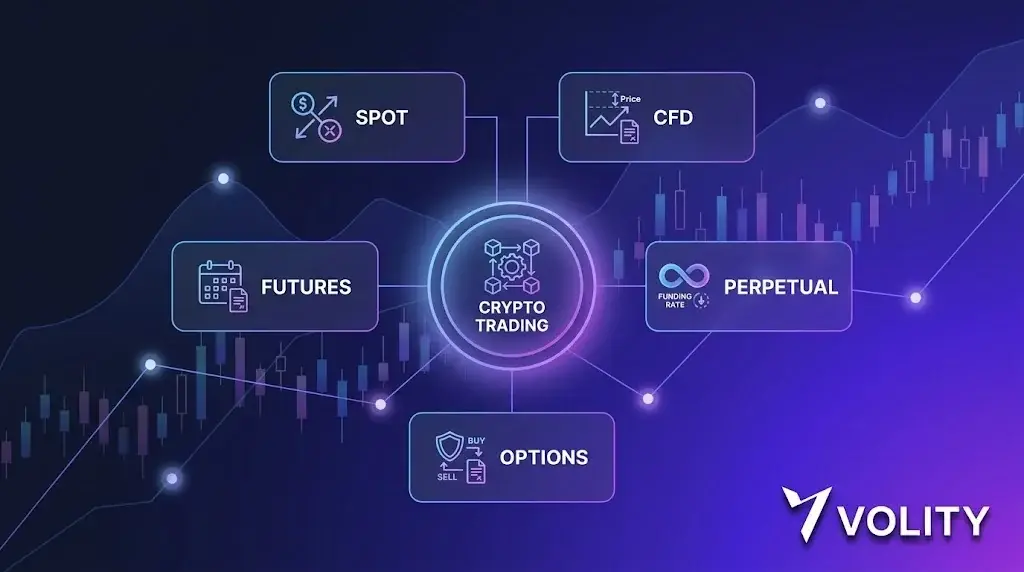
The crypto trading meaning is buying, selling, or speculating on cryptocurrency prices to generate gains or absorb losses. The activity takes five distinct forms, spot, CFD, futures, perpetual, options, each with different mechanics and risk profiles. This page defines each and shows how Volity fits.
The five forms of crypto trading
1. Spot trading. Buy actual cryptocurrency; hold it; sell when ready. You own the coin (or a claim against the custodian). Volity’s wallet supports spot for BTC, ETH, USDT, USDC, and others.
2. CFD trading. Contract for Difference, speculate on price movement without owning the underlying. Leveraged exposure, both directions (long or short), no on-chain custody. Volity’s primary trading product.
3. Futures trading. Standardised contracts with defined expiry. CME lists regulated Bitcoin futures. Most retail crypto futures sit on offshore exchanges as perpetuals (see below).
4. Perpetual contract trading. Futures-style positions without expiry. Funding rate every 8 hours keeps the perp price anchored to spot. Offshore exchanges; not offered directly by Volity.
5. Options trading. Right but not obligation to buy/sell at a strike price by an expiry. Capped buyer loss; uncapped seller loss. Mainly offshore venues; not offered directly by Volity.
Which form is “crypto trading” usually referring to
When people say “crypto trading” without qualifying, they typically mean one of:
- Spot trading on an exchange (Coinbase, Binance, Kraken) for buy-and-hold
- CFD trading on a broker (Volity, IG) for leveraged directional bets
- Perpetual contracts on an offshore exchange for high-leverage tactical positions
The mechanics differ; the underlying asset (crypto price) is the same. Profitability requires different skills per form.
Volity’s “crypto trading” definition
On Volity, crypto trading means both:
- Spot holding in the multi-currency wallet (BTC, ETH, USDT, USDC and others)
- CFD trading of 20+ crypto pairs on Volity MT with leverage up to 1:50
You can do either or both in the same Volity account. Long-term holders use the wallet; active traders use CFDs; many users combine both.
What crypto trading does NOT mean
- Not the same as crypto investing. Investing typically implies long-term hold for fundamental appreciation. Trading typically implies shorter-horizon active positions
- Not the same as mining. Mining produces new crypto through proof-of-work validation. Trading buys and sells existing crypto
- Not the same as staking. Staking earns yield by locking crypto in proof-of-stake validation. Trading does not require staking
- Not the same as yield farming. DeFi yield strategies are separate from trading
Why definitions matter
The term “crypto trading” gets used loosely in marketing and casual conversation. The five forms above carry different:
- Risk profiles: spot has no liquidation; leveraged forms can liquidate
- Tax treatment: spot disposal vs derivative gain vs options-specific rules
- Skill requirements: spot buy-and-hold needs less active management than CFD/perp trading
- Regulatory status: spot is broadly permitted; CFDs banned for retail in some jurisdictions; perps largely offshore
When you decide to “start crypto trading,” choose the form deliberately based on these factors.
Trading is not limited to buying and selling coins. Event contracts let you trade the outcome of a real-world event instead of a price, and our guide covers what prediction markets are and how they pay out.
Sources
Related Volity crypto guides
- Benefits of Crypto Trading: 7 Real Advantages
- Crypto Trading Tips: 12 Habits That Separate Profit
- Live Crypto Trading: Real-Time Execution on Volity
- Crypto Trading Volume Explained
- Crypto Day Trading Platform on Volity MT
- Crypto Trading Charts Guide: How to Read Them
- Crypto Trading Books: 10 Recommendations
- Can You Make Money Trading Crypto?
- Contract for Difference Trading Crypto: How CFDs Work
Frequently asked questions
What does crypto trading mean exactly?
Crypto trading means buying, selling, or speculating on cryptocurrency prices to generate gains or absorb losses. Five forms exist: spot, CFD, futures, perpetual, options. Each has different mechanics. On Volity, crypto trading specifically means spot (wallet) plus CFD (Volity MT).
What is the difference between crypto trading and crypto investing?
Investing implies long-term hold for fundamental appreciation (years). Trading implies active positions on shorter horizons (minutes to weeks). The line is fuzzy; many users do both with different portions of their capital.
Is crypto trading the same as mining?
No. Mining produces new crypto via proof-of-work computation. Trading buys and sells existing crypto. Different activities, different infrastructure, different risk profiles.
What is the easiest form of crypto trading for beginners?
Spot trading in a multi-currency wallet. Buy a small amount of BTC or ETH, hold or sell at your discretion, no leverage, no liquidation risk. Builds familiarity before considering leveraged products.
Is crypto trading risky?
Yes. The underlying market is volatile (BTC has moved more than 50% within a year multiple times). Leveraged forms add amplification risk. Spot forms have no liquidation but full price-exposure risk. Risk-managed approaches mitigate but never eliminate the risk.
Can I do crypto trading on Volity?
Yes. Volity supports both spot crypto holding (wallet) and CFD crypto trading (Volity MT, up to 1:50 leverage). One account combines both.