Quick answer
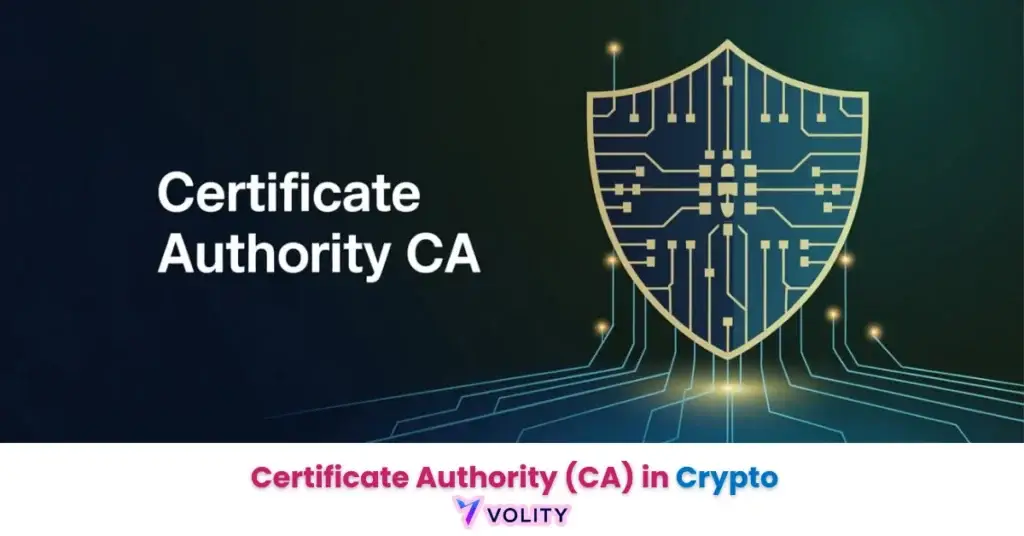
A Certificate Authority (CA) is a trusted organization that issues digital certificates verifying the identity of websites and entities, underpinning HTTPS and secure connections. In Web3 and crypto, CAs and their decentralized alternatives matter for securing wallets, exchanges and identity. A CA vouches that a public key really belongs to who it claims to.
The Crypto Trading Starter Kit
A plain-English PDF: what to check before you trade, how orders and risk really work, and the mistakes to skip. Get it free.
Web security relies on the integrity of third-party Certificate Authorities. A compromised CA can lead to sophisticated phishing and man-in-the-middle attacks on your crypto wallets and exchanges. Always verify the authenticity of any web interface before entering private keys or recovery phrases. Capital at risk.
A Certificate Authority (CA) identifies a trusted third-party entity that issues digital certificates to verify the identity of websites and crypto platforms. They are the foundational trust layer of the internet, and from 15 March 2026 the maximum lifetime of a public TLS certificate drops to 200 days on the way to 47 days in 2029. Identifying valid CA credentials is the primary defense against phishing in the multi-chain ecosystem.
Certificate Authority (CA) identifies the foundational “trust anchor” required to secure all web-based cryptocurrency infrastructure, from centralized exchanges to decentralized application (dApp) interfaces. This technical entity reveals a centralized hierarchy that cryptographically binds a platform’s public key to its verified identity, enabling the HTTPS encryption that protects your transaction data. In 2026, the first step of a staged reduction in certificate lifetimes takes effect, and it is what makes automated certificate management a requirement rather than a convenience.
The interaction between traditional public key infrastructure (PKI) and emerging Web3 identity models has reached a critical hybrid phase. While blockchains eliminate the need for CAs in on-chain settlement, the web interfaces we use to access those chains remain dependent on CA-issued digital signatures. This guide identifies the mandates now reshaping CA trust and explains how these entities protect crypto users from sophisticated phishing.
While understanding Certificate Authority (CA) is important, applying that knowledge is where the real growth happens. Create Your Free Crypto Trading Account to practice with a free demo account and put your strategy to the test.
What is a Certificate Authority (CA) and how does it secure Web3?
A Certificate Authority (CA) is a trusted third-party organization that validates the identity of digital entities and issues encrypted digital certificates to secure web-facing crypto infrastructure. This validation process creates a “trust chain” that enables secure communication across untrusted networks.
Digital certificates function like digital passports. Just as a government passport vouches for a citizen’s identity at international borders, a CA certificate vouches for a website’s identity on the internet. When you visit https://coinbase.com, the CA (such as DigiCert) has cryptographically verified that the private key controlling that domain truly belongs to Coinbase’s legitimate servers, not a malicious imposter.
Public Key Infrastructure (PKI) explains the technical architecture. The CA manages a “Root Store”, a master list of trusted certificate issuers embedded in every modern web browser. When your browser establishes an HTTPS connection, it verifies that the certificate presented by the website is cryptographically signed by a trusted CA. This verification prevents man-in-the-middle attackers from intercepting your traffic.
Web3 interfaces remain dependent on this CA-based system. MetaMask, Coinbase Wallet, and OpenSea all use HTTPS certificates issued by CAs to prevent domain spoofing. Even though the blockchain itself doesn’t need a CA (Bitcoin and Ethereum use decentralized consensus), every web interface to those networks does. CAs now issue for far more than websites: service-to-service APIs, device fleets and automated workloads all need certificates, which is why the total number of machine identities a large organisation manages dwarfs its number of public web servers.
Understanding What Is a DEX (Decentralized Exchange) in Crypto? reveals how these web interfaces integrate with decentralized settlement.
Ready to Elevate Your Trading?
You have the information. Now, get the platform. Join thousands of successful traders who use Volity for its powerful tools, fast execution, and dedicated support.
Create Your Account in Under 3 MinutesWhy the shrinking certificate lifetime makes CA automation mandatory
The CA/Browser Forum has adopted a phased reduction in public TLS certificate lifespans, ending at a maximum of 47 days, and each step requires crypto platforms to move further toward fully automated renewal. The schedule is fixed and public: the maximum lifetime was 398 days until 15 March 2026, becomes 200 days from 15 March 2026, 100 days from 15 March 2027, and 47 days from 15 March 2029.
Every step down that schedule reduces the window of opportunity for stolen certificate abuse. Under the old 398-day maximum, a compromised certificate gave an attacker nearly a year to use it for phishing before it expired. At 200 days that window is roughly halved, and by the time the 47-day limit arrives a stolen certificate is worthless in about six weeks. The reduction in the domain-validation reuse period runs alongside it, so the identity behind a certificate is re-checked far more often as well.
ACME Protocol automation is now mandatory to achieve this velocity. ACME (Automated Certificate Management Environment) is the industry-standard protocol enabling fully automated certificate renewal without human involvement. Platforms like Let’s Encrypt pioneered this approach, allowing servers to request, validate, and install new certificates in minutes. The first cut takes effect on 15 March 2026, when the maximum drops from 398 days to 200; the 47-day limit itself does not apply until 15 March 2029, as set out in the published reduction schedule.
Impact on crypto platforms reveals why outdated approaches now fail. Manual certificate management, where an administrator manually requests a certificate, waits for validation, and deploys it, does not survive contact with a renewal cycle measured in months and heading toward weeks. Any crypto service still using manual renewals experiences frequent “Connection Not Secure” outages as certificates expire before renewal is completed. These outages increase the risk of user traffic being redirected to malicious clones hosted by attackers exploiting the downtime.
Understanding What is Layer 2 in Crypto? | Guide to Scaling Solutions helps contextualize how automation integrates with scaling infrastructure.
WARNING: Manual certificate management stops being viable as lifetimes shorten. Any crypto service still renewing by hand is likely to experience ‘Connection Not Secure’ outages, increasing the risk of user traffic being redirected to malicious clones.
How Post-Quantum Hybrid Certificates protect your crypto data
Post-quantum hybrid certificates combine classical encryption with ML-DSA to defend against future quantum computing attacks. ML-DSA was standardised by NIST as FIPS 204 in August 2024, and hybrid deployment is how it reaches production without breaking clients that do not understand it yet.
ML-DSA Algorithm introduces quantum-resistant digital signatures. ML-DSA (Module-Lattice-Based Digital Signature Algorithm) is the NIST-standardised algorithm for quantum-resistant signatures. Unlike RSA and ECC, which can be broken by large quantum computers, ML-DSA relies on mathematical lattice problems that remain hard even against quantum adversaries.
Dual-signature protection explains how hybrid certificates work. Instead of simply replacing classical signatures with ML-DSA, hybrid certificates carry both simultaneously. A certificate is signed with both RSA/ECC (which current systems trust) and ML-DSA (which future quantum computers cannot break). This approach ensures backward compatibility while providing forward-looking quantum resistance.
Harvesting attacks address the “harvest now, decrypt later” threat. Sophisticated adversaries may already be collecting encrypted cryptocurrency transactions, betting that quantum computers will eventually emerge to decrypt them. Even if your transaction data is encrypted with AES-256 today, a 2030-era quantum computer might decrypt it retroactively. Post-quantum hybrid certificates defend against this scenario by ensuring that encryption happens with quantum-resistant algorithms.
Additional resources: DigiCert: Post-Quantum Cryptography and PQC Hybrid Certificates and NIST FIPS 204: Module-Lattice-Based Digital Signature Standard
💡 KEY INSIGHT: Post-quantum hybrid certificates identify a critical defense layer. By combining classical RSA/ECC with ML-DSA signatures, these certificates ensure your exchange data remains encrypted even against future decryption by quantum computers.
Certificate Authority Standards: What Changes and When
The requirements below are published, dated and checkable. The dates matter more than the headline numbers, because most of the coverage collapses a four-year schedule into a single figure:
| Certificate/Regulation | Specification | Value |
| TLS Certificate | Max Lifespan | 398 days until 15 Mar 2026, then 200 days; 100 days from 2027; 47 days from 2029 |
| Renewal Model | Requirement | Automated issuance and renewal (ACME) in practice at these intervals |
| PQC Standard | Algorithm | ML-DSA (NIST FIPS 204), deployed hybrid alongside RSA/ECC |
| EU Regulation | Framework | eIDAS 2.0, the EU digital identity framework |
| User Auth | Browser Status | Roots in the Chrome Root Store must assert server auth only from 15 June 2026 |
Sources: CA/Browser Forum: Baseline Requirements for TLS Server Certificates, the published certificate-lifetime reduction schedule and the Chrome Root Program Policy.
Turn Knowledge into Profit
You have done the reading, now it is time to act. The best way to learn is by doing. Open a free, no-risk demo account and practice your strategy with virtual funds today.
Open a Free Demo AccountDo Cryptocurrencies and Smart Contracts rely on CAs?
Cryptocurrencies and smart contracts do not rely on Certificate Authorities because they utilize decentralized consensus and native public-key cryptography to secure on-chain data. This represents a fundamental architectural difference from traditional web security.
On-chain autonomy explains the contrast. Bitcoin and Ethereum use the “Satoshi Consensus”, majority agreement among distributed nodes, to validate transactions and maintain the ledger. No central CA is needed; the protocol itself provides the trust mechanism. When you send Bitcoin, the network validates your digital signature directly using your public key, without any intermediary authority.
Smart contract verification operates similarly. When you interact with a smart contract on Ethereum, you trust the code because it’s transparent on-chain (visible on Etherscan) and executed deterministically by thousands of independent nodes. An audit firm may review the code, but no CA needs to sign off on it.
The UI gap clarifies a crucial distinction. The blockchain protocol doesn’t need a CA, but the web application you use to access it does. When you navigate to Etherscan to view your transactions, your browser establishes an HTTPS connection secured by a CA certificate. The website interface requires traditional CA-based trust, even though the underlying blockchain doesn’t.
Bridge CAs represent the 2026 trend of connecting traditional corporate PKI with decentralized Web3 identifiers. These bridges enable enterprises to link their Ethereum addresses to real-world identities through a CA-signed credential. Understanding Smart Contracts: The Self-Executing Code Replacing Lawyers reveals how these hybrid models evolve.
Additional framework: eIDAS 2.0: European Digital Identity Framework
How to verify a Crypto Platform’s Certificate and avoid Phishing
Verifying a crypto platform’s digital certificate identifies the most effective method for distinguishing legitimate exchanges from malicious phishing clones. This practical skill protects you from financial loss and identity theft.
The padlock icon enables quick verification. Click the padlock symbol next to your browser’s address bar to inspect the certificate details. A legitimate exchange will reveal that the certificate was issued by a well-known CA (DigiCert, Sectigo, Let’s Encrypt) and has a short remaining lifetime, because it is being renewed automatically. A phishing site either displays an error or shows a certificate issued by an unknown authority.
Revocation checks via OCSP (Online Certificate Status Protocol) add a secondary layer. Even if a certificate appears valid, it may have been revoked by the CA if the private key was compromised. Modern browsers check the revocation status automatically, blocking access if a certificate is marked as revoked.
Certificate pinning represents the highest security standard. Security-focused wallet applications hardcode the expected CA certificate into their code. If a user’s traffic is intercepted by an attacker (even with a valid certificate from a different CA), the hardcoded “pin” prevents the connection from establishing.
Browser warnings must never be ignored. If Chrome or Firefox displays “Your connection is not private,” you should immediately stop and avoid entering private keys or passwords. This warning indicates a certificate validation failure, either the certificate is expired, self-signed, or issued by an untrusted CA.
Understanding KYC & AML in Crypto: Why Compliance Matters helps connect certificate verification with broader security practices.
Always click the ‘Padlock’ icon in your browser to inspect the certificate. A platform that renews automatically will show a certificate issued recently and expiring soon, which is the visible signature of ACME automation.
Key Takeaways
- Certificate Authorities (CAs) serve as the foundation of web-based trust, issuing digital certificates that enable secure HTTPS sessions for crypto users.
- Maximum TLS certificate lifetimes fall to 200 days on 15 March 2026, then 100 days in 2027 and 47 days in 2029, making automated ACME renewal a requirement.
- Post-quantum hybrid certificates utilize the ML-DSA algorithm to protect encrypted crypto data from future decryption by quantum computers.
- From 15 June 2026 the Chrome Root Store requires publicly trusted roots to serve TLS server authentication only, separating them from client-authentication hierarchies.
- Blockchains and smart contracts remain independent of CAs, relying instead on decentralized consensus and on-chain cryptographic proofs.
- Phishing defense in 2026 requires traders to verify that crypto web interfaces are backed by valid, short-lived CA certificates.
Frequently Asked Questions
This article contains references to Certificate Authorities, web security, and cryptocurrency platforms, and mentions Volity, a regulated CFD trading platform. This content is produced for educational purposes only and does not constitute financial advice or a recommendation to use any service. Always verify the authenticity of any website before entering sensitive information. Some links in this article may be affiliate links.
What our analysts watch: Three trust-fabric signals that determine whether a Web3 platform meets infrastructure-grade standards. Certificate-pinning policy and rotation cadence (a wallet provider whose mobile app pins certificates and rotates them on a published schedule has a credible defence against state-level interception; one that does not is exposed by design). Hardware-security-module evidence in code-signing chains (a binary release signed from an HSM-protected key with attestation is materially harder to tamper with than one signed from a workstation key, and the audit trail is observable). Revocation-checking enablement (OCSP stapling and short-lived certificates limit the blast radius when a CA or intermediate is compromised; platforms that rely on long-lived certificates without short-circuiting carry inherited risk).
Related guides
- Cryptocurrency trading
- Ethereum (ETH) explained
- Risk management
- Crypto trading guide
- Spot trading platform
Volity operates a trading platform and also publishes educational and analytical content about trading. The content on this page is for educational purposes only and should not be considered financial advice. Volity may benefit commercially when readers open trading accounts through links on this site.
Our content is produced and reviewed under documented editorial standards; see our comparison and review methodology.