Quick answer
Crypto derivatives are contracts whose value comes from an underlying cryptocurrency’s price, including futures, perpetual swaps, options and CFDs. They let traders use leverage, go long or short, and hedge without owning the coin. Derivatives dominate crypto trading volume but carry liquidation and funding risk, so they suit experienced traders who manage risk carefully.
The Crypto Trading Starter Kit
A plain-English PDF: what to check before you trade, how orders and risk really work, and the mistakes to skip. Get it free.
Crypto derivatives involve high leverage and extreme price volatility. Liquidations can occur rapidly, resulting in the total loss of margin, a scenario traders call getting rekt. Ensure you understand funding rates and maintenance margin requirements. Past performance is not indicative of future results. Capital at risk.
Crypto derivatives are financial contracts that derive their value from underlying digital assets like Bitcoin and Ethereum. Statistics from Q1 2026 show a record $18.63 trillion in quarterly trading volume, with the EU MiCA regime and UK FCA rules providing regulatory clarity for how major tokens and their derivatives are supervised.
While understanding Crypto Derivatives is important, applying that knowledge is where the real growth happens. Create Your Free Crypto Trading Account to practice with a free demo account and put your strategy to the test.
Crypto derivatives reveal a dominant segment of the digital asset market, accounting for approximately 90% of total global trading activity in 2026. Current data indicates that Binance maintains a 34.9% market share, clearing trillions in futures and options contracts for retail and institutional participants.
Success in these leveraged markets requires transitioning from basic spot holding to managing contractual margin and funding dynamics. This guide identifies the primary contract types, the 2026 regulatory framework, and the risk management benchmarks necessary for professional-grade execution.
What are Crypto Derivatives and how do they differ from spot trading?
Crypto derivatives are financial agreements between two parties to exchange the price difference of a digital asset without requiring physical ownership of the underlying token. Spot trading requires immediate settlement and direct wallet custody of the underlying asset; a trader buying 1 Bitcoin receives 1 BTC in their wallet. Derivative trading operates contractually; the trader never holds BTC, only controls directional exposure through a standardized agreement. Derivatives enable “shorting” (betting on price drops), traders profit when Bitcoin falls by 10% by holding a short perpetual contract, an impossibility in spot markets where you must own the asset to profit from price appreciation.
Most 2026 crypto derivatives settle in stablecoins (USDT or USDC), eliminating the custody friction and enabling instant settlement. forex and stocks trading ultimate guide explains how leverage mechanics differ between traditional and crypto markets.
Ready to Elevate Your Trading?
You have the information. Now, get the platform. Join thousands of successful traders who use Volity for its powerful tools, fast execution, and dedicated support.
Create Your Account in Under 3 MinutesWhat are Futures, Options, and Perpetual contracts?
The primary instruments in the crypto derivatives market consist of standard futures, flexible options, and innovation-focused perpetual contracts. Perpetual futures are the dominant innovation in crypto derivatives; they represent “everlasting” contracts with no expiration date, using periodic funding rate payments to keep the contract price aligned with the spot market. Traditional quarterly futures, used primarily by miners for long-term hedging, expire on fixed dates, requiring contract rollover or settlement. Options grant the right, but not obligation, to buy (call) or sell (put) at a specific strike price on a future date.
Perpetual futures account for over 85% of total derivatives volume on top-tier exchanges like Bybit and OKX, reflecting their popularity for short-term speculation and hedging (Source: CoinGlass, 2026). Master margin and leverage mechanics covers how isolated and cross-margin strategies affect position sizing and liquidation risk.
CME Group Crypto Derivatives Specifications verifies regulated institutional contract types available for institutions.
How do Perpetual Funding Rates influence market sentiment?
Perpetual funding rates are a balancing mechanism that ensures the derivative price converges with the underlying spot market price through periodic interest payments. When the perpetual contract price trades above spot (bullish bias), funding rates turn positive, longs pay shorts a percentage of their notional position every 8 hours. This positive rate eventually deters buyers and attracts sellers, bringing the derivative price back to spot equilibrium. Conversely, negative funding rates (shorts pay longs) signal heavy bearish sentiment where shorts are “crowded” and willing to pay for the privilege of betting on lower prices.
Professional traders use funding rate “heatmaps” to identify over-leveraged market tops or bottoms. When positive funding hits 0.15% per 8-hour period (historically extreme), longs are overpaying for leverage; smart traders fade the bullish bias and short-sell, anticipating a reversal. forex sentiment analysis indicators explains how to interpret sentiment signals for profitable positioning.
How do traders manage risk with Leverage and Margin?
For the deep dive on leverage mechanics specifically, see our crypto leverage guide.
Risk management in crypto derivatives involves the calculated use of isolated or cross-margin to prevent total account liquidation during volatility spikes. Isolated margin allows traders to limit risk to a single position’s collateral; if one contract liquidates, other positions survive. Cross-margin pools all account collateral to support multiple positions simultaneously, increasing capital efficiency but risking total account wipeout if concentrated volatility hits. The “1% Rule” mandates never risking more than 1% of total account equity on any single leveraged setup, regardless of perceived opportunity size.
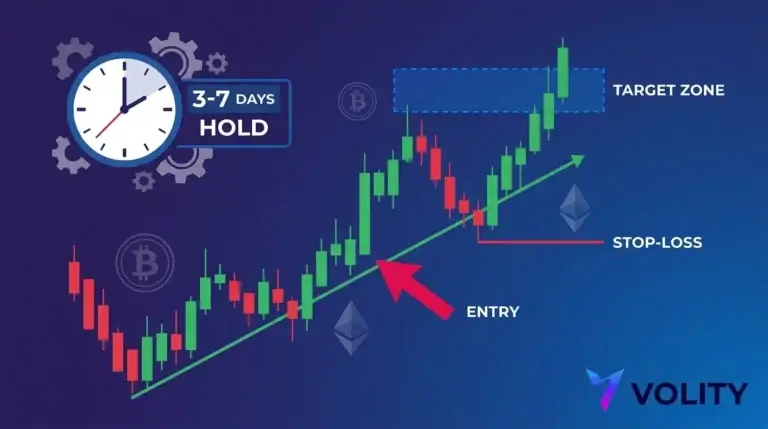
Real trading example (10x Scalp):
A trader established a long entry on BTC/USDT perpetual at $68,500 with 10x leverage and a $1,000 margin. Price rallied to $69,870, a +2% move. The trader realized a $200 profit after 0.05% exchange fees (20% ROI on margin). Past performance is not indicative of future results.
Stop out and margin levels explains maintenance margin calculations and automatic liquidation mechanics.
Is Crypto Derivatives trading legal in the US and UK?
The legality of crypto derivatives depends on the specific jurisdiction and the exchange’s registration with authorities like the FCA or ESMA. In 2026, EU and UK regulators set out clear frameworks for crypto derivatives: the EU MiCA regime and the UK FCA cryptoasset rules define how Bitcoin and Ethereum derivatives are supervised, providing legal clarity for derivatives trading. UK MiCA (Markets in Crypto-Assets Regulation) compliance arrives July 1, 2026, requiring all crypto derivative platforms to obtain CASP (Crypto Asset Service Provider) licensing from the FCA. Prohibited activities remain; the FCA bans the sale of crypto derivatives and ETNs to UK retail consumers, and ESMA caps retail leverage across the EU.
ESMA guidance on crypto-asset derivatives clarifies the current regulatory status of BTC and ETH derivatives.
Crypto CFD vs Spot compares regulated, retail-friendly ways to gain leveraged crypto exposure.
Market share benchmarks reveal the liquidity concentration and institutional dominance across the leading derivatives platforms. Binance’s 34.9% dominance reflects its scale and first-mover advantage, though decentralized exchanges like dYdX are gaining share in 2026.
| Entity | Market Share (Q1 2026) | Q1 Trading Volume | Avg Daily Open Interest |
| Binance | 34.9% | $4.90 Trillion | $23.9 Billion (Source: TokenInsight) |
| OKX | 15.6% | $2.19 Trillion | $6.8 Billion (Source: CoinGlass) |
| Bybit | 10.6% | $1.49 Trillion | $11.0 Billion (Source: CryptoQuant) |
| Gate.io | 8.5% | $1.18 Trillion | $10.7 Billion (Source: TokenInsight) |
| Bitget | 7.2% | $1.01 Trillion | $6.5 Billion (Source: CoinGlass) |
Sources: TokenInsight, CoinGlass, CryptoQuant, 2026
Turn Knowledge into Profit
You have done the reading, now it is time to act. The best way to learn is by doing. Open a free, no-risk demo account and practice your strategy with virtual funds today.
Open a Free Demo AccountKey Takeaways
- Crypto derivatives allow participants to speculate on digital asset prices with leverage without direct token ownership.
- Perpetual futures are the most popular instrument, using funding rates to keep contract prices aligned with spot markets.
- Q1 2026 volume reached $18.63 trillion, with Binance maintaining a dominant 34.9% share of total derivatives activity.
- Under the EU MiCA regime and UK FCA rules, BTC, ETH, and SOL derivatives are supervised through licensed, regulated venues.
- Funding rates provide a “contrarian” sentiment signal; extremely high positive rates often precede local market tops.
- Risk management tools like isolated margin and stop-loss orders are mandatory for surviving 10x+ leverage volatility.
Derivatives infrastructure is moving on-chain, and one venue went as far as building a Layer 1 whose consensus exists to run an order book. If you want the architecture rather than the marketing, read our explainer on what Hyperliquid is.
Frequently Asked Questions
This article contains references to Crypto Derivatives and Volity, a regulated CFD trading platform. This content is produced for educational purposes only and does not constitute financial advice or a recommendation to buy or sell any financial instrument. Always verify current regulatory status and platform details before using any trading service. Some links in this article may be affiliate links.
What our analysts watch: We track three derivative signals daily. Funding rates flag crowded longs or shorts before liquidations cascade. Open-interest builds at key strikes hint at where market makers will defend. Basis (the gap between perpetual and spot) tells us if leverage is leaning bullish or bearish. When funding goes deeply negative while open interest rises, that is usually a short squeeze setup. The opposite reads as a euphoric long flush waiting to happen.
Volity operates a trading platform and also publishes educational and analytical content about trading. The content on this page is for educational purposes only and should not be considered financial advice. Volity may benefit commercially when readers open trading accounts through links on this site.
Our content is produced and reviewed under documented editorial standards; see our comparison and review methodology.